At 4:16 on a warm Thursday afternoon, Police Chief Raymond Mercer believed the woman sitting alone on the park bench was nobody important.
That assumption would destroy him.
The park occupied a narrow green strip between downtown Atlanta’s federal courthouse complex and a row of renovated office buildings. Lawyers crossed it every afternoon carrying briefcases. Courthouse employees ate lunch beneath the old oak trees. Joggers followed the paved path beside the fountain, and people waiting for buses often sat on the black iron benches facing the street.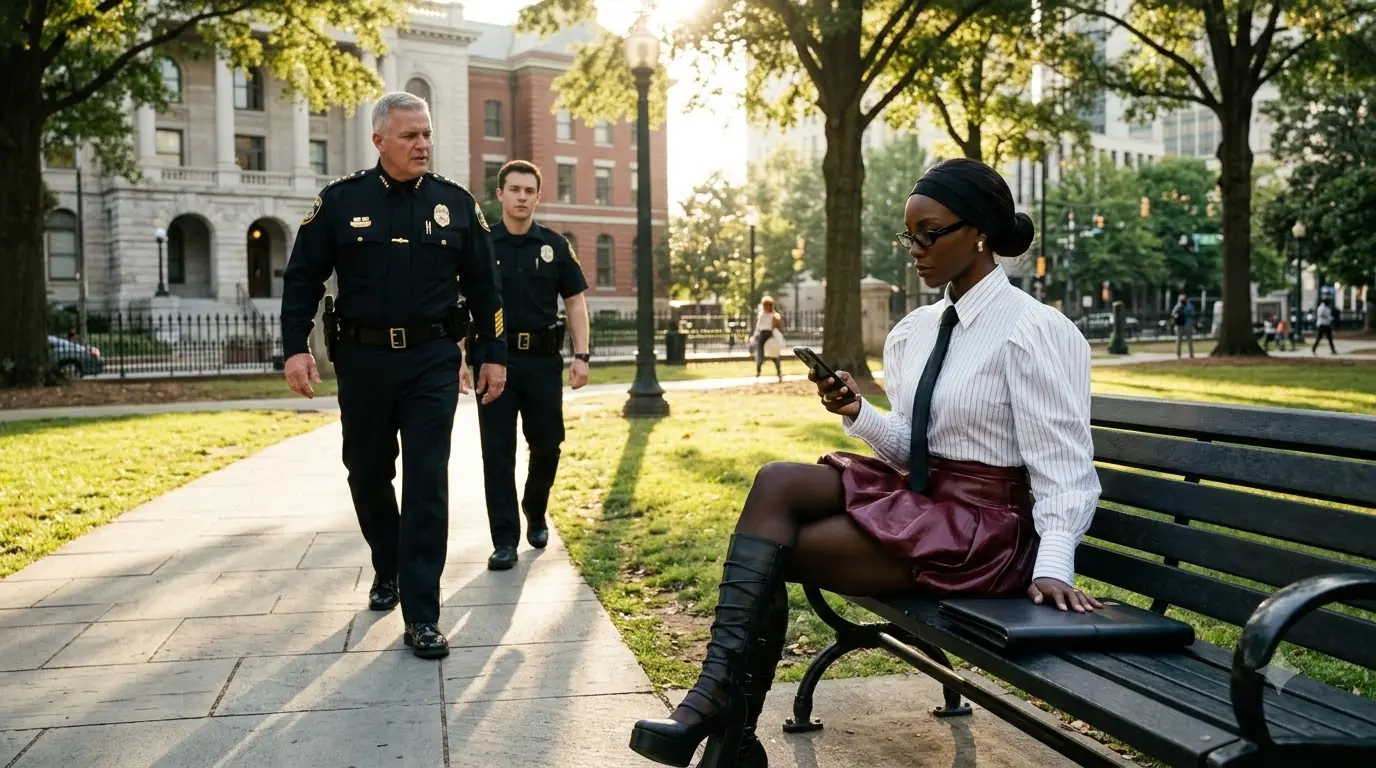
Nothing about the woman seemed threatening.
She sat with one leg crossed elegantly over the other, a slim leather portfolio resting beside her and a phone in one hand.
She was a striking Black woman in her late thirties, tall and slender, with deep-brown skin, almond-shaped dark eyes, and her black hair pulled smoothly into a low bun beneath a wide black headband. Narrow rectangular glasses framed her face.
Her clothing made her impossible not to notice.
A fitted white pinstripe blouse with sculptural sleeves and a narrow matching tie tapered sharply at her waist. A dark burgundy bubble skirt gave the outfit a modern architectural shape, while sheer black tights disappeared into tall, strappy platform boots.
Several pedestrians had looked twice as they passed.
The woman did not appear interested in them.
She was watching the police.
Two patrol officers stood near the southern entrance to the park speaking with a young Black man beside a bicycle. Another officer leaned against a cruiser on the opposite curb. The interactions were peaceful.
The woman occasionally looked at her phone and wrote something in a small notebook.
That was what Police Chief Raymond Mercer noticed.
He had arrived in the park unexpectedly after leaving a luncheon at City Hall three blocks away.
Mercer was fifty-eight, white, silver-haired, broad through the shoulders, and still physically imposing despite three decades behind a badge. Gold command insignia decorated his dark uniform. His polished shoes reflected the afternoon sunlight.
He had built his career on presence.
People moved when he walked into rooms.
Officers stopped talking.
Reporters became more careful with their questions.
City council members called him “Chief” even during private dinners.
Mercer liked the title.
He liked what happened to people’s posture when they remembered it.
Beside him walked Officer Daniel Price, twenty-seven, only fourteen months out of the academy.
Price had expected the chief to return directly to headquarters.
Instead Mercer stopped near the park gate.
“Who’s that?”
Price followed his gaze.
“The woman on the bench?”
“She’s been watching Reed and Simmons.”
Price shrugged.
“Public park.”
Mercer looked at him.
“I know where we are.”
Price immediately regretted speaking.
Mercer continued watching.
The woman lifted her phone.
Not directly at the officers.
But close enough.
Mercer’s jaw hardened.
For the previous six months, cameras had become his least favorite objects in Atlanta.
The department was operating under a federal civil-rights consent decree after a series of lawsuits involving unlawful stops, excessive-force complaints, missing body-camera footage, and inaccurate arrest reports.
Mercer publicly called the agreement a partnership.
Privately, he called it federal occupation.
Every interaction could be reviewed.
Every complaint produced paperwork.
Every supervisor had to explain missing footage.
Outside auditors visited precincts without warning.
Federal monitors attended training sessions.
And officers had begun behaving, in Mercer’s view, as though one imperfect sentence could end a career.
He hated it.
More than that, he hated being watched.
The woman on the bench looked like someone who watched professionally.
Mercer changed direction.
Price followed.
“Chief?”
“Come on.”
The woman noticed them approaching.
She did not stand.
Mercer stopped directly in front of her.
Up close, he saw the notebook.
Small handwriting filled half a page.
Time stamps.
Numbers.
Officer positions.
Mercer’s suspicion hardened into certainty.
“What are you doing?”
The woman looked up calmly.
“Good afternoon.”
“That wasn’t my question.”
Her expression barely changed.
“I’m sitting in a public park.”
Mercer glanced at the notebook.
“You’ve been photographing my officers.”
“I’ve been observing several things.”
“Identification.”
The woman studied him.
Price felt uncomfortable immediately.
He touched the body camera clipped to the center of his uniform.
The red recording indicator was illuminated.
Mercer’s was not.
Price noticed.
He had noticed before they entered the park.
He said nothing.
The woman asked, “Am I being detained?”
Mercer’s eyes narrowed.
“I asked for identification.”