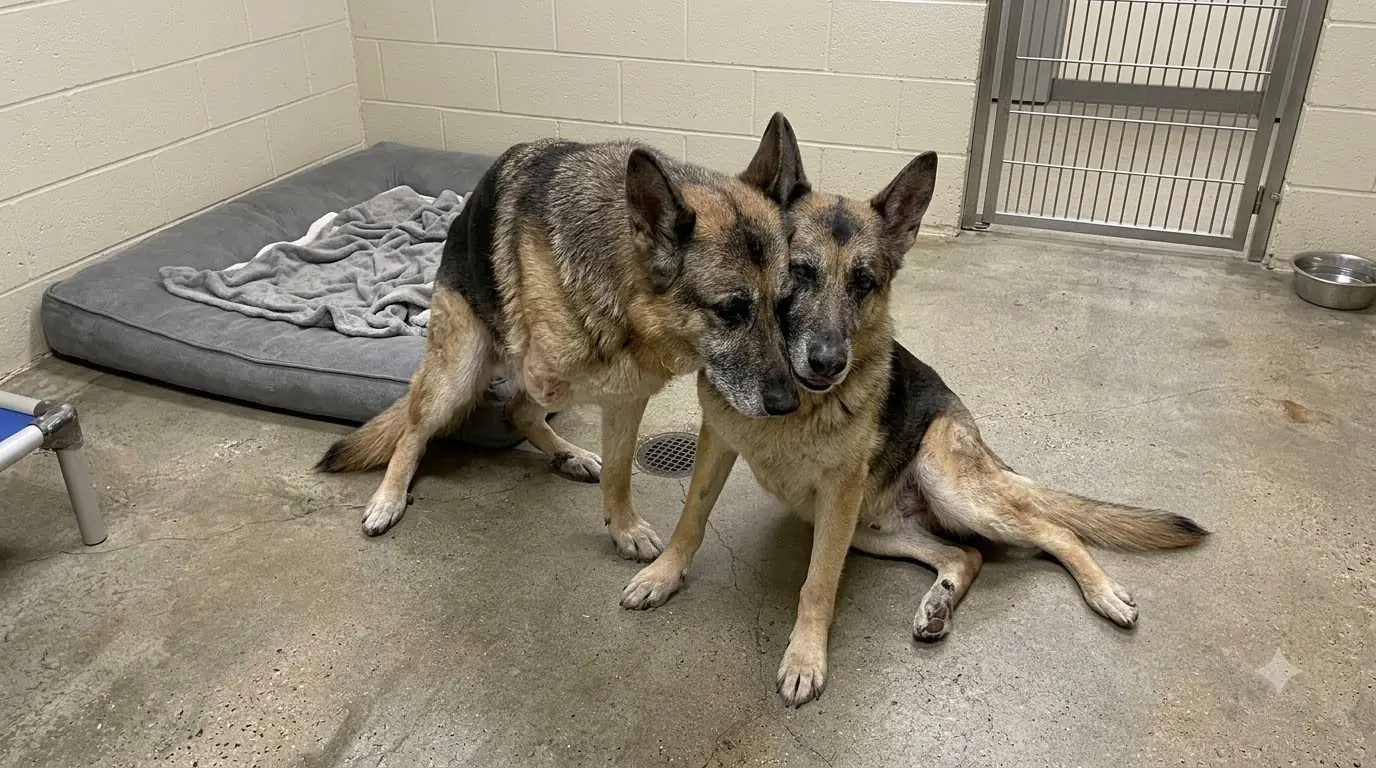
Major tried to stand.
His front legs pushed against the kennel floor first.
His chest came up.
For a moment, the senior German Shepherd managed to lift part of his body from the bedding.
His hind legs barely moved.
Then his rear end slipped sideways.
Major went down.
A few feet away, Ranger immediately started moving.
That was difficult enough on its own.
Ranger was missing one front leg, and severe arthritis had made the limbs he still had increasingly stiff and painful.
Every step required balance.
Every turn took effort.
But Ranger limped across the medical kennel anyway.
He reached Major.
Then he positioned the shoulder on his remaining front side against Major's chest.
For several seconds, the two old German Shepherds stayed like that.
Major tried to reposition himself.
Ranger braced.
Neither dog managed to stay upright for long.
Eventually Ranger's own legs could no longer hold the awkward position.
He lowered himself.
Major settled too.
And the two retired K-9 partners ended up lying against each other on the kennel floor.
For the rescue team, the scene was powerful.
But it also created a difficult question.
How do you protect one disabled dog when he keeps using the little mobility he has left to move toward another?
Ranger and Major Had Worked Side by Side Long Before the Medical Kennel
They weren't two unfamiliar senior dogs who happened to be placed together.
Ranger and Major had served for years in the same K-9 unit before retirement.
Now both were seniors.
And both had significant physical limitations.
Major had lost almost all useful function in his hind legs.
Ranger had lost a front leg and was living with severe arthritis.
The bodies that once supported years of working-dog activity had changed dramatically.
But one familiar part of their lives remained.
They were still together.
Major's Disability Was the More Obvious One
When Major tried to rise, the problem could be seen immediately.
His front half still did much of the work.
He could plant his front paws.
He could lift his chest.
But the rear half of his body could not reliably follow.
His hind legs had almost no functional ability to support him.
That meant something as simple as changing position could become a major physical task.
Standing was harder.
Turning was harder.
Moving between bedding, water, and another part of the medical space required planning and assistance.
A dog does not need to be in obvious distress every second for that level of disability to be serious.
Ranger's Limitations Were Different
Ranger could still move independently.
But watching him carefully revealed how much work that movement required.
A dog missing a front leg must redistribute weight through the remaining limbs.
For Ranger, severe arthritis made that compensation even more difficult.
He could not simply shift his body onto three perfectly healthy legs.
The joints carrying the extra load were old and painful too.
His gait was uneven.
His pace was slow.
And when he stopped, he often needed time before moving again.
That Was Why Staff Noticed What Happened When Major Fell
Ranger did not rush around the medical area unnecessarily.
He conserved movement.
Then Major would attempt to stand.
His hindquarters would slide.
And Ranger would get up.
The pattern repeated often enough that it became impossible to ignore.
Ranger would make his way toward Major despite the obvious physical cost.
Then he would bring his remaining front side close to his partner.
Sometimes his shoulder pressed against Major's chest.
Sometimes the dogs simply ended up leaning into each other.