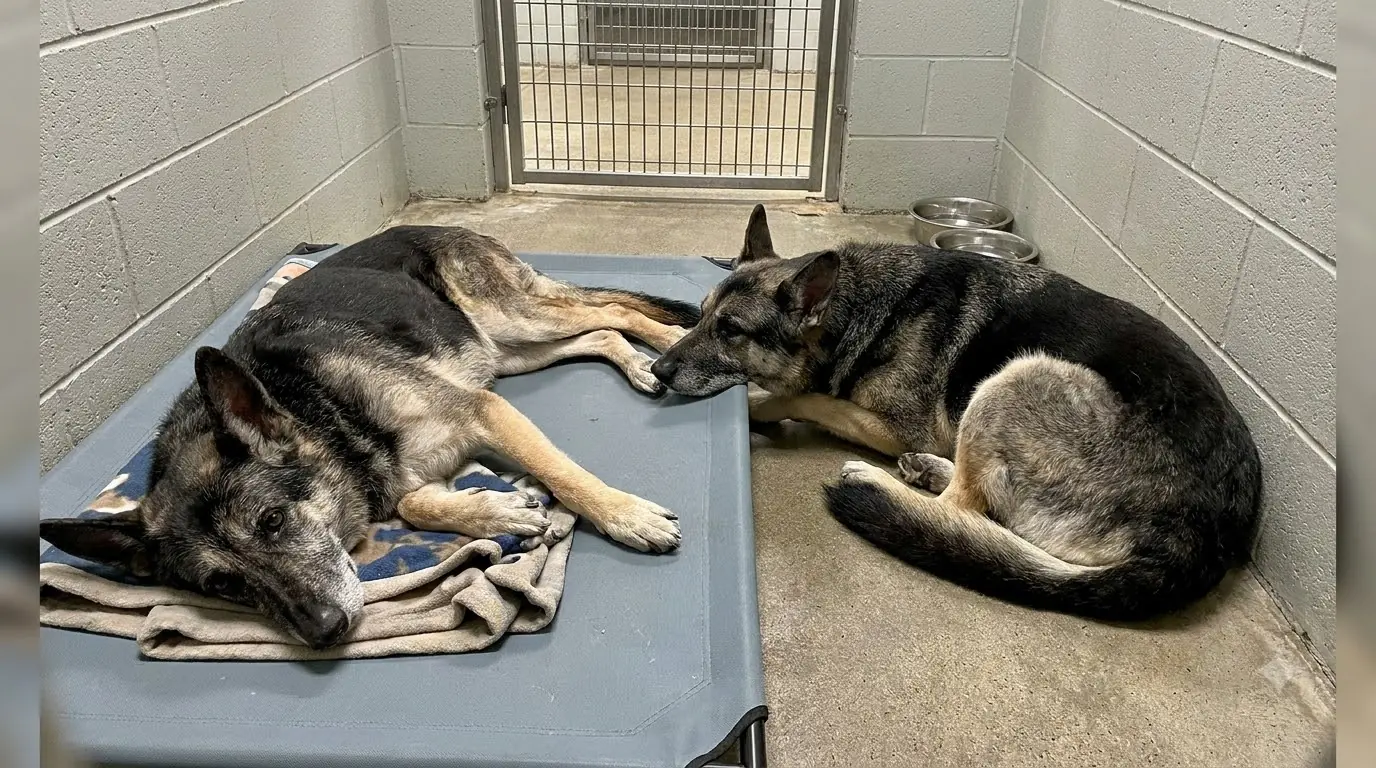
Whenever something moves outside the kennel, Ranger is usually the first to respond.
A cart rolls through the hallway.
A door closes somewhere nearby.
Footsteps stop outside the room.
The senior German Shepherd lifts his head almost immediately.
Then he gets up and walks toward the kennel door.
Ranger stands there for several seconds, ears forward, watching the hallway through the opening.
Only after the noise passes does he turn around.
But he doesn't return to an empty bed.
Across the kennel, another aging German Shepherd is still lying where Ranger left him.
Chief.
His former K-9 partner.
Chief's spinal degeneration has progressed to the point that his hindquarters have lost much of their strength. His rear legs are visibly wasted, and standing without assistance is now extremely difficult.
He cannot get up and follow Ranger every time something happens outside.
So Ranger comes back to him.
He lowers himself beside Chief until their bodies touch.
Then he places his head close to Chief's weakened hind legs.
A few minutes later, another noise may come from the hallway.
And Ranger does the entire routine again.
At First, It Looked Like Ordinary Alertness
German Shepherds can be highly attentive to changes around them, and a rescue kennel is full of unfamiliar sounds.
So nobody found it strange when Ranger watched the door.
What became noticeable was the sequence.
Ranger rarely remained there once the hallway became quiet.
He checked.
He watched.
Then he returned directly to Chief.
Sometimes Chief lifted his head while Ranger was gone.
Other times he remained stretched out on the bedding.
Ranger would settle beside him either way.
The pattern happened often enough that caregivers began recognizing it.
And once they knew where the two dogs had come from, the behavior carried much more context.
Ranger and Chief Had Spent Years Working Together
Before becoming two senior dogs in a rescue kennel, Ranger and Chief had served for years in the same K-9 unit.
They were accustomed to structured days, familiar routines, activity, and one another's presence.
Their working years eventually ended.
But their lives together did not.
After retirement, both dogs remained under the care of the same person.
Then that person died.
With their caregiver gone and no permanent arrangement available for the two aging Shepherds, Ranger and Chief entered rescue together.
For both dogs, nearly everything around them changed.
The sounds.
The people.
The sleeping area.
The daily routine.
But one familiar part of their old life entered the kennel with them.
Each other.
Chief Was Already Losing His Mobility
Chief's condition quickly became one of the rescue's biggest concerns.
Severe spinal degeneration had dramatically affected his hindquarters.
The muscles in his rear legs had wasted.
Getting his feet underneath himself was difficult.
Standing could require assistance.
Moving across the kennel was no longer something caregivers could expect him to do whenever he wanted.
His needs were increasingly those of a mobility-impaired senior dog.
Supportive bedding mattered.
Positioning mattered.
Easy access to water mattered.
Help with movement and hygiene mattered.
So did monitoring his comfort and quality of life as his condition progressed.
Ranger, meanwhile, retained more mobility.
He could still get up.
He could still cross the kennel.
And whenever something happened outside, that difference between the two dogs became especially visible.
Ranger Would Get Up for Both of Them
Chief sometimes reacted to hallway noises too.
His ears might move.
His head might rise.
But his body could no longer reliably follow that response.
Ranger's could.
A sound came from outside.
Ranger went to the door.
Chief stayed behind.
Caregivers could not know what Ranger believed he was doing. They did not describe him as “standing guard” or claim that he thought he was still working a K-9 assignment.
There was no way to know that.
What they could document was simpler.
A hallway sound repeatedly caused Ranger to approach the kennel entrance.
After checking it, he repeatedly returned to Chief.
And instead of settling somewhere else in the room, he usually chose the space immediately beside his old partner.
Then Staff Noticed Where Ranger Put His Head
It was rarely random.
Ranger often positioned himself along Chief's body and rested his head close to Chief's hindquarters.
Those were the legs that had become weakest.
Sometimes they remained extended behind Chief with very little movement.
Ranger would lie so close that his shoulder or side pressed against him.
Then his head came down beside those thin rear legs.
There was no need to give the position a human explanation.
The physical choice was moving enough on its own.
The more Chief lost the ability to move around the kennel, the more often Ranger seemed to spend his resting periods within direct contact of him.
The Rescue Decided Not to Separate Them
That became an important part of their care.
Keeping bonded senior dogs together is not always simple, particularly when one has significant medical needs.
Chief required a setup appropriate for his mobility limitations.
Ranger still needed room to move comfortably and receive normal enrichment appropriate for his own health.
The rescue had to accommodate both.
But separating them unnecessarily would have removed the most familiar part of an already disrupted life.
So whenever medically and practically possible, Ranger and Chief remained together.
Their resting area was arranged with Chief's physical needs in mind.
Caregivers could reach him easily to help reposition or assist him.
Ranger still had access to the door and enough space to move around.
And when he wanted to return to Chief, there was always room beside him.
He almost always used it.
Chief's Condition Continued to Change
There was no sudden recovery waiting for him.
Severe degenerative spinal disease does not reverse simply because a dog receives a better bed and more attention.
Chief could have better days.
He could appear more comfortable.
Supportive care could make movement and resting easier.
But the underlying neurological and mobility problems remained serious.
Eventually, staff saw periods when Chief needed even more assistance.
On harder days, he barely attempted to bring his hindquarters underneath himself.
Ranger's routine changed slightly with him.
He still went to investigate sounds.
But his trips became short.
Door.
Hallway.
Turn.
Chief.
One Day, Ranger Didn't Stay at the Door
A louder noise came from outside the kennel.
Ranger stood immediately.
His ears came forward, and he walked toward the entrance as usual.
Chief lifted his head behind him.
Ranger reached the door.
He looked into the hallway.
Then, before the noise had completely stopped, he turned around.
He walked back across the kennel and lowered himself beside Chief.
Chief's head remained up for another moment.
Ranger settled against his side.
Then both dogs lay down.
It was not proof that Ranger had made some deliberate decision to abandon an old duty.
Nobody needed to make that claim.
It was simply another variation of a pattern staff had been watching since the pair arrived.
Whatever drew Ranger toward the door never seemed to keep him away from Chief for very long.
Ranger Has Started Building New Routines Too
His life is not limited to watching the hallway and lying beside his partner.
Caregivers make sure it isn't.
Ranger receives attention independently.
He gets opportunities to move, sniff, interact, and rest away from constant kennel activity.
Staff want him to form positive associations with the people and routines around him.
That matters especially because Chief cannot participate in everything Ranger can still physically do.
At first, Ranger sometimes seemed reluctant to remain away from the kennel for long.
Gradually, he became more comfortable spending time with familiar caregivers.
He could investigate another area.
Take a slow walk appropriate for a senior dog.
Accept attention.
Then return.
And when he did, Chief was usually exactly where he had left him.
Ranger would approach.
Sniff him briefly.
Circle or reposition himself.
Then lie down beside him again.
The Rescue Is Caring for Two Very Different Senior Bodies
Chief's medical needs are more obvious.
His wasted hind legs immediately show how much mobility he has lost.
But Ranger is a senior dog too.
Years of work and age mean his own comfort has to be monitored.
The rescue cannot allow his role beside Chief to overshadow his individual needs.
Both dogs require appropriate veterinary oversight.
Both need comfortable bedding.
Both need rest.
Both need routines that reflect what their bodies can handle now rather than what they could do during their working years.
The difference is that Ranger can still walk to the door.
Chief usually cannot.
And every time Ranger does, that contrast is impossible to miss.
Nobody Knows How Long Their Routine Will Stay the Same
Chief's condition is progressive.
That means caregivers have to remain realistic about what may come next.
His mobility may decline further.
His level of assistance may increase.
Quality-of-life assessments will remain an essential part of his care.
There is no responsible way to promise that the two dogs will simply continue exactly like this indefinitely.
For now, however, they are together.
And that seems to matter in ways staff can actually observe.
Chief settles with Ranger touching him.
Ranger repeatedly chooses to sleep beside Chief when other resting space is available.
When Ranger leaves briefly, he comes back.
And when the hallway interrupts their quiet, the same old sequence begins.
Ranger Still Checks the Door
A sound travels down the corridor.
Ranger's ears rise.
He gets to his feet.
Chief remains on the bed, his weakened hind legs stretched behind him.
Ranger walks to the kennel entrance.
For a few seconds, the old German Shepherd stands there watching.
Then the hallway becomes quiet again.
Ranger turns.
He crosses the short distance back to the dog who once could have risen and moved beside him.
Chief no longer can.
So Ranger lowers himself instead.
His body presses against his old partner's side.
His head comes down beside Chief's thin hind legs.
And there he stays—until the next sound gives him another reason to check the door, and another reason to come back.