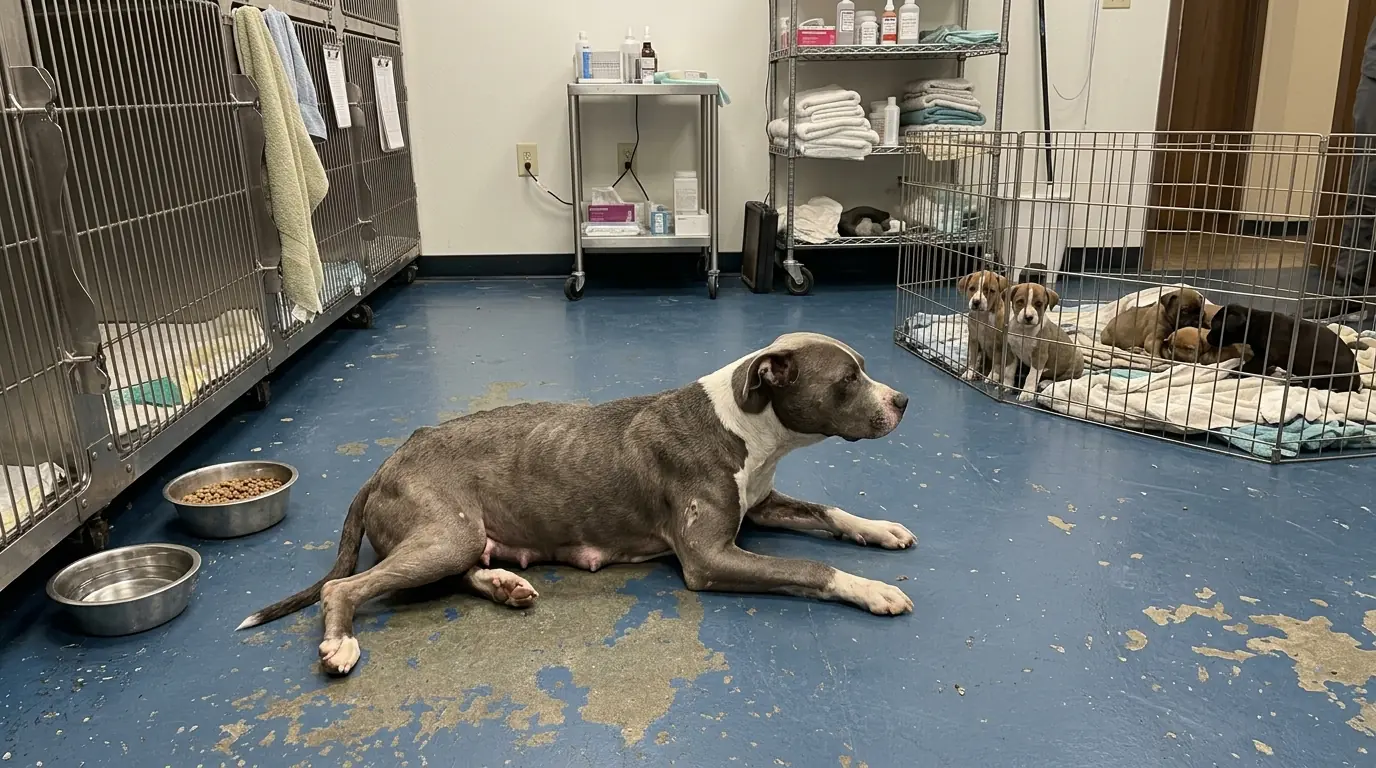
She Was Weak Enough That Walking Had Become a Medical Concern
When Sadie arrived in our care with six puppies, the first thing our veterinary team noticed was not simply that she was thin.
It was how little strength she had left.
Sadie, an adult Pit Bull mix, was alert enough to follow movement around her, but standing required visible effort. Her muscles had very little reserve. When she tried to move across the intake area, she took several slow steps, paused, and lowered herself again.
Her six puppies were in noticeably better spirits. They were small, busy, vocal, and immediately interested in warmth and food.
Sadie was interested in them.
Even during intake, when staff moved the puppies a short distance away so each could be examined, Sadie's attention repeatedly shifted toward the sounds coming from their carrier.
We did not know Sadie's history before she came to us.
We could document her condition. We could document the condition of the puppies. We could document the way she responded whenever they made noise.
Anything beyond that would have been speculation.
What we knew was enough to concern us.
Sadie was severely underweight, physically depleted, and caring for six growing puppies at a time when her own body had very little left to give.
The First Examination Focused on What Her Body Could Safely Handle
Our veterinarian performed a careful examination while keeping handling as low-stress as possible.
Sadie's body condition was poor. Her ribs, spine, and hip structure were unusually prominent, and there was substantial loss of muscle over her hindquarters and along her back.
She was dehydrated, although she remained responsive.
Her heart and lungs were carefully evaluated. Her gums were checked, her abdomen was palpated, and her mammary glands were examined for pain, abnormal swelling, heat, or other evidence of complications associated with nursing.
The veterinary team also evaluated her gait.
There was no obvious sign during the initial examination that Sadie's difficulty walking came from a single traumatic orthopedic injury. Instead, her weakness appeared more generalized. She was exhausted, underconditioned, and lacking the muscle strength needed for normal activity.
Blood was collected to look for problems that could complicate her recovery, including abnormalities associated with dehydration, inadequate nutrition, infection, and other systemic illness.
A fecal sample was also submitted because Sadie's unknown outdoor and preventive-care history made intestinal parasite screening appropriate.
The initial goal was not to perform every possible test.
It was to identify anything that would change what we could safely do for her during those first critical days.
Her results supported what the physical examination had suggested: Sadie needed nutritional rehabilitation, hydration support, rest, and close monitoring.
There was no single dramatic diagnosis that explained everything.
Sometimes there isn't.
Her body had simply reached a point where ordinary demands—standing, walking, nursing, maintaining her own weight—had become difficult to meet.
Six Puppies Changed the Recovery Plan
Caring for Sadie could not be separated from caring for her puppies.
At their age, the puppies were beginning to become more independent and could receive age-appropriate supplemental nutrition rather than relying entirely on their mother.
That became important immediately.
Allowing six puppies unrestricted nursing access would have continued placing a substantial metabolic demand on Sadie's already depleted body. At the same time, abruptly separating a mother from her puppies without considering their developmental stage and her behavior could create unnecessary stress.
The team developed a middle ground.
Sadie and the puppies would remain close enough to see, hear, and smell one another, but their physical access would be managed.
The puppies were set up in a secure pen beside Sadie's recovery area.
Sadie had a thick bed, nonslip flooring, fresh water, and enough room to reposition comfortably without needing to walk far.
The puppies had their own warm bedding, feeding area, and space to move around.
Supervised contact could continue when appropriate.
Most importantly, Sadie could rest.
For the first few days, our veterinarian specifically wanted her activity restricted. She could get up for necessary bathroom trips and brief controlled movement, but staff were instructed not to encourage unnecessary walking simply because she was willing to try.
Willingness and physical readiness are not the same thing.
Sadie needed calories.
She also needed to stop spending calories she did not have.
Breakfast Showed Us What Intake Exams Could Not
The first morning established a routine nobody had planned.
A caregiver entered early with breakfast.
The puppies heard movement before Sadie did much of anything. Six little bodies began shifting around their pen, and their quiet morning noises quickly became the unmistakable chorus of puppies expecting attention.
Sadie lifted her head.
Her food was placed close to her bed so she would not need to cross the enclosure.
She sniffed toward it.
Then one of the puppies squeaked.
Sadie pushed herself upright.
The caregiver did not call her over. Nobody encouraged her to move. In fact, because of the veterinarian's instructions, staff were trying to minimize exactly this kind of unnecessary effort.
Sadie took a slow step toward the puppy pen.
Then another.
When standing became difficult, she lowered her body and continued forward slowly until she reached the barrier separating the two spaces.
The puppies crowded toward her side.
Sadie remained there.
Only after she had reached them and settled beside the pen did she turn her attention back toward the room.
Her breakfast was still waiting near her bed.
That meant staff had a new practical problem.
We did not want Sadie making that trip every morning.
So we changed the room instead of trying to change Sadie.
We Moved Breakfast
The following morning, her food was placed closer to the puppy pen.
Sadie still moved toward the puppies first.
On the third morning, the pattern repeated.
Puppies woke.
Sadie lifted her head.
She moved toward the barrier.
Then she ate.
It would be easy to assign a human explanation to that behavior. We could say she was making a sacrifice or that she had decided her puppies mattered more than food.
We cannot know that.
What we can say is that the pattern was remarkably consistent.
The sound of her puppies prompted Sadie to approach their pen before she began her own breakfast, even when moving was difficult.
That behavior became part of her care plan.
Instead of repeatedly redirecting her back to bed, caregivers arranged her environment so she could remain near the puppies without needing to cross the enclosure.
Her resting bed was repositioned.
Food and water remained within easy reach.
The puppy pen was secured so curious puppies could not climb into her medical space whenever they wanted.
Sadie could choose proximity without being physically overwhelmed by six energetic youngsters.
That small environmental change reduced unnecessary exertion considerably.
Feeding a Severely Underweight Mother Dog Requires Patience
There is an understandable instinct when people see a very thin rescue dog: give her as much food as she wants.
For a significantly depleted dog, nutrition needs to be more thoughtful than that.
Sadie's veterinary team calculated an initial feeding plan based on her condition, digestive tolerance, and increasing nutritional requirements.
Meals were divided throughout the day rather than relying on one or two very large portions.
Her food was calorie-dense and nutritionally complete.
Staff tracked what she ate, how quickly she ate, whether she showed nausea or discomfort afterward, and whether her stool remained normal as portions gradually increased.
Her water intake was monitored as well.
During those early days, numbers mattered.
But so did ordinary observations.
Was Sadie interested in food?
Could she comfortably reach the bowl?
Did she remain alert afterward?
Was she urinating normally?
Could she pass stool without straining?
Was she gaining strength without developing digestive problems?
Recovery from severe underconditioning is not measured by one large meal.
It is measured across many uneventful meals.
Sadie began giving us those.
She ate breakfast.
Then lunch.
Then another smaller meal later.
And when the next morning came, she still checked the puppy pen first.
The Puppies Needed Their Own Medical Workup
The six puppies were examined individually rather than being treated as one healthy-looking group.
Each puppy was weighed and assigned an identification record so changes could be tracked accurately.
Their hydration, gums, abdomen, skin, ears, eyes, heart, lungs, and general development were assessed.
Fecal testing was performed, and their preventive-care schedule was established based on age and veterinary recommendations.
Because young puppies can change quickly, staff recorded their weights regularly.
A puppy that looks active during a five-minute examination can still fail to gain appropriately over the following days. Weight trends give the medical team information that appearance alone cannot.
Fortunately, the puppies adjusted well to supplemental feeding.
They learned quickly that meals appeared in their pen.
That helped reduce their dependence on Sadie and allowed supervised nursing to become less frequent as the veterinary team worked toward weaning.
For Sadie, that mattered physically.
Her body no longer had to carry the full nutritional burden of six puppies.
For the puppies, it was a normal developmental step toward independence.
Sadie's First Progress Was Almost Too Small to Notice
There was no morning when Sadie suddenly stood up and looked completely recovered.
Her improvement arrived in pieces.
First, she began standing with less hesitation.
Then she stopped needing such a long pause after getting up.
A few days later, a caregiver noticed that Sadie had walked back from a bathroom break without immediately lowering herself as soon as she entered her enclosure.
Her posture slowly became more stable.
Her appetite remained dependable.
Her hydration improved.
Her stool stayed acceptable as her feeding plan advanced.
Most importantly, her weight began trending in the correct direction.
We were careful not to interpret weight alone as full recovery.
A depleted dog needs more than pounds.
Sadie had lost muscle, and rebuilding muscle takes time.
As her veterinarian became more comfortable with her stability, her movement restrictions were gradually adjusted.
Short, controlled walks replaced the strictly functional bathroom trips.
Nothing strenuous.
No long walks.
No stairs for exercise.
No enthusiastic play sessions just because she appeared brighter.
The purpose was simply to let her body begin doing a little more without exhausting it.
Her Relationship With the Puppies Started Changing
The puppies did what healthy puppies are supposed to do.
They became busier.
They wrestled.
They climbed over one another.
They investigated bowls, blankets, toys, and every corner of their pen.
Their world was getting larger.
Sadie's world, for the first several days, remained deliberately small.
But she watched them.
When they became noisy, she often moved closer.
When they settled, she rested.
During supervised contact, the puppies sometimes tried to crowd around her as they had before. Staff limited these sessions so Sadie was not constantly climbed on or pressured to nurse.
Gradually, something subtle changed.
Sadie started leaving them voluntarily.
During one supervised session, she stood after several minutes and walked back to her own bed.
Nobody called her.
Nobody lured her away with food.
She simply chose to leave the puppy area and lie down.
For a mother who had spent her first mornings using precious energy just to get closer to them, that was an important shift.
It did not mean her bond with them had disappeared.
It meant safety was giving her room to have needs of her own again.
A Follow-Up Exam Gave Us More Room to Work
At her follow-up veterinary examination, Sadie's condition was reassessed from the beginning.
Her weight had increased gradually rather than dramatically.
Her hydration was normal.
Her appetite and gastrointestinal function remained stable.
Her mammary tissue was also monitored as nursing decreased because the transition away from lactation can occasionally create problems that require attention.
Her gait remained slow but had become more coordinated and confident.
The veterinarian again found no focal pain pattern suggesting that an overlooked major orthopedic injury was responsible for her original weakness.
Her muscle loss remained obvious, particularly over the hindquarters.
That became the next focus.
Sadie was cleared for slightly more activity.
Her caregivers began adding several short walks on level surfaces each day, allowing her to set a comfortable pace.
The goal was not fatigue.
If Sadie's movement deteriorated, if she became reluctant, or if she showed signs of soreness later, the session was shortened.
Rehabilitation in a dog like Sadie is less impressive than people sometimes imagine.
There were no dramatic obstacle courses.
Mostly, there were slow walks.
Controlled standing.
Good footing.
Rest.
Food.
And repetition.
Then Came a Small Setback
As Sadie became more energetic, she began trying to do more than her body was ready to handle.
One afternoon, the puppies became excited when a caregiver entered their area.
Sadie stood quickly and moved toward them.
Later that day, staff noticed that she seemed more fatigued than she had that morning.
She was not acutely lame, and there was no obvious new injury, but her movements were slower.
Her veterinarian reassessed her.
There was no evidence of a significant orthopedic event.
The most likely explanation was straightforward: Sadie had overdone it.
Her activity was reduced temporarily.
She received additional rest, and staff returned to shorter movement sessions.
Within a short period, she was back to her previous level.
The setback was minor, but it was useful.
Sadie's enthusiasm was recovering faster than her conditioning.
From then on, caregivers became even more careful not to let her brighter behavior dictate the pace of rehabilitation.
The Morning Routine Changed Before Anyone Expected It To
For more than a week, breakfast followed the same basic sequence.
The puppies stirred.
Sadie went toward them.
Then she ate.
One morning, a caregiver entered and found Sadie already lying beside the puppy pen.
That was not unusual.
The puppies woke as breakfast was prepared.
Sadie raised her head.
Her bowl was set down nearby.
This time, she did not get up.
She looked toward the puppies as they shuffled around on the other side of the barrier.
Then she leaned forward and began eating.
It was a tiny change.
Nobody wanted to turn it into more than it was.
But the same thing happened again.
Sadie was learning that she did not need to spend her limited energy checking every sound immediately.
The puppies were still there.
Breakfast was still there.
Her bed was still there.
Predictability had begun replacing urgency.
Moving Into Foster Care Required a Different Kind of Adjustment
Once Sadie was medically stable enough to leave the rescue's intensive-care setup, we began planning foster placement.
The puppies were approaching an age and level of independence where their care could increasingly be managed separately.
Sadie's foster home was selected with her physical condition in mind.
It was quiet.
There were limited stairs.
The floors could be covered with nonslip runners where necessary.
Her foster caregiver understood that a dog who appeared increasingly cheerful was still recovering from significant physical depletion.
Sadie arrived with her food plan, weight targets, activity restrictions, medical records, and follow-up schedule.
She also arrived with a bed she already knew.
We try to preserve familiar objects when they are useful and safe. A new home contains unfamiliar smells, sounds, doors, appliances, and routines. Something that smells like the previous environment can make the transition less abrupt.
During her first evening, Sadie did very little.
She explored part of the room.
She drank.
She ate.
Then she returned to her bed.
Her foster caregiver did not follow her around trying to make her socialize.
Sadie was allowed to watch.
The First Quiet House May Have Been Its Own Challenge
Shelter and medical environments have rhythms.
Doors open.
Dogs vocalize.
People move through hallways.
Bowls arrive.
Laundry carts roll past.
A foster home can suddenly seem unusually quiet by comparison.
For the first few nights, Sadie reacted to some household sounds by lifting her head immediately.
The refrigerator cycling on.
A vehicle outside.
A cabinet closing.
Footsteps in another room.
She did not panic, but she remained watchful.
Her foster caregiver maintained a predictable schedule.
Meals appeared at consistent times.
Bathroom breaks followed familiar routes.
Walks remained short.
Rest was never interrupted simply to encourage interaction.
After several days, Sadie began sleeping more deeply.
Instead of curling tightly at one edge of the bed, she sometimes stretched onto her side.
She also began choosing where to rest rather than always returning to the smallest protected area available.
Those behaviors did not prove that all stress was gone.
They did show that she was becoming more comfortable in the environment.
Meanwhile, Six Puppies Were Becoming Six Individual Dogs
Back at the rescue, the puppies continued growing.
As their personalities became easier to observe, staff stopped thinking of them simply as "Sadie's six."
One was consistently first to investigate a new toy.
Another preferred to watch its siblings before joining.
One ate with impressive focus.
Another seemed far more interested in climbing into the nearest lap than finishing a meal quickly.
They continued through their veterinary and preventive-care schedule, with weight monitoring and age-appropriate socialization.
Their time with Sadie continued decreasing.
This was important emotionally as well as medically.
Sadie did not need to remain responsible for six puppies indefinitely.
The puppies needed opportunities to learn about people, environments, handling, play, rest, and appropriate independence.
When supervised visits occurred, Sadie greeted them.
But she no longer remained glued to the group.
Sometimes she investigated them and then walked toward a caregiver.
Sometimes she settled nearby.
Sometimes she seemed ready to leave before the puppies were.
We followed her lead.
Food Stopped Being Something She Needed to Rush
Sadie's relationship with meals changed as her recovery continued.
At intake, food was part of a medical strategy.
Every portion was measured.
Every response was observed.
Over time, meals became ordinary.
That ordinariness is one of the things rescue work rarely gets enough credit for.
A dog does not need every day to contain a breakthrough.
Sometimes success is a dog expecting breakfast because breakfast has arrived every morning.
Sadie eventually began walking into the kitchen area when her foster caregiver prepared her food.
She waited nearby without frantic behavior.
When the bowl was placed down, she ate.
Then she often walked away.
There was no searching for more food around the room.
No need to finish and immediately check the puppy pen.
No puppies were calling from behind a barrier.
The routine had changed completely.
Her body condition continued improving at a controlled pace.
As she gained both weight and muscle, her daily food amount was reassessed rather than simply increased indefinitely.
The objective was a healthy body condition, not maximum weight.
Building Muscle Took Longer Than Putting Weight Back On
Several weeks into recovery, Sadie looked dramatically different to people who had not seen her since intake.
Her ribs were less prominent.
Her coat looked healthier.
Her posture had improved.
But her veterinary team continued paying close attention to muscle.
Fat and muscle do not return at identical rates.
Sadie's hindquarters still needed conditioning.
Her walks gradually became longer as tolerated.
She was encouraged to move over safe, level terrain at a controlled pace.
Normal daily activities—standing, turning, walking through the house, stepping onto different stable surfaces—became part of her rehabilitation.
Because she was a Pit Bull mix who could become physically powerful once healthy, we also wanted to avoid rushing her into high-impact activity simply because her outward appearance had improved.
Running, repetitive jumping, and intense play could wait.
Her foster caregiver focused instead on calm enrichment.
Food puzzles.
Sniffing opportunities.
Short training sessions.
Reward-based leash work.
Rest.
Sadie proved to be highly food-motivated, which made training easy to structure without putting physical pressure on her.
We Began Learning Who Sadie Was Outside of Survival
One of the challenges in rescue medicine is that intake behavior is not always a reliable picture of a dog's long-term personality.
Pain changes behavior.
Exhaustion changes behavior.
Fear changes behavior.
A mother caring for puppies may behave differently once those puppies are independent.
Sadie at intake was quiet, physically limited, and intensely attentive to the puppy pen.
Sadie in foster care began showing more preferences.
She liked soft bedding but often abandoned an expensive dog bed for a folded blanket near her foster caregiver's chair.
She enjoyed sniffing in the yard.
She was interested in visitors but did best when they allowed her to approach rather than reaching over her immediately.
She learned household routines quickly.
She also began showing playful behavior in brief bursts.
At first, it was simply a play bow followed by two excited steps.
Later, she picked up a soft toy and carried it across the room.
Her foster caregiver did not turn that into a long game.
Sadie's body was still catching up.
But seeing her initiate play told us something that an intake blood panel never could.
She was beginning to have energy left for activities that were not necessary for survival.
Preparing Sadie for a Permanent Home
We do not consider a dog adoption-ready simply because she looks better in photographs.
Sadie's medical recovery had to be sufficiently stable.
Her exercise tolerance needed to improve.
Her weight needed to approach an appropriate range.
Her preventive veterinary care needed to be addressed according to her individualized plan.
And we needed enough behavioral information to describe her honestly to potential adopters.
Her foster caregiver documented how she behaved when left alone for appropriate periods, how she walked on leash, how she responded to visitors, how she settled at night, and what environments appeared comfortable or stressful.
We also continued veterinary follow-ups.
Sadie's recovery was moving in the right direction.
There was no miracle moment.
There were weeks of food, sleep, controlled exercise, observation, and gradual adjustment.
That was exactly what she needed.
Her Puppies Reached Their Own Milestone
Eventually, the puppies no longer needed Sadie for nutrition.
They had become active young dogs with their own medical records, routines, and developing personalities.
Their adoption planning could proceed individually when they were medically and developmentally ready.
Sadie was no longer simply "the mother with six puppies."
That distinction was important.
Mother dogs can sometimes become almost invisible in rescue storytelling because attention naturally shifts toward puppies.
We wanted Sadie's future to be considered on its own.
She had spent the beginning of her time with us responding to every sound from the pen beside her.
Now she needed a home where nobody expected her to keep doing that job.
The Breakfast We Remember Most Was Not the First One
The image many of us remember from Sadie's early days is simple.
A severely underweight dog.
A bowl of food.
Six puppies making noise behind a nearby barrier.
And Sadie using what little strength she had to move toward them before eating.
We never needed to invent an explanation for it.
The behavior itself was enough.
Weeks later, during foster care, Sadie's caregiver sent us an ordinary morning update.
Sadie had gotten out of bed, stretched, walked into the kitchen, and waited while breakfast was prepared.
Her bowl was placed on the floor.
She ate.
Afterward, she walked into the living room and settled on her blanket.
Outside, a neighbor's dog barked.
A vehicle door closed.
Sadie lifted her head for a moment and then put it back down.
There was no puppy pen to reach.
There was no reason to crawl anywhere.
Her body was stronger now, but the more meaningful change was that her daily life no longer required her to spend every bit of strength she had.
Meals were predictable.
Rest was available.
Her puppies were safe and growing independently.
Sadie could finally be cared for as an individual dog rather than only as the exhausted mother of six.
Her recovery will continue to require appropriate nutrition, conditioning, routine veterinary care, and a permanent family prepared to maintain the stability she has gained.
But the dog who once struggled across a medical enclosure before touching her own breakfast now walks comfortably to her bowl.
And when she finishes eating, she can simply walk away.