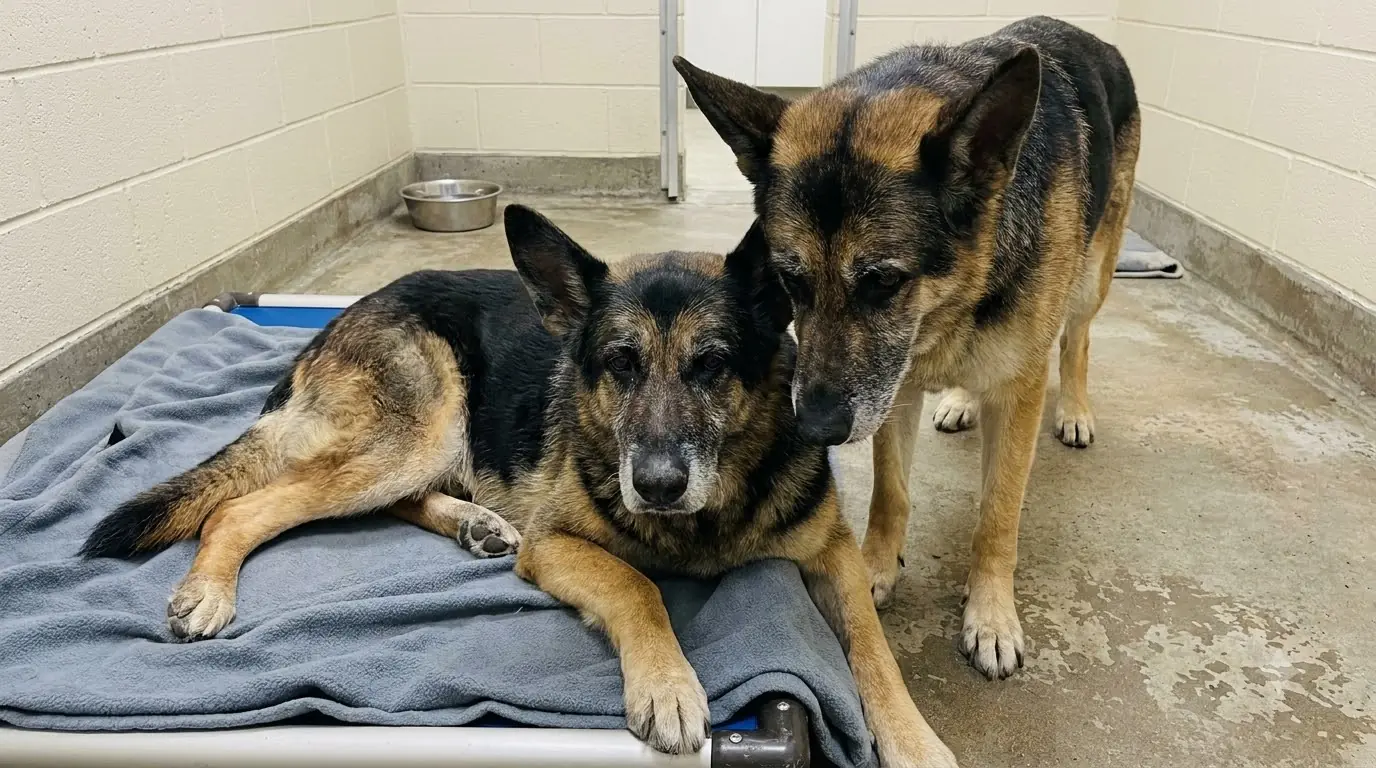
The movement is slow enough that it would be easy to miss.
Duke shifts forward on his bed, plants his front paws against the floor, and tries to pull himself toward the edge. His front half still responds. His back half barely does.
Before Duke gets far, Rex begins pushing himself up.
For a younger German Shepherd, standing would take a second. For Rex, it has become a process. His aging joints are stiff, especially after he has been lying down for a while. He braces his front paws, shifts his weight carefully, and takes a moment before his hind legs straighten beneath him.
Then he moves beside Duke.
Rex positions himself close enough that his shoulder presses against Duke’s side. He stays there while Duke drags himself a little farther, his weakened hind legs trailing behind him.
And when Duke finally settles back onto the bedding, Rex lowers himself down beside him.
It is something shelter staff have now watched happen more than once.
For two senior dogs whose bodies are beginning to fail them in very different ways, it has become one of the quietest routines inside their shared medical kennel.
They Had Already Spent Years Side by Side
Rex and Duke did not meet at the shelter.
The two senior German Shepherds had spent years together before arriving there, including years working as K-9 dogs before eventually retiring.
By the time they entered shelter care, neither looked like the powerful working dogs they once had been.
Age was visible in both of them.
Gray had begun spreading around their muzzles. Their movements were slower. Getting up after a long rest took more effort, and the quick turns and easy strides of younger Shepherds had been replaced by careful steps.
But Duke’s condition was considerably more serious.
His hind end had become progressively weaker because of degenerative spinal disease.
By the time he was evaluated, his rear legs could provide very little meaningful support.
Duke’s Front Legs Were Doing Most of the Work
Duke could still reposition himself.
That distinction mattered.
He was not completely immobile, but almost every movement required his front legs to compensate for what his hind legs could no longer do.
When he wanted to move off his bedding, he would reach forward with his front paws and pull. Sometimes his rear paws scraped along the floor behind him. At other times, he managed to bring one leg partially underneath himself before it slipped away again.
Staff quickly learned that simply watching him struggle was not an option.
Repeated dragging can create secondary problems for dogs with severe mobility impairment. Skin can become irritated where it rubs against bedding or flooring, and a dog that cannot reposition normally needs additional monitoring for pressure sores, hygiene issues and discomfort.
So Duke’s kennel setup became part of his medical care.
His resting area was kept heavily padded. Staff helped reposition him when necessary and checked the areas most vulnerable to friction and pressure. His veterinary plan focused not on promising that his damaged mobility would suddenly return, but on keeping him comfortable and preserving as much safe independence as possible.
And through much of it, Rex remained nearby.
Then Staff Started Noticing What Rex Was Doing
At first, Rex standing whenever Duke moved did not seem especially unusual.
The dogs had lived together for years. In a shared kennel, one dog getting up often causes the other to get up as well.
But Rex was not simply following Duke around.
There was a pattern.
When Duke remained comfortably on his bed, Rex often rested too.
When Duke began struggling to move, however, Rex would lift his head.
If Duke continued pulling himself forward, Rex would eventually rise.
Then he would move directly alongside him.
Rather than walking ahead, Rex stayed close to Duke’s weaker side. Sometimes their bodies touched only briefly. Other times Rex planted himself there long enough for Duke to lean against his shoulder while trying to reposition himself.
Rex would remain standing until Duke stopped moving.
Only then would the older Shepherd lower himself back to the floor.
Standing Was Becoming Hard for Rex, Too
That detail made the routine harder for staff to ignore.
Rex was not a young, healthy dog effortlessly following his companion.
His own mobility was declining.
Years of activity combined with old age had left him stiff, and his veterinary evaluation showed the kinds of orthopedic limitations commonly managed in senior large-breed dogs. After sleeping, his first few steps could be particularly slow.
Staff began making sure Rex had supportive bedding of his own and that he did not need to cross slippery flooring unnecessarily. His activity was kept controlled, and his comfort and mobility were monitored alongside Duke’s.
Yet when Duke started moving, Rex continued getting up.
No one at the shelter could say exactly why.
It would be easy to describe the behavior as Rex “protecting” Duke because of their working history. But dogs cannot explain their motives, and staff were careful not to turn an observable behavior into something they could not prove.
What they could see was simpler.
Duke struggled.
Rex noticed.
Rex got up and placed himself beside him.
And he kept doing it.
Keeping Them Together Became Part of Their Care
Separating senior bonded dogs can sometimes create additional stress, especially when they have lived together for years.
In Rex and Duke’s case, there was also little reason to remove the companionship they already had as long as sharing space remained safe.
Instead, staff adjusted the medical kennel around both dogs.
The floor needed enough traction for Rex to move without slipping and enough padding to protect Duke when he dragged or repositioned himself. Bedding had to be arranged so staff could assist Duke without forcing Rex into a cramped corner.
Water remained easily accessible. Resting areas were kept close together. Staff also watched carefully to make sure Rex was not exhausting himself every time Duke moved.
That last part mattered.
Rex could offer proximity, but he could not become Duke’s mobility device.
When Duke needed meaningful assistance, a person had to provide it.
Duke Needed More Help Than Rex Could Give
As Duke’s hind-leg weakness progressed, veterinary care increasingly centered on mobility support and quality of life.
A support harness could help staff stabilize his rear end for short, controlled movement. His skin needed regular inspection. His bedding had to stay clean and dry, particularly because dogs with severe hind-end weakness can eventually have difficulty controlling or positioning themselves for elimination.
Pain and comfort also required ongoing assessment.
Degenerative spinal conditions do not always behave like an injury that can simply heal with rest. Depending on the underlying disease, weakness may continue even when discomfort is well managed.
That meant Duke’s care had to be realistic.
The goal was not to force him to walk normally again.
It was to help him move when he could, assist him when he could not, and continuously evaluate whether he was still comfortable and engaged with the world around him.
Rex’s needs were quieter, but they mattered just as much.
Staff did not want the older Shepherd repeatedly straining painful joints because he felt compelled to rise whenever Duke shifted.
So they began helping sooner.
A Small Change Made Their Routine Easier
Instead of waiting for Duke to drag himself far enough that Rex would struggle to his feet, staff tried to anticipate when Duke needed repositioning.
His bedding was arranged so he could shift more easily without traveling across the kennel.
When he needed to move farther, staff supported him.
Rex still reacted.
His ears would lift when Duke began moving. Sometimes his head came up immediately. On better days, he would stand and take those familiar slow steps toward him.
But there were also times when Duke no longer had to struggle long enough for Rex to intervene.
A staff member was already there.
And Rex could remain on his bed.
For two elderly dogs, that was its own kind of progress.
Their Future Would Have to Account for Both Dogs
Rex and Duke were not the kind of pair whose needs could be reduced to finding someone with a backyard and two food bowls.
Duke required hands-on mobility care and continued veterinary oversight. Any foster, rescue placement or permanent home would need to understand that his spinal disease might continue to progress.
Rex needed senior care of his own.
Keeping them together would require space with good traction, accessible resting areas and people physically able to help Duke without asking Rex to compensate for him.
It also meant accepting uncertainty.
There might never be a point when Duke walked normally again.
There might come a time when his care shifted more fully toward palliative or hospice support, with comfort and quality of life becoming the primary measures guiding each decision.
For Rex, aging would continue as well.
The shelter could not give either dog their younger bodies back.
What it could do was make sure neither one had to struggle unnecessarily.
Rex Still Gets Up
Even with the changes, the old behavior has not disappeared completely.
Sometimes Duke shifts unexpectedly before anyone reaches him.
His front paws stretch forward. His chest lifts from the bed. His weakened back legs fail to follow the way they once did.
Across the kennel, Rex notices.
The senior Shepherd raises his head.
Then, slowly, he pushes himself upright.
His own legs are stiff now. He takes a moment to steady himself before walking the short distance between their beds.
He comes alongside Duke and stops.
Shoulder against side.
Two aging German Shepherds standing—or trying to stand—in the same small space.
Staff no longer need Rex to hold that position for long. They can step in, support Duke’s hindquarters and guide him safely back onto his padded bed.
And once Duke is settled, Rex does what he has done again and again.
He lowers his aging body beside him.
The difference now is that Rex does not have to carry the whole routine himself.
After years of the two dogs working side by side, the shelter’s job has become remarkably simple:
when Duke cannot stand, help him—and when Rex tries to stand beside him anyway, make sure there is a soft place waiting for both of them when they lie back down.