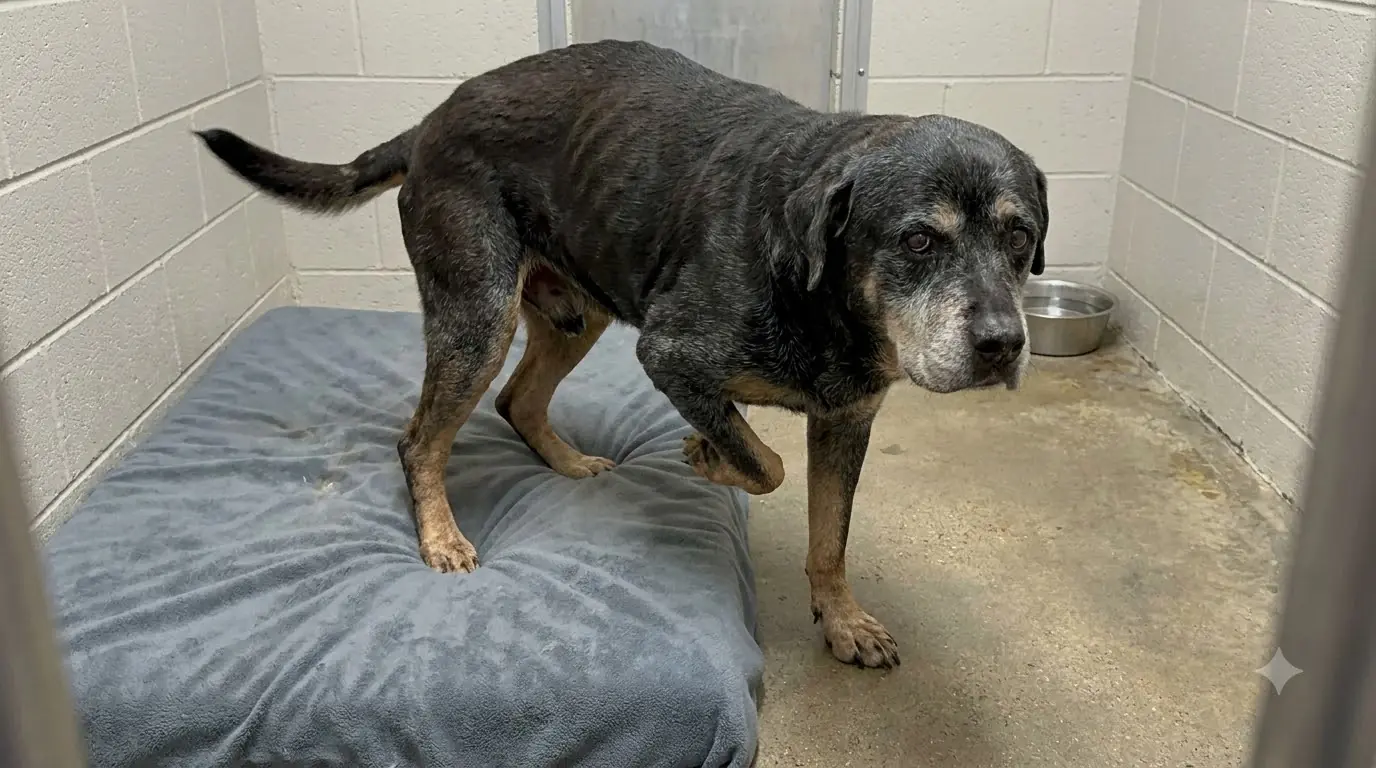
Roscoe spends almost his entire day lying down.
The 10-year-old Rottweiler rests on a thick mattress inside a medical kennel, where staff can watch his weakened body closely.
One of his front legs looks noticeably different from the others.
An old fracture healed without proper treatment before Roscoe reached the rescue, leaving the limb deformed and difficult to use normally. Most of the time, he keeps it drawn close to his chest.
That leaves three legs to do the work.
And right now, even those three are weak.
But there is one sound that almost always makes Roscoe try.
The lock on his kennel door.
Click.
Roscoe's head rises.
A caregiver opens the gate.
Before anyone asks him to move, his three usable legs begin shifting underneath him.
He pushes.
His chest comes off the mattress.
His injured front leg remains tucked against him.
For a few seconds, Roscoe is standing.
His tail gives a small wag.
Then the trembling starts.
His legs shake harder.
His body sinks.
And Roscoe has to lie down again.
The entire attempt may last only seconds.
Still, the next time that lock opens, he often tries again.
Roscoe Was Found Behind an Empty House
Before there was a medical bed, there was a backyard.
Roscoe had been discovered confined behind a vacant home after being left there for days without proper care.
By the time help reached him, his body was severely depleted.
He was not simply an older dog who had missed a meal.
He had lost significant condition and strength.
Then there was the front leg.
Its abnormal position suggested a problem that had existed long before his rescue.
Veterinary evaluation confirmed an old fracture that had not been properly treated when it happened.
The bone had already healed abnormally.
Nobody at the rescue could know exactly how Roscoe originally injured it or why appropriate care had not been provided.
They did not need to invent an explanation.
The condition of the limb was enough to show that Roscoe had been compensating for it for some time.
The Old Injury Changed the Way He Had to Move
A healthy dog distributes weight across four limbs.
Roscoe could not do that normally.
Because the damaged front leg could not function like the other three, standing required him to shift his weight elsewhere.
His remaining front leg carried more responsibility.
So did his hindquarters.
That might have been manageable when Roscoe was stronger.
After days without adequate care and with his body badly depleted, compensation became much harder.
The rescue could see it every time he tried to rise.
His usable front paw planted firmly.
His hind legs worked underneath him.
The damaged limb stayed elevated against his chest.
Then his entire body shook under the effort.
Roscoe still knew how to get up.
His body simply could not keep him there for long.
Staff Initially Tried to Stop Him From Doing It So Often
The first few times caregivers opened the kennel, Roscoe's reaction was immediate.
He attempted to stand.
People naturally wanted to help.
A hand might move toward his chest or body to support him.
But staff quickly learned that the better approach was often to prevent the situation from becoming a test of Roscoe's strength at all.
They came down to his level.
If medication needed to be given, they worked with him where he was whenever possible.
If someone wanted to spend time with him, Roscoe did not need to stand first.
His medical care was brought to the mattress.
Still, the sound of the door opening frequently triggered the same attempt.
Then They Noticed His Tail
Roscoe's tail did not move dramatically.
His body did not have much energy for dramatic movements.
But when the gate opened and someone entered, staff often saw a small wag.
Sometimes it happened while he was trying to stand.
Sometimes Roscoe had already given up and lowered himself onto the mattress.
The tail still moved.
That detail helped staff understand something important about how to interact with him.
Roscoe did not need to be upright for the interaction to continue.
If his legs failed after three seconds, the person did not leave.
They stayed.
They sat beside him.
They spoke to him from the floor.
Roscoe could remain lying down and still receive everything he had been trying to rise for.
His Weakness Could Not Be Fixed With Exercise
A severely depleted senior dog with an abnormal weight-bearing limb cannot simply be walked until he becomes stronger.
Roscoe first needed medical stabilization and appropriate nutritional support.
His old fracture also required careful veterinary assessment because the problem was no longer a fresh, straightforward break.
The bone had healed in an abnormal position.
That meant the team had to consider Roscoe as a whole dog rather than focusing only on what the leg looked like.
Was the limb painful?
How functional was it?
Could Roscoe compensate safely?
What options were appropriate given his age, body condition and overall health?
Those questions required veterinary judgment.
Meanwhile, Roscoe needed rest.
The First Goal Wasn't Four-Legged Walking
It was comfort.
Food appropriate to his recovery plan.
Hydration.
A safe place to sleep.
Management of pain or other symptoms according to veterinary guidance.
And enough time for his depleted body to begin recovering from what it had been through.
Staff watched his appetite closely.
They monitored his energy.