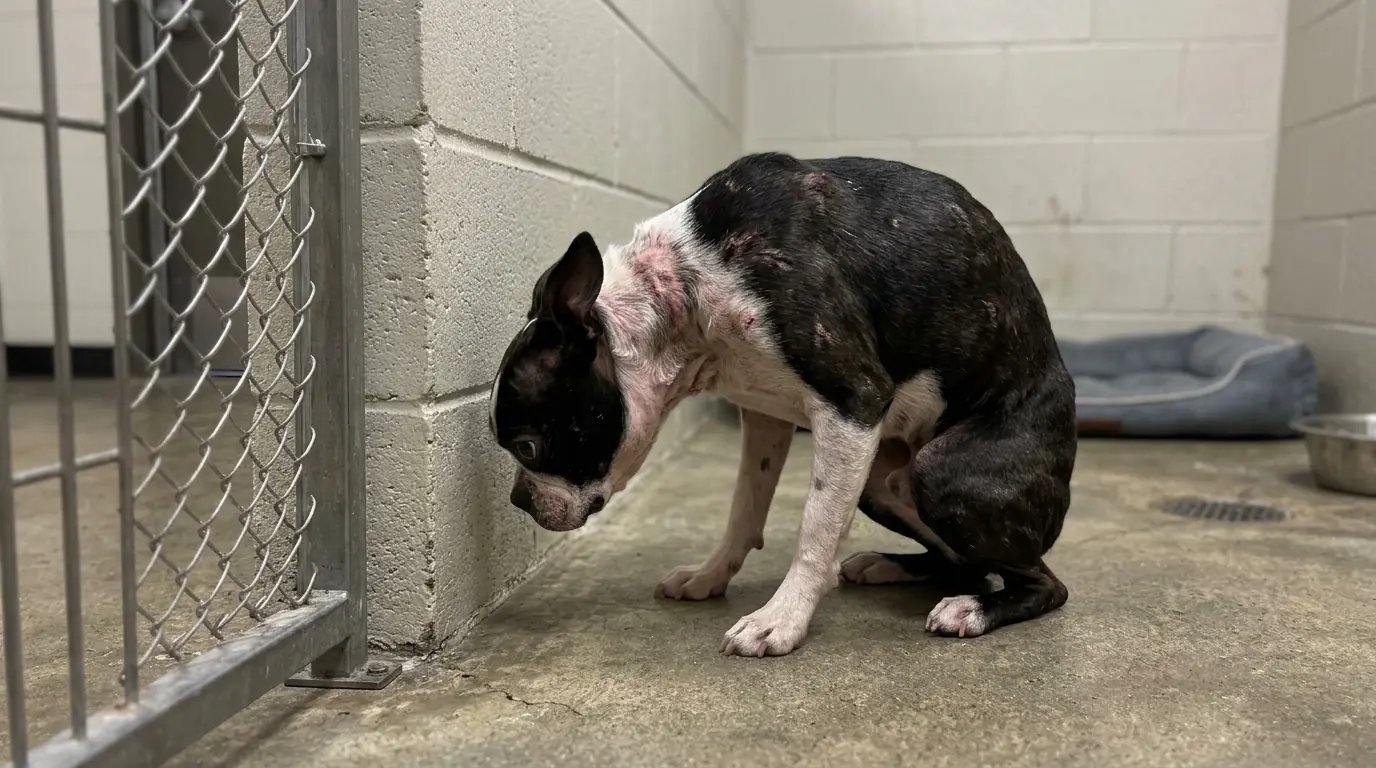
Rosie recognizes the sound before the door moves.
Click.
The metal latch releases.
Immediately, the five-year-old Boston Terrier mix turns away.
She does not wait to see who is coming.
She does not approach the front of the kennel.
Instead, Rosie walks toward the wall, places her face inches from it, and lowers her head until her chin is almost against her chest.
Then she becomes still.
The kennel door opens behind her.
Rosie does not turn around.
Sometimes nobody even enters.
The door closes again.
Still, she remains facing the wall.
Minutes can pass before Rosie finally lifts her head.
Rosie Arrived From a Vacant House
Her physical condition already gave the shelter plenty to address.
Rosie was underweight.
Hair was missing around portions of her neck where the skin was scraped and irritated.
Several older wounds were in various stages of healing.
Exactly how each injury happened was unknown.
The shelter knew where Rosie had been found.
It did not know everything that had happened before she was removed from the property.
That uncertainty matters.
Her scars should not be turned into a history nobody witnessed.
But her current behavior can be observed very clearly.
And the kennel latch produces one of Rosie's strongest reactions.
She Doesn't Need to See the Door Open
That is what makes the pattern unusual.
Rosie can be resting with her back partially toward the kennel entrance.
Someone touches the latch.
Click.
Her head rises.
Then she turns toward the wall.
The reaction begins before the door itself swings inward.
Whatever part of the sequence matters most to Rosie, the sound alone is enough to start it.
She Makes Herself Look Smaller
Her posture changes almost immediately.
Rosie's head drops.
Her shoulders round.
Her weight shifts backward.
Her ears change position.
Sometimes her body lowers slightly without fully lying down.
Then she waits.
She does not bark.
She does not rush forward.
She does not try to escape through the opening.
She simply turns away.
Even an Open Door Doesn't Change Her Mind
The kennel door may remain open briefly while food, water, or bedding is managed.
Rosie has a clear path toward the opening.
She does not take it.
Her face stays pointed at the wall.
That makes this very different from a dog waiting eagerly for the chance to leave the kennel.
Rosie appears more concerned with what the opening door might bring toward her than with what lies beyond it.
But Nobody Can Know Exactly What Rosie Expects
It would be tempting to construct a simple explanation.
Perhaps a door opening once predicted something frightening.
Perhaps she learned that turning away changed what happened next.
Perhaps the metallic click resembles a sound from her previous environment.
Those are possibilities.
They are not established facts.
Rosie cannot explain the association.
The shelter does not need to invent one.