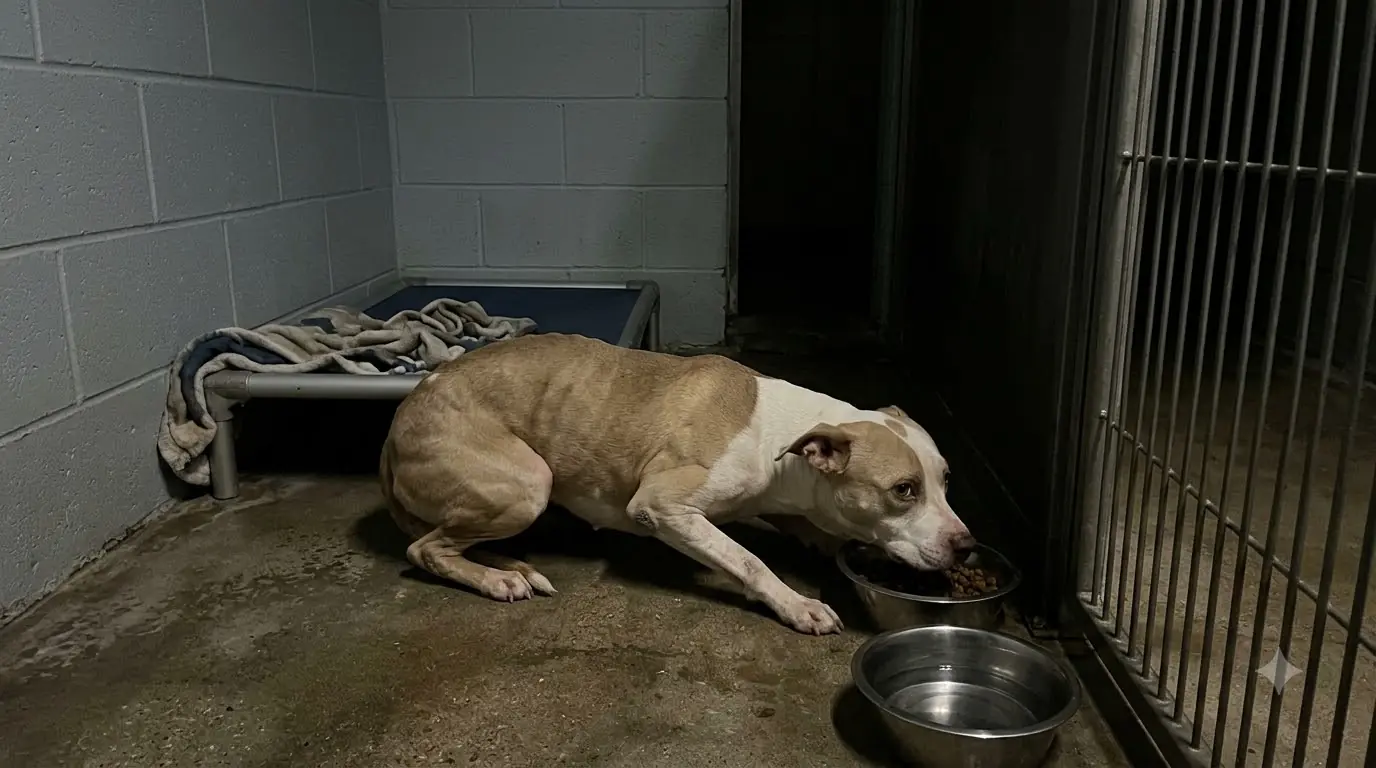
Every morning, Rosie gets a fresh bowl of food.
And every morning, the 7-year-old American Pit Bull Terrier does something that worried shelter staff almost immediately.
She walks toward it.
Stops.
Then stands beside the bowl without eating.
Sometimes she lowers her head and smells the food.
Sometimes she simply watches the hallway.
Hours can pass.
The food remains untouched.
Yet medical checks have not revealed a physical problem preventing Rosie from eating.
And Rosie clearly does get hungry.
Staff discovered that only after they began looking at the shelter's nighttime camera footage.
Because once the lights go out, the hallway becomes quiet, and the last footsteps disappear, Rosie changes.
She lowers her body close to the floor.
Slowly approaches the bowl.
Then she eats.
Fast.
And when the bowl is empty, Rosie does something even stranger.
She grabs it.
Carries it back to her bed.
And pushes it underneath.
By morning, Rosie is lying above an empty bowl that staff never left there.
Her Thin Body Made the Uneaten Meals Impossible to Ignore
Rosie had arrived underweight.
There were also multiple older callused areas on her body.
Those physical signs told caregivers that her condition deserved careful attention.
But they did not tell staff exactly what had happened before Rosie entered the shelter.
Nobody could responsibly look at old calluses and reconstruct her entire history.
What mattered immediately was Rosie's condition now.
She needed appropriate nutrition.
She needed monitoring.
And staff needed to understand why a dog who was already thin appeared unwilling to eat.
At First, They Looked for a Medical Explanation
A dog standing over food without eating can have many possible causes.
Pain, nausea, dental problems, gastrointestinal illness, medication effects, stress and other medical issues can all affect appetite.
So Rosie's behavior could not simply be labeled emotional.
She needed to be evaluated.
The important finding was that Rosie remained physically capable of eating.
Nothing identified during her examination explained an inability to chew or swallow her meals normally.
That still didn't mean her behavior could be ignored.
Rosie was underweight.
Whether the obstacle was physical, environmental or behavioral, she needed enough nutrition to recover.
Then Someone Checked the Bowl in the Morning
It was empty.
That created a different question.
Rosie had ignored the food for much of the day.
Staff had seen it themselves.
Yet sometime overnight, she had eaten.
The next night, caregivers paid closer attention.
Again, Rosie barely touched the food while normal shelter activity continued.
Then morning came.
The bowl was empty.
Soon the pattern became obvious enough that staff reviewed the overnight footage.
That was when they finally saw what Rosie was doing.
The Camera Captured a Different Dog
The shelter had gone quiet.
Lights were off.