Rusty’s story did not begin with a shelter deadline. It began beside a road, where a driver noticed a reddish-and-white dog sitting near a patch of weeds several yards from passing traffic. At first, the driver assumed someone must be nearby, because Rusty was not wandering aimlessly or chasing cars. He remained in roughly the same place, occasionally standing when a vehicle slowed and then sitting again when it continued past. When the driver returned along the same road almost two hours later and saw the dog still there, she stopped and called for help. There was no house immediately nearby, no person searching the shoulder, and nothing about the scene that explained why a young dog with a clean enough coat and obvious familiarity with people had been left alone there.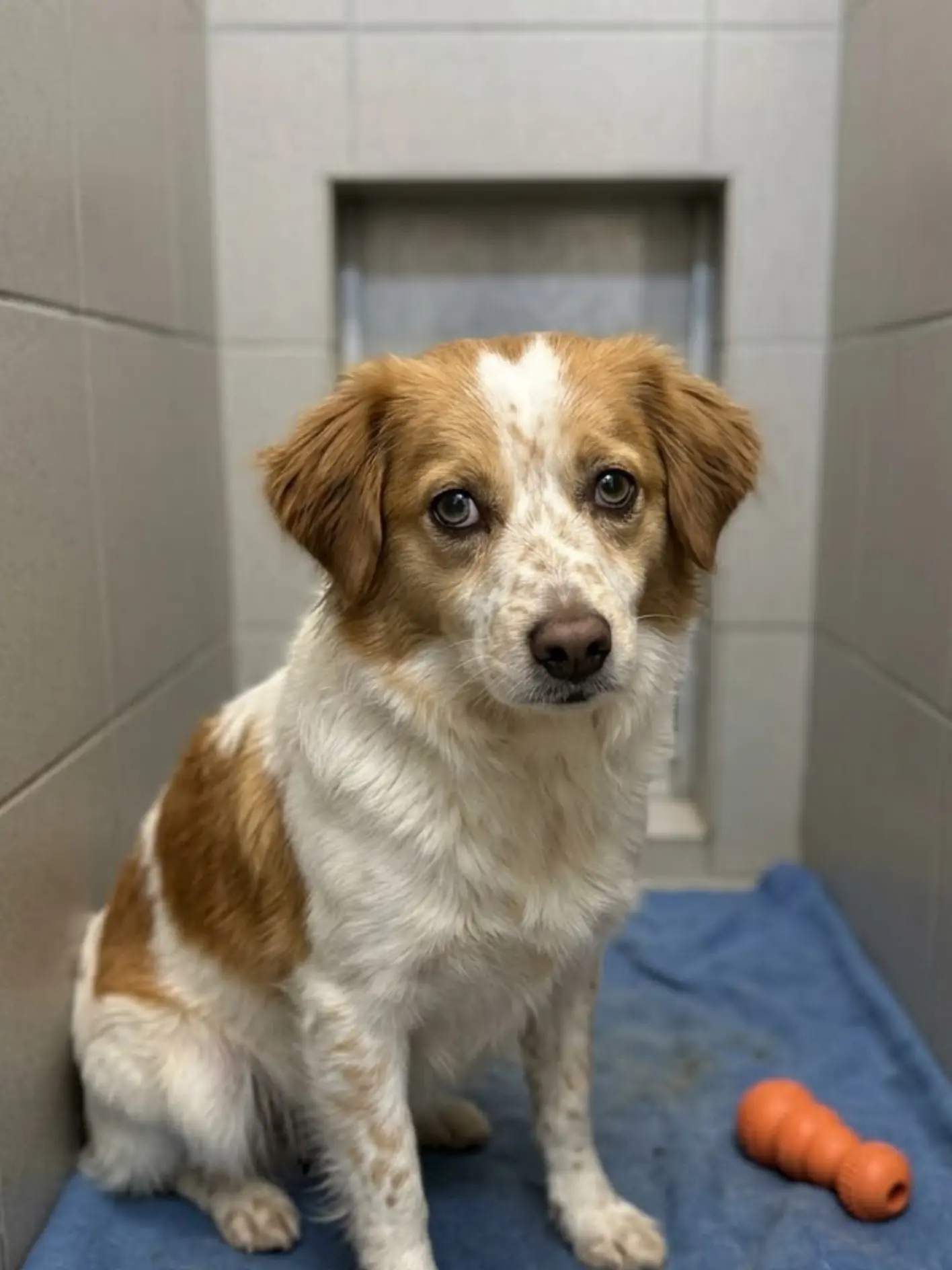
Animal-control workers eventually approached Rusty slowly and were able to secure him without a struggle. He wore an old collar but no identification that led directly to an owner, and nobody arrived during the shelter’s owner-search period to claim him. Staff could not prove that he had deliberately been abandoned, and they were careful not to turn uncertainty into fact, but nobody could ignore the practical reality: whatever life Rusty had known before that morning had ended, and there was no confirmed person waiting to take responsibility for him.
Once he became available for adoption, employees expected the next part of his story to move quickly. Rusty was a young adult, probably somewhere around two years old, with a soft red-and-white coat, freckles across his face and legs, and large brown eyes that made him look almost puppyish from certain angles. He was not especially large, did not arrive with a major medical crisis, and showed no known bite history during his stay. He accepted routine handling, learned the shelter schedule quickly, and seemed to understand a leash well enough that staff suspected somebody had once spent real time with him.
That combination usually helped a dog get noticed, and Rusty was noticed almost immediately. Visitors stopped in front of his kennel, commented on his coloring, and asked volunteers whether he was still available. Several people took photographs through the bars. Parents pointed him out to their children, and couples stood nearby discussing whether he looked more like a spaniel, retriever, or cattle-dog mix. Staff heard the same sentence often enough that it became almost routine: “He won’t be here long.”
During Rusty’s first week, that prediction still sounded reasonable. He was not the dog visitors hurried past. If anything, his problem was stranger than that. People liked him easily, but liking him never seemed to become the final decision. One couple spent nearly an hour with Rusty outside the kennel and seemed genuinely impressed by how quickly he relaxed once the noise of the building faded. He investigated the exercise yard, accepted treats gently, and eventually walked beside them without pulling much at all. The meeting ended only after they explained that both adults worked long shifts and regularly came home after ten or eleven hours away. They had hoped an adult shelter dog would automatically be comfortable alone for that amount of time, but staff could not promise it. Rusty’s previous household history was unknown, and the first weeks in a new home could require far more supervision than they were able to provide.
The couple left disappointed, but the decision itself was responsible. A successful adoption is not measured by whether the dog gets out of the building that afternoon; it is measured by whether the dog can remain in the new home after the excitement disappears. Rusty needed someone prepared for training, adjustment, veterinary care, routine, and the possibility that he would behave differently once he felt secure. Still, responsible reasoning meant very little from his side of the kennel door. He left the exercise yard with an employee, returned to the same run, and watched the gate close.
A few days later, another visitor came specifically because she had seen Rusty online. She lived alone, owned her home, and had previously adopted two rescue dogs. Her meeting with Rusty went so well that employees began quietly preparing themselves for the possibility that he was finally leaving. She sat on the floor instead of calling him repeatedly, allowed him to approach when he was ready, and laughed when he eventually leaned his shoulder against her knee. Then she mentioned the three cats waiting at home. The shelter had no reliable history of Rusty living with cats, and staff could not guarantee that a calm-looking dog would automatically be safe around small animals in a completely different environment. The woman appreciated the honesty and decided that experimenting with the safety of her elderly cats was not a risk she wanted to take.
Rusty stayed.
This became the pattern of his shelter life. Nothing dramatic happened, yet every possible exit disappeared for a different practical reason. A renter liked him but discovered a pet restriction in the lease. A family with young children wanted a dog with a more complete history around kids. One man scheduled an appointment, exchanged several enthusiastic messages with staff, and never arrived. Another visitor loved Rusty during a walk but admitted that his partner had not agreed to getting a dog at all. Staff encouraged him to settle that conversation before bringing an animal into a household where one adult already objected.
None of those people hated Rusty. Most of them left saying something similar: someone else would be perfect for him.
The problem was that “someone else” never seemed to walk through the door.
A volunteer named Claire began spending more time with Rusty during his second week and realized that the dog visitors saw inside the kennel was only part of the picture. Rusty did not advertise himself aggressively. When the building was loud, he often sat quietly on the blue blanket near the back of his run, watching people rather than pushing forward to meet them. Some visitors interpreted his stillness as sadness, while others assumed he was simply uninterested. Claire saw something simpler. Rusty needed a few minutes before deciding whether someone was safe, and the shelter environment rarely rewarded dogs who required patience.
Outside, the difference was obvious. Once the barking and constant movement were behind him, Rusty became curious and more animated. He liked sniffing slowly along the edge of the yard and often stopped to examine whatever scent had caught his attention. After ten or fifteen minutes, he began checking where Claire was rather than focusing entirely on the environment. He did not demand affection, but he increasingly chose to stand beside her when they stopped walking, and after several outings he began greeting her at the kennel gate before she had even attached the leash.
Claire started recording short videos because she wanted people to see the dog she had come to know rather than only the photograph of Rusty sitting behind bars. The shelter shared footage of him walking calmly, accepting treats, and resting beside her after exercise. The response online was larger than anything his original profile had received. People called him beautiful, asked how he could still be available, and tagged friends who had talked about adopting. Someone offered to pay his adoption fee. Another person volunteered to contribute toward professional training for whoever brought him home.
For two days, the comments created the impression that Rusty had suddenly acquired dozens of possibilities. Inside the shelter, nothing had changed. Nobody had completed the adoption process, no foster had been approved, and no rescue organization had confirmed that it could take responsibility for him. Rusty was more visible than ever, yet he still slept on the same blue blanket.
That difference between attention and placement is one of the most difficult realities surrounding shelter animals. A photograph can travel thousands of miles while the dog in the photograph never moves. A post can accumulate hundreds of comments from people who genuinely care, but every individual viewer may assume that somebody closer, wealthier, more experienced, or already involved will handle the practical part. The more popular a dog appears online, the easier it sometimes becomes to believe he is already safe.
Rusty was surrounded by people saying someone should take him home. What he did not have was someone actually doing it.
While volunteers continued promoting him, conditions inside the shelter began changing. Several stray dogs arrived during one weekend, including animals whose owners still needed time to locate them. Two dogs entered after a family suddenly lost housing, and another kennel had to be removed from ordinary use because an animal required medical separation. The number of available runs dropped quickly. Rusty’s daily care did not suddenly become worse—he still received food, clean water, walks when staffing allowed, and attention from people like Claire—but the amount of time the building could comfortably promise became less certain.
That distinction matters because a shelter is not an unlimited waiting room. Dogs continue arriving whether or not the animals already inside have found homes. Lost pets need somewhere safe while families search. Injured animals require housing. People facing hospitalization, eviction, or other crises sometimes surrender animals because every alternative has disappeared. When enough dogs leave through adoption, foster care, rescue transfer, or reunification, space opens again. When those exits slow while intake continues, long-stay animals become vulnerable even if they have done nothing wrong.
Rusty was gradually becoming one of those dogs.
Staff contacted several rescue organizations before his case became formally urgent. One group liked his profile but had no appropriate foster homes available. Another agreed to share his information with volunteers but explained that it did not operate a large facility where another dog could simply be placed. A third rescue said it could consider Rusty if someone first volunteered to foster him locally.
For a short time, that seemed possible. A woman who worked from home saw one of Claire’s videos and offered to foster Rusty for several weeks. She had previous dog experience, no children, and enough time to help him decompress. The conversation moved far enough that Claire allowed herself to imagine arriving for her next shift and finding Rusty’s kennel empty.
Then the woman checked with her landlord. Her lease allowed her own registered pet but prohibited temporary foster animals without additional approval, and the property owner refused.
The foster placement disappeared before Rusty ever knew it existed.
The following morning, he stood when Claire approached with the leash, exactly as he always did. To the humans around him, hours of calls and messages had nearly produced a completely different future. To Rusty, breakfast had simply been followed by another ordinary walk.
As his stay lengthened, Claire noticed that the kennel environment was beginning to affect the way he presented himself. Rusty remained easy with familiar employees, but he became less interested in unfamiliar visitors during busy periods. Instead of standing when every person approached, he sometimes stayed on his blanket and watched from several feet away. He occasionally barked when another dog passed close to his gate, behavior that had been rare during his first week.
Outside, he still settled.
That contrast became part of his updated profile. Staff did not hide the kennel barking because honesty was important if the next placement was going to last. They explained that confinement and prolonged shelter stress can alter behavior and that the dog someone met through the bars might behave differently after decompression in a stable home. That information narrowed the audience, but it also made the remaining inquiries more realistic.
One man with previous experience owning similar dogs visited twice and appeared comfortable with everything staff told him. He owned a house, had a fenced yard, no cats, and a schedule that could accommodate Rusty during the transition. The second meeting went so well that Claire privately believed the search was over.
The man said he wanted one night to discuss the decision with his adult daughter, who lived with him.
He never returned.
Messages eventually went unanswered.
Rusty stayed.
By then, the shelter had begun discussing several longer-stay dogs requiring immediate placement. Rusty’s name appeared on the list. It did not mean his outcome had already been decided, but it meant the comfortable assumption that another week would always exist was gone. Volunteers intensified outreach, rescue contacts were tried again, and previous potential adopters received updates.
Social media responded with anger once people realized Rusty might actually be at risk. Some accused the shelter of failing him. Others criticized every person who had met him and walked away. Claire understood the emotional reaction, but she knew the situation was more complicated than assigning blame. The employees feeding Rusty were also the people calling rescues. The woman with elderly cats had made a responsible decision. The renter could not rewrite a lease. A family working eleven-hour days could not create more hours simply because a shelter dog needed them.
Nobody had to be deliberately cruel for Rusty to run out of options.
That was the part people found hardest to accept. Sometimes an animal reaches an emergency not because nobody cares, but because every available resource is limited at the same time. Rescue organizations want to help but lack fosters. Families want to adopt but face housing restrictions. Shelter staff want more time but cannot stop new animals from arriving. Sympathy accumulates while physical space disappears.
Eventually, Rusty’s status changed from urgent to critical.
If no appropriate adopter, foster, or rescue placement was secured that day, he could be euthanized because the shelter needed space.
Today.
For the people following his case, the word transformed everything. For Rusty, nothing about the morning seemed different. His food arrived. His water was replaced. The sounds of neighboring dogs filled the building. When Claire appeared carrying the leash, he stood immediately and moved toward the gate because that was one routine he understood.
She took him outside.
They followed the route they had walked dozens of times. Rusty spent several minutes investigating a patch of grass before returning toward Claire, then wandered with her to the quieter side of the yard. She sat on the low bench they often used after walks, and Rusty remained nearby before eventually settling close enough that his shoulder rested against her leg.
Claire stayed there longer than usual.
The scene would have looked completely ordinary to anyone passing by. Rusty was not clawing at a gate or somehow pleading with her to save him. He watched movement beyond the fence, sniffed the air, and occasionally looked toward Claire when she shifted position. The urgency existed in human documents and conversations, not in anything the dog could understand.
That normality was what made the moment difficult.
Rusty had not become dangerous. He had not suddenly stopped being adoptable. He had simply remained homeless for longer than a crowded shelter could comfortably sustain.
Claire eventually stood and walked him back inside. Rusty entered his kennel without resistance. The gate closed again.
The shelter shared another update asking people not to assume the situation was resolved because the post had thousands of views. Anyone seriously considering adoption or foster care needed to contact the shelter directly. Donation offers could help with expenses, but money could not become a living room. Shares could spread his story, but a share could not physically remove him from the building.
Rusty needed an address.
Several new inquiries came quickly. A family wanted him but asked whether the shelter could hold him for four more days until they returned from vacation. Staff could not promise that. Another person offered to take him immediately but planned to keep him permanently outdoors on an unsecured property. That was not considered a responsible placement. A woman volunteered to foster but already had a dog with a serious history of attacking unfamiliar animals and no ability to keep them safely separated.
The shelter continued saying no when saying yes appeared likely to create another crisis.
By early afternoon, Rusty was still there.
The person who ultimately changed his story was not someone seeing his photograph for the first time. His name was Marcus Hill, and he had met Rusty almost two weeks earlier. Marcus was fifty-four and worked as a maintenance supervisor for an apartment complex about thirty minutes from the shelter. He had owned dogs through most of his adult life but had been without one since his older shepherd mix died the previous year.
Marcus had originally visited simply to look. He told staff he was not certain he wanted another dog yet, but Rusty caught his attention because he did not rush toward him. During their first meeting, Marcus sat quietly while Rusty explored the room, and after nearly twenty minutes the dog finally approached and accepted a treat.
Marcus liked him.
Then he left.
The reason was not housing, money, or another pet. Marcus simply believed he was not ready. Losing his previous dog had been difficult, and beginning another decade-long responsibility felt like admitting that part of his old life was permanently over.
Before leaving, Marcus told Claire that Rusty would probably be gone within days.
He became another person expecting someone else to choose him.
When the final-day update appeared, Marcus recognized the dog immediately.
He read the comments.
Hundreds of people wanted Rusty safe.
No one had taken him.
Marcus closed the post and returned to work.
Less than an hour later, he opened it again.
The question bothering him was not whether Rusty deserved a home. He already knew the answer. The question was whether the reason he had walked away two weeks earlier had actually changed.
It had not.
Marcus was still grieving his old dog.