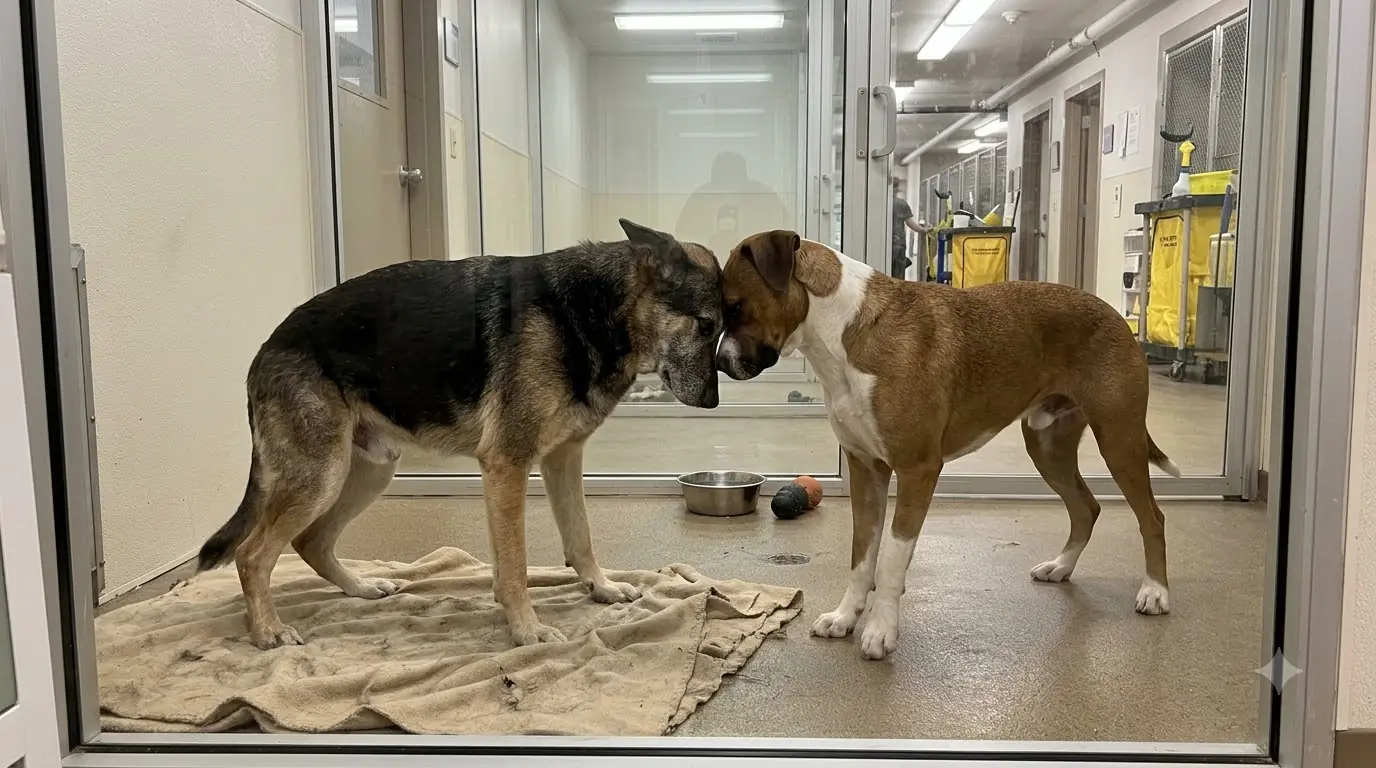
In the adoption viewing area, Cooper is usually the first dog people notice.
He steps forward.
He watches whoever is approaching.
Sometimes he moves closer to the glass before staff even reach the kennel.
Sadie usually does something different.
The 9-year-old German Shepherd mix stays slightly behind him.
Not hidden.
Not panicked.
Just back far enough that Cooper remains between her and whatever is new.
That pattern has become so familiar that staff can often predict it before a visitor reaches their space.
Cooper moves first.
Sadie watches Cooper.
Then she decides what to do.
It is one of the clearest ways their relationship shows up during the day.
They had already been together long before they entered the shelter, and whatever routines they developed before arriving seem to have followed them in.
Staff see it in where they stand.
Where they sleep.
How Sadie approaches new people.
How Cooper checks back toward her.
And most clearly, what happens when one of them leaves.
One afternoon, Cooper was taken out of the viewing area for a meeting with a family.
Sadie watched him disappear through the door.
Then she did something staff had not seen her do before.
She turned toward the blanket they usually shared.
She picked up one corner.
Dragged it toward the glass.
Then lay down on it facing the hallway.
And she stayed there until Cooper came back.
They Arrived With a History Together
Sadie and Cooper had shared a life before they entered the shelter.
They were not two strangers introduced because they happened to have compatible temperaments.
They already knew each other.
The exact details of their earlier life are not the center of their story now.
What matters most is what staff can observe every day.
Sadie is older.
At nine, she has a more deliberate pace.
She tends to take time with unfamiliar people and unfamiliar situations.
Cooper is five.
He is more willing to step forward first.
That difference has become part of how they function as a pair.
Cooper investigates.
Sadie watches.
If Cooper remains comfortable, Sadie often begins to relax.
If he approaches someone, she may eventually follow.
If he settles, she settles too.
Neither dog spends every second attached to the other.
They can rest separately.
They can interact individually with staff.
They have different levels of confidence and different ways of moving through the shelter.
But again and again, they use each other as a reference point.
For Sadie especially, Cooper appears to make unfamiliar situations easier to understand.
Cooper Usually Goes First
The viewing area is designed to help potential adopters see dogs in a quieter, more open setting.
For Cooper, that usually means opportunity.
He notices people.
He steps closer.
He is often curious about what is happening on the other side of the glass.
Sadie is more cautious.
When footsteps approach, she tends to remain behind Cooper rather than moving to the front herself.
Sometimes she stands a few feet back.
Sometimes she positions herself almost directly behind him.
If Cooper engages, Sadie watches.
The important part is what often happens next.
She begins moving forward.
Maybe only one step.
Then another.
If the person remains calm and Cooper continues to look comfortable, Sadie may come close enough to sniff.
She does not need to be pulled forward.
Cooper simply makes the first move.
Sadie uses that information.
It is not dramatic.
It is not something that can be captured fully in a single photograph.
But over repeated interactions, it becomes a pattern.
Cooper's confidence creates space for Sadie to find her own.
Sadie Is Not Just the Shy One
It would be easy to describe the pair in simple terms.
Cooper is outgoing.
Sadie is shy.
That is not completely wrong, but it leaves too much out.
Sadie is observant.
She is careful.
She often seems to prefer understanding a situation before participating in it.
Once comfortable, she can be present without constantly seeking reassurance.
She does not need Cooper to physically touch her every time something changes.
Sometimes she simply needs to know where he is.
Cooper, meanwhile, is not permanently focused on Sadie.
He has his own interests.
He responds to people.
He explores.
He can be distracted by toys, scents, and activity.
But when the two are together, there is a repeated awareness between them.
Cooper moves.
Sadie tracks him.
Sadie stands.
Cooper often notices.
They do not behave identically.
That is exactly what makes their relationship feel real.
The Blanket Became Part of Their Routine
Sadie and Cooper often share a blanket.
It is not the only soft place available.
It is simply the one they repeatedly choose.
Sometimes Cooper lies down first.
Sometimes Sadie does.
Sometimes they rest with only part of their bodies touching.
Other times one settles close enough that there is almost no space between them.
The blanket itself is ordinary.
Shelters wash blankets constantly.
They get folded, unfolded, moved, replaced, and rearranged.
But for Sadie and Cooper, this particular shared space had become familiar.
That is why staff noticed what Sadie did when Cooper left for the family meeting.
She did not simply remain where she had been.
She moved the blanket.
The Afternoon Cooper Left Without Her
A family had arranged to meet Cooper.
That kind of interest is both encouraging and complicated when two dogs have an established relationship.
Someone can genuinely connect with one dog without having the ability to adopt two.
There may be housing limits.
Existing pets.
Budget concerns.
Space limitations.
Or simply a household structure that makes taking on two animals unrealistic.
The shelter does not assume bad intentions.
The job is to understand the dogs and make thoughtful decisions.
So Cooper was taken out for the meeting.
Sadie remained behind.
She watched the door close.
For a moment, she stood facing the hallway.
Then she turned.
She walked toward the blanket the two dogs usually shared.
She picked up one corner in her mouth.
Dragged it toward the glass.
Then lowered herself onto it.
Facing the hallway.
She Stayed There the Entire Time
Sadie did not bark continuously.
She did not throw herself at the glass.
She did not pace without stopping.
Her behavior was quieter than that.
She waited.
The viewing area continued operating around her.
People moved past.
There were sounds from other parts of the shelter.
Activity came and went.
Sadie remained on the blanket.
Her body was positioned toward the place where Cooper had disappeared.
Every so often, she lifted her head.
She watched.
Then she settled again.
The entire visit passed that way.
For staff, the moment stood out because Sadie had changed her normal use of the blanket.
It was no longer simply a place to rest with Cooper.
She had dragged it closer to the route he had taken.
Then she lay on it facing that direction.
It would be easy to assign a human explanation to the behavior.
Staff do not need to.
What happened was already meaningful.
Cooper left.
Sadie moved their shared blanket.
She positioned herself toward the hallway.
She stayed there.
What Separation Looks Like for Sadie
There are many ways animals react when a familiar companion leaves temporarily.
Some become restless.
Some vocalize.
Some lose interest in what is happening around them.
Some simply become quieter.
Sadie's response appears to be stillness and watching.
She did not suddenly forget how to function.
She remained safe.
She could rest.
But her attention changed.
Instead of using Cooper to interpret the environment, Sadie no longer had him available.
So she watched the place where he had gone.
That distinction matters.
No responsible shelter should claim that a short separation proves two animals could never adapt to life apart.
Behavior has to be evaluated over time.
But repeated patterns matter too.
With Sadie and Cooper, staff already knew that Sadie used Cooper's behavior as information.
They already knew she approached people more readily after watching him.
They already knew they shared resting space.
The family meeting added another piece.
When Cooper disappeared, Sadie did not simply switch her attention to something else.
She waited for him.
Cooper Returned With His Priorities Clear
Eventually, the door opened.
Cooper appeared in the hallway.
Sadie saw him.
Her response was immediate.
She struggled to her feet.
At nine, getting up is not always as effortless as it may once have been, and she did not spring up in a single motion.
But she got there.
Cooper entered the space.
His water bowl was nearby.
So were toys.
He ignored both.
He ran directly toward Sadie.
Then he stopped in front of her.
And pressed his forehead against hers.
For a moment, neither dog moved much.
Sadie's tail tapped the floor.
Once.
Then again.
After spending the afternoon facing the hallway, she finally stopped watching the door.
Cooper was back.
That Reunion Changed the Conversation
The shelter had already been treating Sadie and Cooper's relationship seriously.
The reunion made the issue harder to ignore.
Again, staff did not need to exaggerate.
Nobody claimed Sadie could never be separated from Cooper under any circumstances.
Nobody claimed Cooper's brief absence caused permanent distress.
The behavior itself was enough.
Sadie watched Cooper leave.
Moved their blanket.
Waited facing the hallway.
Then struggled to stand when he returned.
Cooper bypassed the water and toys.