Sawyer had been inside the shelter long enough to recognize the difference between ordinary footsteps and the sound of someone approaching with a leash. When employees moved through the kennel row carrying cleaning supplies, he usually watched from behind the bars without getting up. When a familiar volunteer appeared holding a leash, however, his large ears rose almost immediately and he stepped forward, hopeful for the few minutes outside that had gradually become the most predictable part of his day.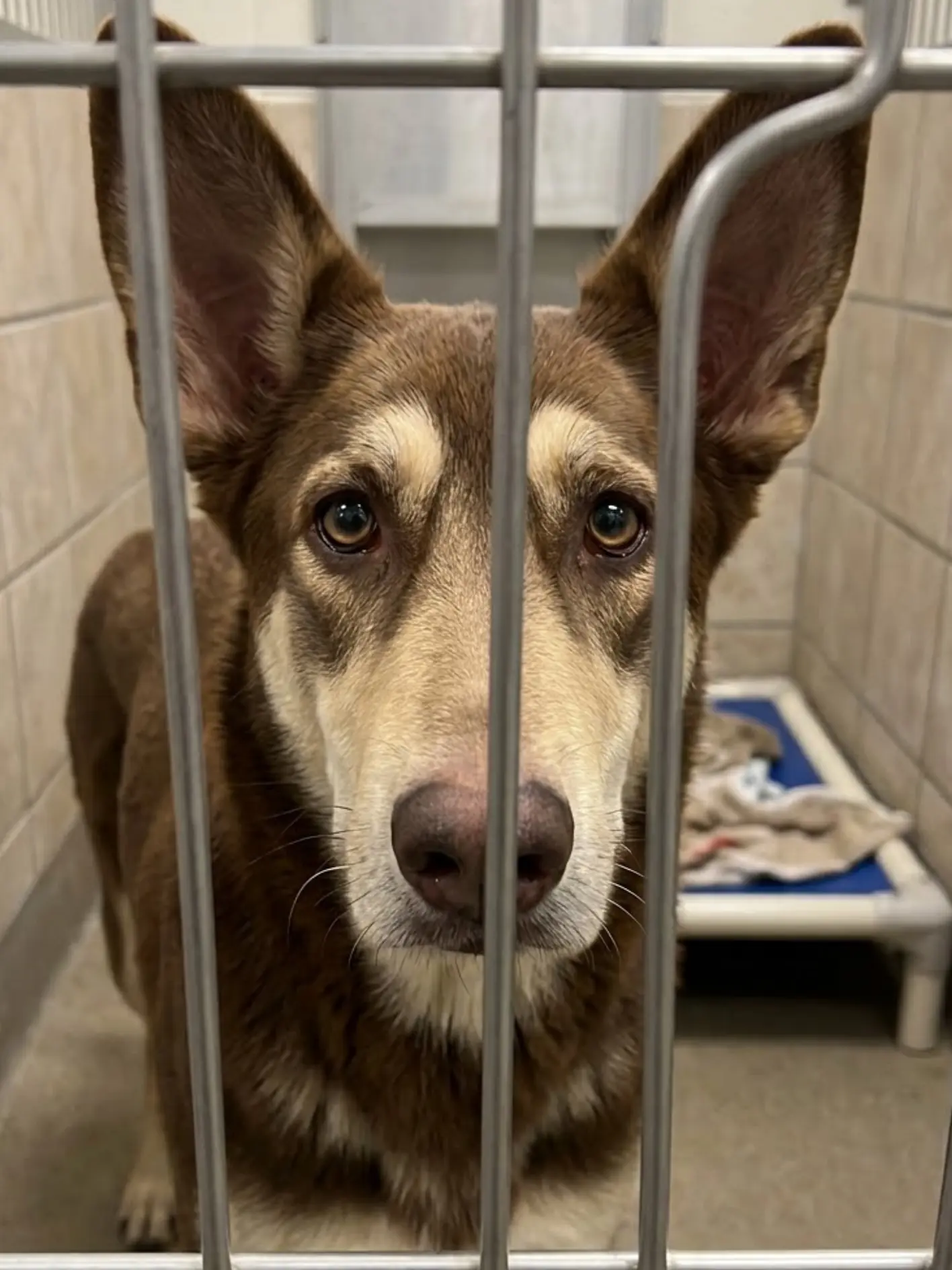
That small routine was one of the reasons the notice attached to his record felt so difficult for the people caring for him. Sawyer did not appear to know that anything had changed. To him, the building still followed the same schedule it had followed yesterday: breakfast, cleaning, barking from neighboring dogs, occasional visitors and, if someone had enough time, a walk outside. The humans were the only ones who knew that tomorrow had acquired an entirely different meaning.
Unless an appropriate adopter, foster home or rescue placement was confirmed before the deadline, Sawyer was scheduled to be euthanized because the shelter needed space.
Employees had spent weeks trying to prevent the situation from reaching that point, partly because Sawyer had originally looked like a dog who should have been relatively easy to place. He was a young adult with an unusual brown-and-tan coat, large upright ears and a long, expressive face that made visitors stop almost automatically when they reached his kennel. He appeared healthy enough for adoption, showed no known bite history during his shelter stay and became increasingly manageable around people he recognized.
The problem was never that Sawyer frightened everyone away.
People liked him.
That was what made his story more complicated.
Sawyer had arrived without a reliable history after being found loose near the edge of a commercial district. A maintenance worker opening a small warehouse early one morning noticed him moving between parked vehicles and assumed an owner was nearby. The dog remained in the area for much of the morning, however, occasionally approaching people and then retreating again when they moved too quickly. Eventually animal-control officers were contacted and were able to secure him without a major struggle.
He wore an old collar but carried no identification that led directly to a family. Staff followed the available process for trying to locate an owner, but no one came to claim him. Nobody at the shelter could say whether Sawyer had escaped and traveled farther than someone realized, had changed owners before being found or had simply become another dog whose previous life ended without anyone there knowing exactly why.
Employees avoided inventing an explanation.
What they could evaluate was Sawyer himself.
During his first several days, he appeared uncertain but not difficult to handle. He allowed routine examinations, accepted food readily and became visibly more relaxed when the same employees returned. He walked on a leash as though the equipment was familiar, although the excitement of leaving his kennel sometimes made him pull strongly during the first few minutes. Once outdoors, much of that energy faded and Sawyer usually became more interested in smells along the ground than in dragging the person behind him.
Those observations made shelter staff optimistic.
Sawyer was also immediately noticeable to the public. His enormous ears and unusual markings gave him an appearance unlike many of the dogs around him, and people frequently stopped to look. Several asked what breed he was, although staff could offer only an estimate based on appearance rather than a documented pedigree. Others photographed him through the gate and told employees that he was one of the most interesting-looking dogs they had seen that day.
More than once, somebody predicted that Sawyer would be adopted quickly.
For a while, employees believed them.
The first serious possibility appeared during his opening weekend. A couple who had recently purchased their first house arrived after seeing Sawyer’s photograph online. They were looking for a young adult dog rather than a puppy and liked the idea of an animal that might already have some experience living around people.
Sawyer’s first few minutes with them were typical. He moved around the meeting area, investigated the floor and remained more interested in the shelter employee than in the strangers. The couple did not seem discouraged. They waited, offered treats and allowed him to choose when to approach.
Gradually, he did.
By the end of the meeting, Sawyer had accepted treats from both adults and stood close enough for the woman to scratch gently beneath his neck. They took him outside, where his body language loosened further and he walked with considerably less tension after the first several minutes.
Staff began thinking this could be the answer.
Then the couple described their plans for the following year. Both traveled frequently for work, sometimes at the same time, and neither had yet arranged consistent pet care. They had imagined Sawyer accompanying them on some trips but admitted that many involved flights, hotels and changing schedules.
Shelter employees did not tell them the arrangement was impossible. They explained that Sawyer’s complete history was unknown and that moving him directly from a kennel into a life of frequent travel could be challenging. He might eventually handle new environments well, but no one could responsibly promise that outcome before he had even learned one stable home.
The couple discussed it privately and decided they were not ready.
They left without Sawyer.
The decision was responsible, yet its effect on Sawyer’s situation was simple. He went back to the kennel.
Another opportunity came several days later when a woman who had previously owned shepherd-type dogs came to meet him. She handled Sawyer confidently, did not seem bothered by his initial excitement and spent nearly an hour outside with him. Employees liked the way she asked about training, decompression and veterinary care rather than focusing only on his appearance.
Then she mentioned her two elderly cats.
There was no reliable information about Sawyer’s behavior around cats. Staff could not guarantee that his calmness around people meant he would automatically be safe around small animals in a home. The woman considered whether gradual introductions could be managed, but both cats had lived with her for more than a decade and she ultimately decided she did not want to gamble with their safety.
Again, nobody had done anything wrong.
Again, Sawyer remained.
That pattern followed him through much of his stay. One household liked him but wanted a dog with a documented history around young children. A renter discovered an unexpected restriction after contacting the property manager. Another person scheduled a meeting, exchanged messages with staff and simply never arrived.
Sawyer was rarely rejected because somebody met him and decided he was a bad dog.
Instead, he became trapped inside a series of reasonable obstacles.
A volunteer named Brooke started walking him several times each week and eventually described Sawyer as a dog who needed five minutes more than most people were willing to give him. Inside the kennel, his size and upright ears sometimes made him appear more intense than he actually behaved. When strangers stopped in front of him, Sawyer often watched without immediately approaching, and when the building became especially loud he occasionally stepped farther back.
Outside the kennel, Brooke saw more of him.
Sawyer liked slow walks once the first rush of excitement passed. He was fascinated by scents and could spend several minutes examining one patch of grass as though nothing else in the world mattered. He was not a dog who constantly demanded affection, but after enough time with the same person he often stayed nearby and periodically returned to check where they were.
Brooke also noticed that familiarity mattered tremendously. During their first outings, Sawyer treated her like any other stranger. After a week, he stood when she approached the kennel. After two, he began moving toward the gate before she had even attached the leash.
The changes were small, but they revealed the central difficulty in presenting Sawyer to adopters. The dog someone met in the first three minutes was not necessarily the dog they would know three weeks later.
Brooke began taking photographs and short videos outside because she wanted potential adopters to see more than the image of Sawyer staring through metal bars. One clip showed him walking quietly after exercise. Another showed him standing beside Brooke while she sat on a bench, his attention shifting between her and activity beyond the fence.
The shelter shared the footage.
Interest increased immediately.
People commented on his ears, his eyes and the way he seemed calmer outside. Several said they could not understand how he was still available. Others tagged friends or relatives who had talked about adopting.
One person offered to pay Sawyer’s adoption fee.
Another offered money for a trainer.
Someone else wrote that she would donate toward transportation if a rescue organization outside the area could take him.
For a few days, Sawyer’s online presence made him look almost safe.
Inside the shelter, nothing had changed.
There was no signed adoption.
No approved foster.
No confirmed rescue pull.
Sawyer still returned to the same kennel after every walk.
This difference between attention and placement became increasingly important as his stay continued. People often assume a dog receiving hundreds of comments must already have several serious applicants. One viewer sees a dozen people asking whether the animal is available and assumes someone else has completed the next step. Another sees rescue groups tagged repeatedly and concludes that one of them must be arranging a transfer.
Sometimes everybody watching believes somebody else is handling it.
The dog remains exactly where the photograph was taken.
Sawyer became one of those dogs.
While his visibility grew, the shelter itself entered a difficult period. Several stray dogs arrived over one weekend, some of whom still needed time for owners to locate them. Two animals entered after an emergency housing situation left their family unable to keep them, while another kennel became temporarily unavailable because a dog required medical separation.
The building did not suddenly stop caring about Sawyer. His meals still arrived, employees continued cleaning his kennel and Brooke continued walking him whenever her volunteer schedule allowed. What changed was the number of empty spaces around him.
Animal shelters operate within physical limits. New cases do not necessarily stop because existing dogs have not found homes. Lost animals need somewhere safe while families search. Injured dogs may require immediate housing. People experiencing eviction, hospitalization or other emergencies sometimes surrender animals because every other option has disappeared.
For the system to continue functioning, animals also have to leave.
Adoption creates space.
Foster placement creates space.
Rescue transfer creates space.
Reunification with an owner creates space.
When those exits happen more slowly than intake, dogs that seemed secure earlier in the month can suddenly become vulnerable.
Sawyer’s name eventually appeared among the animals needing accelerated placement.
Staff contacted rescue organizations before the situation became critical. One group liked his profile but had no available foster home large enough for him. Another offered to share his photographs but explained that it did not operate a kennel facility where Sawyer could simply be moved. A third rescue said it could consider taking responsibility if a local foster stepped forward first.
For several days, Brooke focused almost entirely on finding that temporary home.
A promising offer finally came from a man who had owned similar-sized dogs before and lived in a house with a fenced yard. He seemed comfortable with Sawyer during the meeting and initially said he could foster for several weeks.
Then staff learned that his resident dog had a history of serious conflict with unfamiliar animals.
The man believed the dogs could simply meet in the backyard and “figure things out.”
The shelter and rescue organization disagreed.
Urgency did not make an unsafe introduction responsible.
That foster disappeared.
Another woman offered to help but discovered that her lease treated temporary foster animals the same way it treated permanent pets and required management approval. The request was denied.
Again, a possible door closed before Sawyer ever walked through it.
The dog knew none of this.
He woke each morning and followed the shelter routine.
That contrast weighed increasingly heavily on Brooke. She could spend hours messaging rescue coordinators and possible fosters, become convinced that Sawyer might finally leave, and then learn that a landlord, resident animal or practical limitation had ended the plan. The following morning, Sawyer would simply stand when he saw her leash, unaware that an entire possible future had disappeared overnight.
As his stay lengthened, shelter stress began showing in small ways. Sawyer became more vocal when unfamiliar dogs passed closely by his kennel and sometimes paced during busy adoption hours. He remained easy with familiar handlers and generally settled once outside, but his presentation through the bars became less appealing at exactly the moment he needed new people to consider him.
Staff updated his profile honestly. They explained that Sawyer had become louder in the kennel but continued to behave differently outside it. They did not describe him as perfect, because pretending every limitation did not exist might produce a fast adoption and an equally fast return.
The goal was not merely to move Sawyer for one night.
It was to find somewhere he could stay.
One potential adopter seemed to understand that better than most. A man named Eric visited twice, owned a home, had no other pets and had previous experience with large dogs. His second meeting with Sawyer went so well that Brooke quietly believed the weeks of waiting might finally be ending.
Eric asked sensible questions about training and decompression and seemed completely comfortable handling the leash.
Before leaving, however, he said he needed to talk with his fiancée.
He never returned.
A text from staff received no answer.
Sawyer remained.
By then, the shelter could no longer pretend that time was simply another resource they could keep extending. Another group of animals arrived, and several longer-stay dogs were moved into critical placement status.
Sawyer was one of them.
The shelter’s public message changed accordingly. He needed an adopter, foster or rescue placement urgently. Volunteers asked people not to treat social media comments as evidence that someone else was already helping.
The response was enormous.
People offered money.
They offered transportation.
They tagged dozens of rescue organizations.
Some became angry and demanded to know why the shelter would consider euthanasia for a healthy-looking dog.
Brooke understood the anger, but she also understood the problem inside the building. The employees feeding Sawyer were not the people preventing him from leaving. They were making the same calls everyone wanted made. Rescue organizations were not refusing him because they believed his life lacked value; many simply had every foster home occupied.
The missing resource was physical space somewhere else.
Eventually, the shelter issued the notice everyone had been trying to avoid.
If Sawyer did not have an appropriate placement secured before tomorrow, he was scheduled to be euthanized for space.
Tomorrow.
For weeks, people had said Sawyer still had time.
Now the amount of time could be measured in hours.
Brooke came to the shelter early the next morning. She expected the knowledge to make Sawyer look somehow different, even though logically she knew it could not.
He looked exactly the same.
When she approached with the leash, Sawyer stood.
She clipped it to his collar and walked him outside.
For the first several minutes, he did what he always did. He followed smells along the edge of the yard, paused near the fence and became completely absorbed in one patch of grass. Gradually he returned toward Brooke, and the two moved to the shaded corner where they often rested.
Brooke sat.
Sawyer remained standing beside her for a moment before lowering himself onto the ground.
She placed one hand lightly against his shoulder.
Sawyer stayed.
There was nothing theatrical about the scene.
He did not understand that he might not receive another morning walk.
He did not know his photograph was circulating with increasingly desperate language.
He was simply outside with someone familiar.
Brooke stayed longer than usual before bringing him back.