Molly and Scout have two beds in their kennel.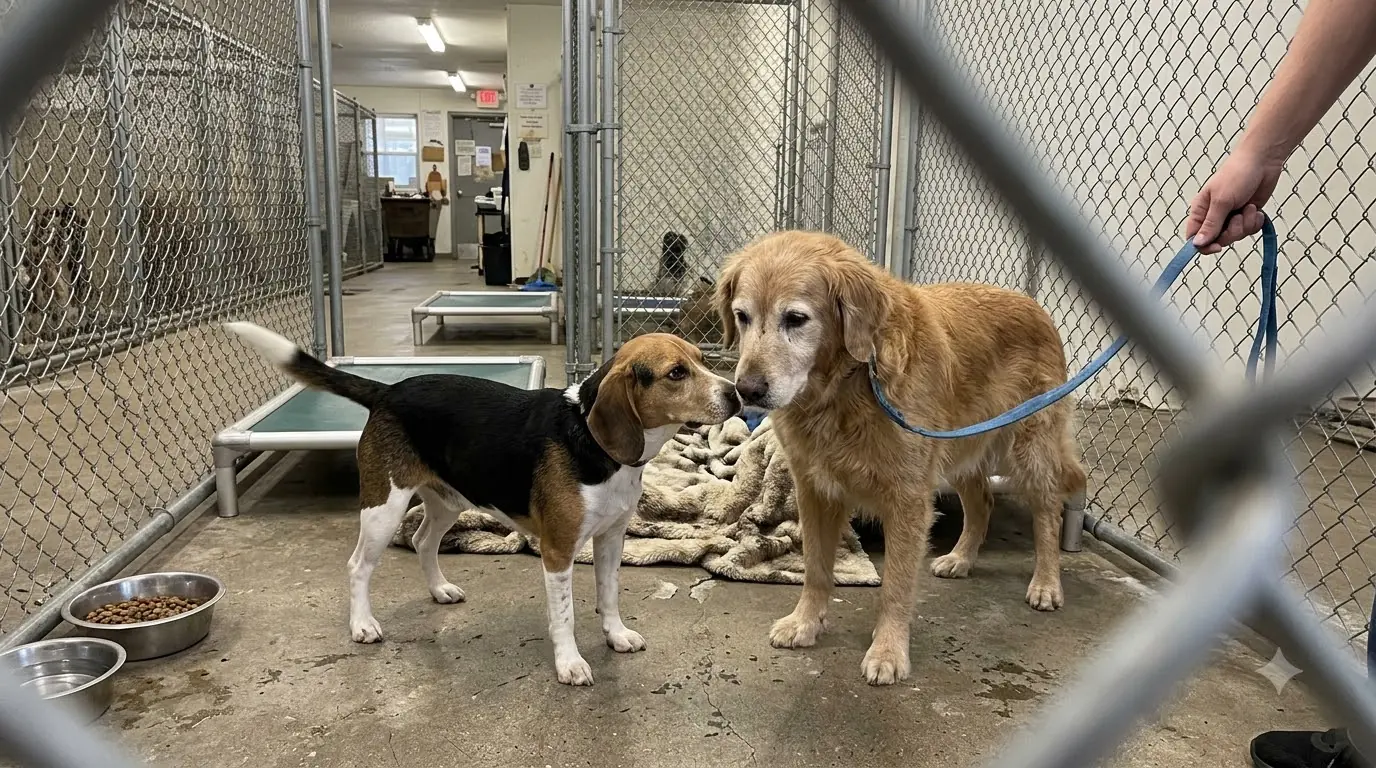
Most nights, one of them remains empty.
After the last evening walk, after dinner bowls have been collected and the kennel row begins to quiet, Molly usually settles onto a blanket. Scout circles once or twice, checks where she is, and lowers himself beside her.
Sometimes there is plenty of room elsewhere.
Scout chooses Molly anyway.
He curls against her side and, once he is comfortable, often stretches one paw across her back.
Molly does not move away.
By morning, they are usually still close.
It is one of the simplest things staff members see during a shift, but it explains more about these two dogs than almost anything written on an adoption profile.
Scout is six years old, a Beagle mix who notices unfamiliar sounds quickly. Molly is nine, a Golden Retriever mix with a steadier way of moving through the world.
Scout watches.
Molly goes first.
Scout hesitates.
Molly waits.
And when something unfamiliar happens, Scout's first response is often not to look toward a person.
He looks for Molly.
Two Dogs Learning a New Routine Together
Molly and Scout have shared the same kennel since the day they entered the shelter.
What is known with certainty is what staff can observe now: whatever their life looked like before this kennel, they arrived as two dogs already accustomed to relying on each other's presence.
The shelter did not need weeks to notice it.
It was visible almost immediately.
Molly was the more comfortable of the two with the new environment. She was not completely unaffected by the change — most dogs need time to understand a shelter's unfamiliar sounds, smells, schedules, people, and routines — but she was willing to investigate.
When someone approached quietly, Molly would often step forward.
Scout tended to remain farther back.
If a kennel door opened, Molly wanted to know what was happening.
Scout wanted to know what Molly thought about what was happening.
That difference became especially noticeable when footsteps came down the kennel row.
Scout would hear them before he could see who was approaching. His body would become more cautious, and he would often slip behind Molly.
Then he would press his face against her side.
Molly did not step away.
She simply remained where she was.
Sometimes the person continued past their kennel. Sometimes a staff member stopped to offer treats or prepare them for a walk. Eventually Scout would peek around Molly's shoulder.
If Molly remained relaxed, Scout often began to relax too.
It was an early clue that helping Scout adjust to shelter life was going to involve understanding the dog standing beside him.
Molly Usually Goes First
Their personalities are not the same, and that may be part of why their relationship works so well.
Molly is older and more measured.
At nine, she does not need to investigate every sound or turn every moment into activity. She enjoys attention, appreciates a comfortable place to rest, and is generally more willing than Scout to approach unfamiliar situations.
Scout is younger, but youth does not automatically make a dog more confident.
He is interested in his surroundings while also being cautious about them.
When the pair enters a new space, Molly commonly begins exploring first.
Scout follows.
If Molly stops to sniff something, Scout comes closer.
If a new person sits nearby without pressuring them, Molly may approach while Scout watches from a safer distance.
He seems to gather information from her.
There is no dramatic signal between them.
Molly does not need to pull Scout forward.
She simply moves.
Scout sees her move, waits, and often decides that he can move too.
That pattern appears in small ways throughout their day.
When leashes are brought out, Molly is usually ready first.
When the kennel opens, Scout often lets her step through before following.
In the exercise yard, Molly may begin walking the perimeter while Scout stays close for the first few minutes.
Once he understands where they are, his nose takes over and he becomes much more recognizably Beagle-like, investigating scents and wandering farther away.
Even then, he checks back.
If Molly changes direction, Scout frequently notices.
If she heads toward the gate, he is rarely far behind.
The Empty Bed Tells Its Own Story
Shelter staff deliberately give Molly and Scout options.
They have separate sleeping spaces because being bonded does not mean two dogs should be forced to share everything.
They have room to move away from each other.
They can rest independently.
They receive individual attention.
Their behavior is meaningful precisely because closeness is usually something they choose.
At bedtime, Scout's choice is particularly consistent.
He wants to know where Molly is.
If she settles first, he usually settles near her.
The second bed may remain untouched while two dogs occupy one blanket.
Sometimes Scout curls tightly against Molly's side.
Other times he sleeps slightly behind her.
And then there are the nights when someone checking the kennel sees his paw resting across her back.
It is not dramatic.
There is no crying, no staged photograph, no extraordinary event.
There are simply two dogs, asleep.
Yet shelter work is full of moments like this — ordinary behaviors that become important because they repeat.
One night could be coincidence.
Night after night becomes a pattern.
Scout chooses proximity to Molly when the building gets quiet.
Molly continues making space for him.
The Hour That Made Their Bond Especially Clear
One afternoon, Molly needed a routine medical exam.
There was no emergency.
There was no frightening diagnosis waiting at the other end of the hallway.
It was simply part of responsible shelter care.
For Molly, it meant temporarily leaving the kennel.
For Scout, it meant something unfamiliar: Molly walked out without him.
He watched her leave.
Then he moved toward the kennel door.
Staff offered him his normal routine and gave him time to settle, but Scout remained focused on the hallway.
His food was available.
He did not show much interest in it.
Instead, he stayed near the door and looked in the direction Molly had disappeared.
Minutes passed.
Scout changed positions occasionally, but he kept returning to the same place.
The hallway.
The gate.
The direction Molly had gone.
Nearly an hour passed that way.
It would be easy to exaggerate what that meant. Scout was safe. He was not in physical danger. Dogs can behave differently when a familiar companion temporarily leaves, particularly in an environment that is already relatively new to them.
But staff did not need to exaggerate anything.
What Scout actually did was enough.
He waited.
Then footsteps returned.
Molly came back down the hallway.
Scout was standing before she reached the kennel.
When she returned, he hurried toward her and touched his nose to hers.
His tail began moving again.
He followed her back inside.
Only after Molly was there did the ordinary parts of Scout's afternoon begin to return.
For staff, that hour clarified something they had already suspected from the sleeping arrangements, the walks, and Scout's habit of hiding behind Molly.
Molly was not merely the dog sharing his kennel.
She was part of how Scout navigated it.
Separation Looks Different for Every Bonded Pair
Responsible shelters have to be careful about the language used around bonded animals.
Not every pair that enjoys sleeping together must necessarily be adopted together.
Not every dog that becomes restless when a companion leaves is incapable of eventually adjusting to life separately.
And nobody can responsibly predict that something catastrophic would happen if two animals were apart.
That is why staff pay attention to patterns rather than labels.
With Molly and Scout, those patterns continue to point in the same direction.
Scout functions with noticeably more confidence when Molly is nearby.
When she leaves, he becomes more watchful.
When she returns, he settles more easily.
The medical-room visit was the clearest example, but it was not the only one.
Short individual activities have produced similar, if less pronounced, behavior.
Scout tends to check the kennel entrance.
He listens to movement in the hallway.
He may take longer to settle.
When Molly returns, he approaches her quickly.
Molly appears to tolerate short separations more comfortably than Scout does.
That difference is important.
Their relationship is not perfectly symmetrical.
Scout seems to depend more heavily on Molly's presence for reassurance.
Molly, meanwhile, provides that reassurance largely by doing very little.
She does not constantly monitor him.
She does not have to.
Her predictability appears to be enough.
The Challenge Is Not Finding Someone Who Likes Them
Molly is the kind of dog many visitors notice.
An older Golden Retriever mix can appeal to adopters looking for a calmer companion, particularly someone who appreciates senior dogs and does not necessarily want the intensity of a young puppy.
Scout has his own appeal.
He is six, curious, expressive, and once comfortable, much more interested in interacting with the world around him.
Individually, either dog could attract attention.
That is exactly what makes their situation complicated.
A person can genuinely adore Molly and still have room for only one dog.
Someone can connect with Scout but live in housing that limits the number of pets.
A household may already have a resident dog and reasonably decide that adding two more animals would be too much.
Another adopter may have enough physical space but not enough financial flexibility for the routine care of two dogs, particularly with one entering her senior years.
Those are not bad adopters.
In many cases, recognizing those limits is responsible.
Adopting two dogs means budgeting for two.
Two sets of routine veterinary care.
Two sets of food.
Two sets of preventives.
Potentially two different medical needs as they age.
It also means providing each dog with individual attention rather than treating them as a single unit simply because they are closely connected.
That narrows the pool of appropriate homes.
The shelter may encounter many people capable of giving one good dog an excellent life.
Molly and Scout need something more specific:
someone capable of giving two different dogs good lives without asking them to give up the relationship that currently helps Scout feel secure.
Their Days Continue While That Home Is Sought
Molly and Scout do not know anything about adoption applications.
They know routines.
Morning begins with movement in the kennel row.
Molly wakes, Scout notices, and soon both are standing.
Breakfast arrives.
Scout eats more comfortably when the morning feels predictable. Molly is generally less concerned about the activity around them.
After breakfast comes cleaning, walks, outdoor time, enrichment, staff visits, and the changing rhythm of people moving through the building.
When one leash appears, both dogs notice.
Whenever possible, they participate in activities together, though staff also work with them as individuals.
That distinction matters.
Keeping a bonded pair together should not mean making them dependent on doing absolutely everything as a unit.
Scout still benefits from developing confidence with people.
Molly still deserves attention that is hers alone.
Both need to be understood as individual dogs.
But when they reunite, their familiar pattern resumes almost immediately.
Scout checks Molly.
Molly continues with whatever she was doing.
Outside, Scout may become the more energetic investigator.
His Beagle side appears when there are interesting smells to follow.
Molly tends to move at a steadier pace.
Scout may move ahead briefly, then look back.
If Molly turns, he notices.
If she pauses, he often circles back.
Their bond does not mean they spend every second physically touching.
It means they repeatedly choose to reconnect.
Visitors See Two Different Dogs
Adoption hours bring another kind of activity.
Voices appear outside the kennel.
People pause.
Some continue walking.
Others stop.
Molly is usually easier to read immediately.
She may approach while Scout remains behind her.
For someone meeting them for the first time, Scout's hesitation can initially make him seem less interested.
Staff explain that giving him time matters.
Pressure rarely helps a cautious dog.
Molly often does.
If a visitor sits quietly and Molly approaches, Scout can watch the interaction.
He sees Molly accept attention.
He sees that nothing alarming happens.
Eventually, he may come closer.
Sometimes it begins with only a few steps.
Then a sniff.
Then another retreat.
Then another approach.
Molly does not instruct him.
Her presence simply gives him a familiar reference point in an unfamiliar interaction.
This is one reason their adoption profile presents them together.
It would be easy to photograph Molly alone looking relaxed and Scout alone looking uncertain.
That would miss the most important information about both dogs.
To understand Scout, people need to see him with Molly.
What Scout Gives Molly
Because Scout's dependence is easier to notice, there is a risk of telling their story as though Molly gives and Scout only receives.
Daily life suggests something more balanced.
Scout brings movement into Molly's day.
In the exercise yard, he is often the one interested in investigating one more scent or moving toward another corner.
Molly follows at her own pace.
When Scout becomes playful, Molly may engage briefly before returning to her preferred calmer rhythm.
He also stays near her during rest.
At nine, Molly appears perfectly capable of sleeping independently.
Scout still chooses her.
Their relationship is therefore not simply about a nervous dog using a confident dog as protection.
It is companionship expressed differently by two personalities.
Molly provides steadiness.
Scout provides company and activity.
Molly makes unfamiliar situations easier for Scout.
Scout rarely lets Molly spend long stretches entirely alone.
They are not identical dogs.
They do not need identical things.
That is precisely why an adopter would need to understand both.
Showing People the Pair They Actually Are
The shelter's job is not to romanticize their bond.
It is to document it accurately and find a home that can support it.
That means adoption photos include both dogs.
Videos show ordinary moments rather than only posed portraits.
Potential adopters are told that Scout can be cautious.
They are also shown what happens when Molly is beside him.
People interested in the pair are encouraged to spend meaningful time with both dogs rather than making a decision based on a few seconds at the kennel gate.
Practical conversations matter too.
Can the household accommodate two medium-to-large dogs?
Are there restrictions on the number or size of pets?
Are there resident animals?
What would introductions need to look like?
Can the adopter manage the exercise needs of a six-year-old Beagle mix while also considering the changing needs of a nine-year-old Golden Retriever mix?
Is there a realistic plan for veterinary expenses as Molly gets older?
Does the household understand that Scout may need patience in new situations?
And perhaps most importantly, does the adopter want Molly and Scout as two individual animals — not merely as an emotional package?
A good placement needs all of those answers to line up.
Sometimes Someone Comes Looking for One
One of the difficult realities of bonded-pair adoption is that interest does not always arrive evenly.
A visitor may notice Molly first.
Another may ask about Scout.
Sometimes someone has read about one dog before arriving and does not initially realize there is another dog involved.
That creates a conversation.
Staff can explain what they have observed.
They can describe the shared bed.
Scout hiding behind Molly when the kennel row becomes noisy.
His behavior while Molly was at her medical exam.
The way he becomes more willing to approach new people after watching her.
But responsible adoption counseling is not about pressuring someone into taking a second animal they cannot support.
If a person's home can responsibly accommodate only one dog, that reality matters.
Two dogs cannot be squeezed into a situation that is financially, physically, or logistically unsuitable simply to produce an emotional adoption story.
So sometimes a person who likes one of them leaves without adopting either.
That can be disappointing.
It can also be the responsible outcome.
Molly and Scout do not merely need someone moved by their story.
They need someone whose life can actually accommodate its reality.
Meeting Them Together Changes the Picture
The most useful meet-and-greets are often the ones in which people spend enough time to see beyond the kennel.
Scout may begin cautiously.
Molly generally makes the first introduction easier.
Once Scout realizes Molly is comfortable, his behavior can change.
His nose starts working.
His posture loosens.
He investigates.
Sometimes he approaches the visitor only after Molly has already done so.
That sequence matters because it gives people a more accurate picture of the dog they would be bringing home.
Scout is not simply "the nervous one."
He is a dog whose confidence emerges under the right conditions.
Molly is one of those conditions.
Likewise, Molly is not merely Scout's security system.
She is an older dog with her own preferences, pace, needs, and personality.
Anyone seriously considering them needs to want both.
That is the standard the shelter continues to work toward.
A Different Kind of Interest
Recently, the pair's story has begun reaching people specifically because they are being presented together.
That distinction matters.
Instead of beginning every conversation with someone interested in Molly or someone interested in Scout, staff have begun receiving interest from people who understand from the beginning that there are two dogs involved.
No placement is considered successful simply because someone says yes quickly.
The next step is determining whether the home makes sense.
For Molly and Scout, that requires looking beyond the emotional appeal of keeping them together.
Their potential adopter needs enough room.
Their schedule needs to work for two dogs.
Their financial plan needs to account for routine and unexpected veterinary care.
Any resident animals need appropriate introductions.
The household needs to understand Scout's cautious side and Molly's age.
And everyone involved needs to be prepared for the fact that their needs may change independently over time.
At nine, Molly is already a senior.
Scout is six.
There may come a time when Molly prefers shorter walks while Scout still wants more activity.
An adopter will need to adjust rather than assuming bonded dogs must always do exactly the same thing.
Keeping them together does not mean erasing their individuality.
It means preserving their relationship while caring properly for each dog.
Their Current Status
For now, Molly and Scout remain together while the shelter continues looking for the right placement.
There has been interest.
There have been conversations.
But the goal is not simply to move them out of a kennel as quickly as possible.
The goal is a home that is sustainable for both.
Until that happens, staff continue doing what they can to make shelter life predictable.
Molly and Scout share their kennel.
They spend outdoor time together.
They receive enrichment.
They meet people.
They also receive individual handling and attention so that each dog continues developing skills independently.
Scout is still the more cautious of the pair.
Molly is still the one he watches.
That has not changed.
What has changed is how clearly everyone understands what their relationship means.
The hour Molly spent away for her routine exam helped make that visible.
Scout did not create a dramatic scene.
He did something quieter.
He waited.
The Home That Could Work
Molly and Scout do not necessarily need an enormous property or a perfect storybook setting.
They need practicality.
A household considering them should have enough space for two dogs to rest comfortably and move around without being crowded.
The adopter should be prepared for the normal expenses associated with two pets.
Because Molly is nine, responsible planning for senior veterinary care is especially important.
Scout may need patience during the transition.
A new house will contain unfamiliar rooms, unfamiliar sounds, unfamiliar routines, and possibly unfamiliar people.
Molly's presence may help him, but an adopter should still allow Scout to adjust at his own pace.
He should not be forced into interactions simply because Molly is comfortable.
Both dogs need individual attention.
Both need exercise appropriate to their age and condition.
Both need veterinary care.
Both need opportunities to rest separately even if they choose not to use them.
If there are resident pets, thoughtful introductions would be necessary.
If there are children, compatibility would need to be evaluated based on the dogs' observed behavior and the household's circumstances rather than assumptions based on breed or age.
Most importantly, the adopter needs to understand the difference between adopting "a bonded pair" as an idea and adopting Molly and Scout as individuals.
Scout is cautious and curious.
Molly is steady and older.
Scout may need more reassurance.
Molly's needs may change sooner as she ages.
Scout may eventually require more activity than Molly wants.
Their relationship matters enormously.
So do the two dogs inside it.
One Blanket, Again
Evening eventually returns to the kennel row.
There are fewer footsteps.
Bowls have been collected.
Leashes are put away.
The building becomes quieter.
Molly settles down.
Scout notices.
There is another bed available.
He could choose it.
Instead, he walks toward Molly.
He circles, lowers himself beside her, and adjusts until he is comfortable.
Before long, one paw is resting across Molly's back again.
Tomorrow, there may be another visitor.
There may be another application to review, another conversation about space and schedules and veterinary costs, another person trying to decide whether two dogs realistically fit into one household.
Those decisions matter.
For tonight, Molly and Scout know only the routine they have built together.
Scout has Molly beside him.
Molly has Scout curled against her.
And somewhere outside their kennel, the shelter is still looking for the person who will understand that making room for one of these dogs means making room for the other too.