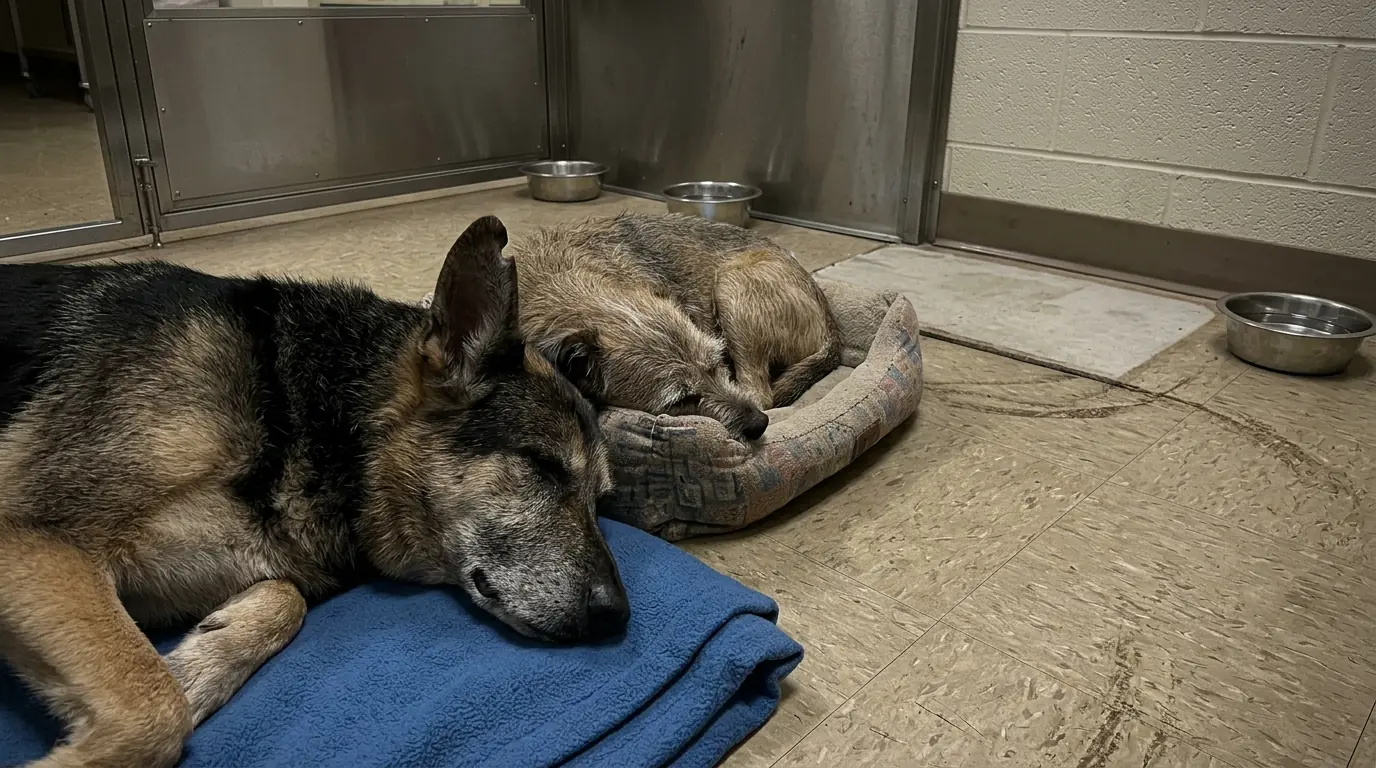
They Had Already Learned to Stay Close Before Anyone Found Them
By the time Maggie and Ben were brought into our rescue, both dogs looked as though the previous several days had taken a considerable toll.
Maggie, an older Shepherd mix, and Ben, a senior Terrier mix, had been found wandering together after days of persistent rain.
We do not know where they had come from.
We do not know how long they had been together before they were seen.
And although their condition raised understandable questions, we could not verify whether they had become lost, been left behind, or had been living outdoors for a longer period.
What rescuers could document was much simpler.
They were wet.
They were tired.
Maggie's back legs were weak enough that she occasionally lowered her hindquarters when she tried to remain standing.
Ben was extremely thin beneath his rain-soaked coat.
And despite their different physical problems, the two dogs stayed remarkably close to one another.
When the person who found them first approached, Ben moved several steps ahead.
Maggie followed slowly.
When Maggie stopped, Ben stopped too.
Neither dog acted aggressively, but neither seemed ready for a stranger to walk straight up and grab a collar.
The rescuer turned sideways, kept some distance, and tossed small pieces of food onto the ground.
Ben approached first.
Maggie watched.
Once Ben began eating, she came closer.
That became the first of many moments in which staff would notice that one dog's behavior seemed to influence the other.
Getting Maggie Into Safety Took More Time
Ben could walk independently despite his poor body condition.
Maggie had more trouble.
Her rear legs were not paralyzed, but they lacked strength and stability. On the wet ground, her paws occasionally slipped, and she compensated by shifting more weight forward.
Instead of forcing her to walk a longer distance, rescuers brought the vehicle as close as safely possible.
A slip lead was placed on Ben first.
Maggie was allowed to sniff another lead before it was gently secured.
Because of her weakness, staff used a supportive sling beneath her abdomen during the short movement to the vehicle.
Ben climbed in with assistance.
Maggie hesitated at the threshold.
Then she heard Ben moving inside.
She turned her head toward the sound and stepped forward.
With support under her hindquarters, she entered.
They rode to the rescue together.
Intake Immediately Revealed Two Very Different Medical Priorities
Both dogs needed medical evaluation, but for different reasons.
Ben's most obvious concern was his weight.
His ribs and spine were prominent, and there was visible loss of muscle over his hips and shoulders. Staff could feel very little padding beneath the skin.
He was hungry, but that did not mean we could simply place a large bowl in front of him and allow unrestricted eating.
Severely underconditioned dogs need a thoughtful nutritional plan.
Maggie was thin as well, though not nearly to Ben's degree.
Her greater concern was mobility.
When she walked across the examination room, her front legs moved normally, while her rear steps were shorter and less stable. She sometimes dragged a hind toe briefly before correcting the foot.
She was also unusually unresponsive when a staff member spoke from one side of her.
That observation led to another finding.
Maggie had substantial hearing loss in one ear.
Maggie Could Hear, but Not Equally From Both Sides
Our veterinarian examined Maggie's ears carefully.
There was no large foreign object blocking the canal, and there was no simple problem that could be immediately corrected during intake.
Further evaluation supported significant unilateral hearing impairment.
Maggie retained useful hearing on the opposite side.
That distinction became important almost immediately.
A dog who hears well from only one side can have difficulty locating where a sound originates.
Someone approaching from the impaired side may seem to appear without warning.
A bowl being placed down outside the dog's stronger hearing field may not get the same response.
And in an unfamiliar environment, the inability to orient accurately to sound can contribute to vigilance and poor sleep.
We could not determine precisely when Maggie's hearing loss had developed.
It may have been longstanding.
It may have progressed gradually.
What mattered for her current care was learning how to approach her in ways that did not repeatedly startle her.
Her Weak Hind Legs Needed a Separate Investigation
Hearing loss did not explain Maggie's mobility problems.
Her neurologic and orthopedic examinations were therefore performed separately.
She remained able to bear weight through both hind limbs.
There was no obvious acute fracture.
Her hips and knees were evaluated for pain and instability, and her spine was palpated carefully.
Because she was a senior dog with significant hind-end weakness, radiographs were appropriate.
Imaging showed chronic degenerative changes consistent with age-related orthopedic disease, including arthritis affecting areas that could reasonably contribute to stiffness and reduced mobility.
The findings did not support an acute catastrophic injury.
Her severe weakness also appeared to reflect poor conditioning.
A dog who has lost muscle cannot compensate for arthritic joints as effectively as a well-conditioned dog.
Maggie's treatment plan therefore focused on several things at once: pain control, safe movement, improved footing, gradual strengthening, and maintaining a body weight that would not place unnecessary strain on her joints.
She did not need emergency surgery.
She needed time.
Ben's Hunger Had to Be Managed Carefully
Ben's examination raised a different set of questions.
Why was he so thin?
We could not answer that by appearance alone.
Bloodwork was performed to evaluate his red and white blood cells, kidney and liver values, protein levels, electrolytes, and other indicators of systemic illness.
A fecal sample was submitted for parasite testing.
Urinalysis was also performed as part of his senior evaluation.
Nothing in the initial testing pointed to one dramatic disease as the sole explanation for his low weight.
He did have significant loss of muscle and body fat, and his nutritional history was unknown.
That meant controlled feeding was still the safest starting point.
Ben was offered smaller, measured meals divided throughout the day.
Staff monitored how quickly he ate, whether he vomited, how his stool responded, how much water he drank, and whether his energy level changed as calories increased.
His meals were supervised separately.
That detail became necessary almost immediately.
Ben Ate as Though Every Bowl Might Disappear
Ben was not aggressive around food.
But he was intense.
The moment a bowl reached the floor, he began eating quickly.
He finished before Maggie and immediately searched the surrounding area for anything else edible.
That did not make him a "bad" dog.
It meant his feeding behavior needed management.
We did not know what his previous access to food had been, and we were not going to invent a history to explain it.
We simply responded to what we saw.
Ben was fed where he could eat without competition.
Slow-feeding strategies were introduced when appropriate.
Staff remained nearby to monitor him.
Once he finished, he was prevented from reaching Maggie's meal.
Maggie, meanwhile, was given enough time to eat at her own pace.
For the first several days, meals were clinical.
Measured food.
Written intake.
Stool monitoring.
Weight checks.
But at night, another part of their relationship began revealing itself.
Their Medical Kennel Had Two Beds
Because both dogs required monitoring, they were placed in a quiet medical recovery area rather than the general kennel population.
They were housed together because neither had shown behavior suggesting that shared housing was unsafe, and both appeared calmer with the other nearby.
The enclosure was large enough to provide separate resting areas.
Maggie received a thick orthopedic bed with a low edge that she could step onto without lifting her hind legs very high.
Ben had his own padded bed several feet away.
Nonslip mats covered the walking areas.
Water remained in a fixed location.
Staff intentionally left clear paths so Maggie would not have to maneuver around unnecessary objects.
The first evening, both dogs settled after the final medication and bathroom break.
When staff checked them later, something had changed.
Ben's bed was no longer where it had originally been placed.
It had shifted closer to Maggie.
At first, nobody thought much about it.
Beds move.
Dogs scratch at blankets.
They circle.
They push bedding while getting comfortable.
The next night, it happened again.
Ben Kept Moving to Maggie's Hearing Side
Maggie had one ear with substantially better hearing.
Staff had already begun approaching her primarily from that side whenever possible.
Ben apparently preferred that side too.
During overnight observations, he repeatedly repositioned his bedding until he was lying beside Maggie on the side from which she could still hear well.
Sometimes he moved the entire lightweight bed.
Sometimes he pulled the bedding partly out of it.
Sometimes he simply abandoned his assigned bed and settled on a blanket beside hers.
The exact arrangement varied.
The side did not.
Ben usually ended up near Maggie's better-hearing ear.
We could not say whether he understood her hearing impairment in any human sense.
There was no way to know that.
But we could describe the pattern.
And there was another piece.
Maggie slept differently once he settled there.
Maggie Was a Light Sleeper Without Him Beside Her
During her earliest nights in medical care, Maggie rested but did not always sleep deeply.
Small noises made her lift her head.
A kennel latch.
Footsteps.
A cart moving down the hall.
If the sound came from the side she heard poorly, she sometimes turned sharply as though trying to determine what had happened.
The medical area was kept as quiet as practical, but a rescue facility can never be completely silent.
When Ben was still moving around the enclosure, Maggie remained particularly alert.
She watched him.
She repositioned.
She lifted her head repeatedly.
Then Ben would lie down near the side of her stronger ear.
Within a short time, Maggie's posture changed.
Her head lowered.
Her muscles relaxed.
Eventually she stretched onto her side.
That deeper resting posture appeared consistently enough for staff to note it in her behavioral record.
Nobody needed to claim that Maggie "couldn't sleep without Ben."
She did sleep at other times.
But her deepest, least vigilant nighttime rest frequently followed his settling beside the side where she could still hear him.
We Changed the Room Instead of Trying to Change Them
Once the pattern became clear, caregivers stopped placing Ben's bed across the enclosure.
There was little reason to make him move it every night.
We repositioned the beds so Ben could settle naturally beside Maggie's stronger-hearing side while both dogs still had enough room to move freely.
That small change reduced nighttime shifting.
It also gave Maggie a predictable resting arrangement.
For a senior dog with hearing impairment, limited mobility, and an unknown recent history, predictability can matter enormously.
Her bed stayed in the same location.
Ben's stayed near it.
The water bowl stayed put.
Caregivers approached from her hearing side whenever practical and spoke before touching her.
If staff had to approach from the other direction, they made sure Maggie could see them first.
Within several nights, her sleep became less fragmented.
Pain Management Helped Maggie Move More Comfortably
Maggie's veterinary team started an appropriate pain-management plan for her chronic orthopedic discomfort.
Because pain medication in older dogs should be chosen with medical history and laboratory results in mind, treatment was based on her examination and screening tests rather than automatically giving the same drug used for every arthritic dog.
Staff monitored her appetite, stool, activity, and general comfort after medication began.
Her movement remained restricted to what she could safely handle.
Initially, bathroom trips were brief.
A support sling was available when she appeared fatigued.
Nonslip surfaces were essential.
We were not trying to make Maggie walk far.
We were trying to make the walking she needed to do safer and more comfortable.
Within the first week, she began standing with slightly less effort.
She still had weakness.
She still needed time to get her hind legs positioned underneath her.
But she stopped lowering herself as frequently during short trips.
That allowed us to begin thinking about gentle rehabilitation.
Ben's Progress Was Measured in Ounces, Not Miracles
Ben did not suddenly look healthy after several meals.
Weight restoration does not happen that way.
He was weighed on a regular schedule, with staff looking at the trend rather than celebrating every small daily fluctuation.
His portions increased gradually according to his tolerance and veterinary plan.
His stool remained stable.
He stayed hydrated.
His bloodwork did not reveal a reason to stop advancing nutrition.
Slowly, his weight began increasing.
But his behavior around food took longer to change.
He still watched caregivers carrying bowls.
He still ate rapidly.
He still checked the floor after meals.
For safety, supervised feeding continued.
One week of predictable meals was not enough to erase a strong food-seeking pattern.
There was no need to rush it.
The Dogs Began Developing Separate Daytime Routines
One of our goals was to support their bond without making either dog's entire recovery dependent on the other.
During the day, Ben and Maggie began spending short periods apart.
Ben might go for his veterinary check while Maggie remained resting.
Maggie might participate in a brief mobility session while Ben worked on calm food enrichment elsewhere.
At first, Maggie often looked toward the doorway when Ben left.
Ben sometimes paused outside the enclosure and turned back.
Neither dog showed severe panic.
That was useful information.
They were strongly connected, but they could tolerate manageable separation.
When Ben returned, he typically walked directly toward Maggie.
She usually sniffed him and then settled again.
At night, however, the old arrangement remained.
Ben slept on her hearing side.
Rehabilitation for Maggie Started With Very Little
Maggie's early rehabilitation would not have looked impressive on video.
That was the point.
Her body was not ready for impressive.
The first exercises involved controlled standing on stable footing.
Short walks.
Slow weight shifting.
Careful turns.
The veterinary team monitored for pain, knuckling, dragging, worsening weakness, or fatigue.
When she looked tired, the session ended.
As her comfort improved, the distance increased gradually.
Maggie began using both hind limbs with better consistency.
She remained a senior dog with chronic orthopedic disease.
Nothing about treatment erased that.
But greater strength could help her compensate for what could not be cured.
Her caregivers also learned something about motivation.
Maggie was not especially interested in moving for toys.
Food worked sometimes.
Ben worked surprisingly often.
If he walked slowly ahead with a caregiver, Maggie frequently followed.
We used that sparingly.
The goal was not to make Ben responsible for her physical therapy.
But his presence sometimes gave her a familiar reason to take the next few steps.
Ben Had His Own Senior-Dog Concerns
As Ben gained weight and became more active, we were able to evaluate him more accurately.
Severe thinness can hide other problems because weakness dominates everything.
He had mild age-related stiffness but remained more mobile than Maggie.
His dental examination showed disease that would eventually need attention once his overall condition was stable enough for an elective anesthetic procedure.
That was not urgent on the first day.
Nutrition came first.
Medical stability came first.
Once he had gained enough weight and repeat evaluation supported moving forward safely, dental treatment could be scheduled according to veterinary recommendations.
This staged approach is common in rescue medicine.
Not every problem needs to be solved on intake day.
Some treatments are safer after the dog is stronger.
One Night Ben Didn't Move His Bed
About two weeks into recovery, staff noticed something unusual.
Ben was tired after a day that included a veterinary recheck and slightly more activity than usual.
That evening, he ate his meal and went directly to his bed.
The bed had been positioned near Maggie's good-hearing side, as usual.
But during cleaning earlier that day, it had been placed slightly farther away than normal.
Ben did not move it.
Maggie settled on her own bed.
For several minutes she remained upright.
She looked toward the hallway.
Then toward Ben.
Ben was already asleep.
Maggie eventually lowered her head.
She slept.
Nothing bad happened.
It was a useful reminder that the behavior we had observed was a preference and routine, not proof that Maggie was incapable of resting without his active assistance.
The following night, however, Ben was more energetic.
He pawed at his bedding.
He pushed.
He turned twice.
And he ended up right beside her hearing ear again.
Their Foster Placement Needed Room for Two Different Seniors
Once both dogs were medically stable enough to leave the recovery ward, we looked for a foster home that could accommodate them together.
The household needed more than affection.
It needed practical features.
Minimal stairs.
Good traction.
Space for two separate feeding stations.
An understanding of controlled weight restoration.
A willingness to manage a dog with unilateral hearing loss.
Experience with older dogs was preferred.
Most importantly, the foster caregiver needed to understand that Maggie and Ben could be closely bonded without being treated as one animal.
They had separate medical plans.
Separate food requirements.
Separate medications and monitoring.
They simply preferred to remain near each other.
A suitable foster family opened its home.
Ben Found the Correct Side on the First Night
The foster caregiver set up two beds in the living room.
Maggie's orthopedic bed was positioned against a wall where she would not need to worry about movement behind her.
Her better-hearing ear faced into the room.
Ben's bed was placed nearby.
Not touching.
Just close.
During the first evening, both dogs explored slowly.
Ben sniffed almost everything.
Maggie moved more cautiously and needed help with one slippery transition before additional floor runners were put down.
After dinner, the house grew quiet.
Maggie settled.
Ben walked around his bed twice.
Then he pulled at the blanket with his front paws.
He turned the bedding until his body was positioned beside Maggie's stronger-hearing side.
His foster caregiver had been told about the pattern.
Seeing it happen in a completely new environment made the earlier observations feel even more significant.
Again, we could not know his intention.
But the preference had traveled with them.
Maggie Learned the Sounds of a House
A rescue medical ward has its own noises.
A foster home has others.
Dishwasher.
Television.
Refrigerator.
Front door.
A neighbor's lawn equipment.
Rain against windows.
Because Maggie heard poorly on one side, new sounds sometimes caused her to search for their source.
Her foster family quickly adopted the same handling strategies used at the rescue.
They approached where she could hear them when possible.
They did not wake her by unexpectedly touching the deaf side.
They used gentle vibration through the floor or moved into her visual field if necessary.
Within days, Maggie became less watchful.
The house developed a pattern.
Morning bathroom trip.
Breakfast.
Medication.
Rest.
Short walk.
More rest.
Predictability helped.
So did Ben.
Ben's Eating Behavior Slowly Became Less Urgent
Foster care gave Ben something a busy medical ward could not fully provide: weeks of ordinary, repetitive meals in the same calm location.
He remained separated from Maggie while eating because that was the safest way to make sure both dogs received exactly what they needed.
At first, he finished rapidly.
Over time, food enrichment and slower feeding techniques helped reduce the pace.
He still loved meals.
He still arrived immediately when he heard food being prepared.
But he began leaving the bowl after finishing rather than searching obsessively around Maggie's feeding space.
One morning, he finished and walked into the living room without checking her dish at all.
His foster caregiver noticed because it was the first time.
Not a dramatic breakthrough.
Just a small indication that food was becoming predictable.
Maggie's Stronger Legs Changed the Way They Moved Together
As rehabilitation continued, Maggie became more capable.
She still had an uneven gait.
She still needed caution on slippery surfaces.
She still had days when stiffness was more noticeable after rest.
But she no longer needed the support sling for every outing.
Her walks increased in duration slowly.
Ben often went with her.
At first, he had naturally moved faster and then waited.
Later, Maggie could keep a steadier pace.
The two senior dogs began walking side by side for longer stretches.
Their foster caregiver did not push distance.
A slow ten-minute sniffing walk could be more useful than a long outing that left Maggie sore.
Some days were shorter.
Weather mattered.
Energy mattered.
Arthritis is not identical every morning.
Their plan remained flexible.
Their Bond Became Easier to Understand When They Felt Better
In the medical ward, nearly everything Maggie and Ben did was filtered through illness, exhaustion, hunger, and unfamiliarity.
In foster care, personality emerged.
Ben was curious.
He liked investigating grocery bags, although they were kept safely out of reach.
He learned that the sound of a treat jar was worth waking up for.
He enjoyed soft toys but had little interest in retrieving them.
Maggie was quieter.
She preferred watching household activity from a comfortable bed.
She liked slow chest scratches and would gently lean into a familiar caregiver.
She did not like being approached suddenly from her impaired-hearing side, but once people understood that, interactions became much easier.
They did not spend every minute together.
Ben sometimes slept in another room.
Maggie sometimes chose a sunny patch by herself.
Their bond was strongest in transitions.
New places.
Nighttime.
Unfamiliar sounds.
That was when they tended to find one another.
Adoption Planning Had to Preserve What Was Working
Eventually, both dogs reached the point where long-term placement could be discussed.
Ben's weight had improved significantly, although maintaining a healthy condition would remain important.
His future dental care and routine senior monitoring were clearly documented.
Maggie's mobility had improved, but she would always need a home willing to accommodate chronic orthopedic limitations.
Her hearing loss was also unlikely to disappear.
Neither condition prevented her from having a good quality of life.
It simply shaped the kind of environment that suited her.
We decided to seek placement for Maggie and Ben together.
Could they survive apart?
Probably.
That was not the standard we wanted to use.
We had watched them through medical recovery.
We had watched Ben choose Maggie's hearing side night after night.
We had watched Maggie rest more deeply when he settled.
We had watched them tolerate brief separation while continuing to seek each other afterward.
Their behavior suggested that keeping them together offered meaningful stability.
After everything else in their lives had changed, we saw no benefit in removing that.
Their New Family Was Prepared for the Details
The family eventually selected for them understood that adopting a bonded senior pair was not the same as adopting two young, healthy dogs.
They discussed Maggie's flooring needs.
They learned how to approach her from the side where she could hear.
They understood that she might need long-term pain management and periodic reassessment of her mobility.
They reviewed Ben's feeding routine and his weight history.
They agreed to continue separate meals.
They understood the need for regular senior veterinary care.
Most of all, they understood that Ben was not Maggie's medical device.
He did not exist to guide her.
Maggie was not responsible for managing Ben's food anxiety.
They were two individual dogs who happened to have developed a deeply consistent way of sharing space.
The First Night in Their Permanent Home Repeated the Story One More Time
Their new family set Maggie's bed against a quiet wall in the bedroom.
Her stronger-hearing side faced into the room.
Ben's bed was placed beside hers.
The family expected him to use it.
He had other ideas.
He circled.
Scratched at the blanket.
Pushed the lightweight bed several inches.
Then he lay down in the narrow space closest to Maggie's hearing ear.
Maggie remained upright for a while.
New houses contain unfamiliar sounds even when they are quiet.
Air vents.
Plumbing.
Floorboards.
A distant car.
Ben shifted once.
His collar tags made a faint sound.
Maggie's head turned toward him.
Then she lowered it to the bed.
Within minutes, both dogs were asleep.
The Meaning of That First Medical-Kennel Night Changed With Time
When staff first saw Ben moving his bed, it seemed almost accidental.
Then it happened again.
And again.
We became careful observers because rescue work requires that distinction.
We do not know if Ben understands that Maggie has one ear that works better than the other.
We cannot know whether he consciously chooses that side for her benefit.
What we know is observable.
Given the choice, he repeatedly settles there.
Maggie frequently rests more deeply after he does.
That behavior followed them from a medical kennel to foster care and then into a permanent home.
But something else has changed.
Maggie no longer startles at every nighttime sound.
She knows the rhythm of the house.
Her legs are stronger than they were when she arrived soaked and exhausted after days of rain.
She can rise from her bed more comfortably, walk outside at her own pace, and return without needing support every time.
Ben no longer looks as though every missed meal could become an emergency.
He has regained weight.
He eats measured portions.
He finishes, drinks some water, and usually walks away.
Their medical problems have not vanished.
They are senior dogs.
Maggie still has chronic mobility limitations.
She still hears the world unevenly.
Ben still needs his weight monitored, and age will bring its own changes for him.
Their family understands that.
There was never going to be a perfect ending in which two older dogs became young again.
That was not what they needed.
They needed stability.
He Still Chooses the Same Side
These days, Ben does not have to drag a bed across a medical kennel.
His family already knows where to put it.
Maggie's bed stays in its familiar place.
Ben's goes beside the ear that can still hear him most clearly.
Some nights he climbs into his own bed immediately.
Other nights he rearranges the blanket first.
Maggie may already be asleep.
Sometimes she is still watching the room.
Ben turns a few circles.
He lies down.
There may be the quiet sound of his paws against bedding or the small movement of his collar.
Maggie's ear shifts toward him.
Then her head lowers.
Eventually, the room becomes still.
We found Maggie and Ben at a point when neither dog's body was doing particularly well.
One struggled to move.
The other desperately needed nutrition.
Their recovery required veterinary testing, pain control, controlled feeding, rehabilitation, careful handling, foster care, and weeks of observation.
Yet the detail everyone remembers is much smaller.
A little senior Terrier moving his bed.
Not randomly across the room.
Not to the door.
Not closer to the food.
Night after night, he moved it beside the one side where Maggie could still hear him.
Now nobody moves it back.