The first warning appeared while Evelyn Hart was stopped beneath a red light on Fifth Avenue.
It was so ordinary that she almost ignored it.
A small amber engine symbol illuminated near the center of the digital instrument panel. Evelyn glanced at it, frowned, and looked back through the windshield. Morning traffic crawled south beneath a pale Manhattan sky. Delivery trucks double-parked along the curb. Yellow taxis squeezed through openings that seemed too narrow to exist. Pedestrians crossed before the signal changed, carrying coffee, shopping bags, briefcases, and the particular impatience of people who had already decided they were late.
Her car had fewer than five thousand miles on it.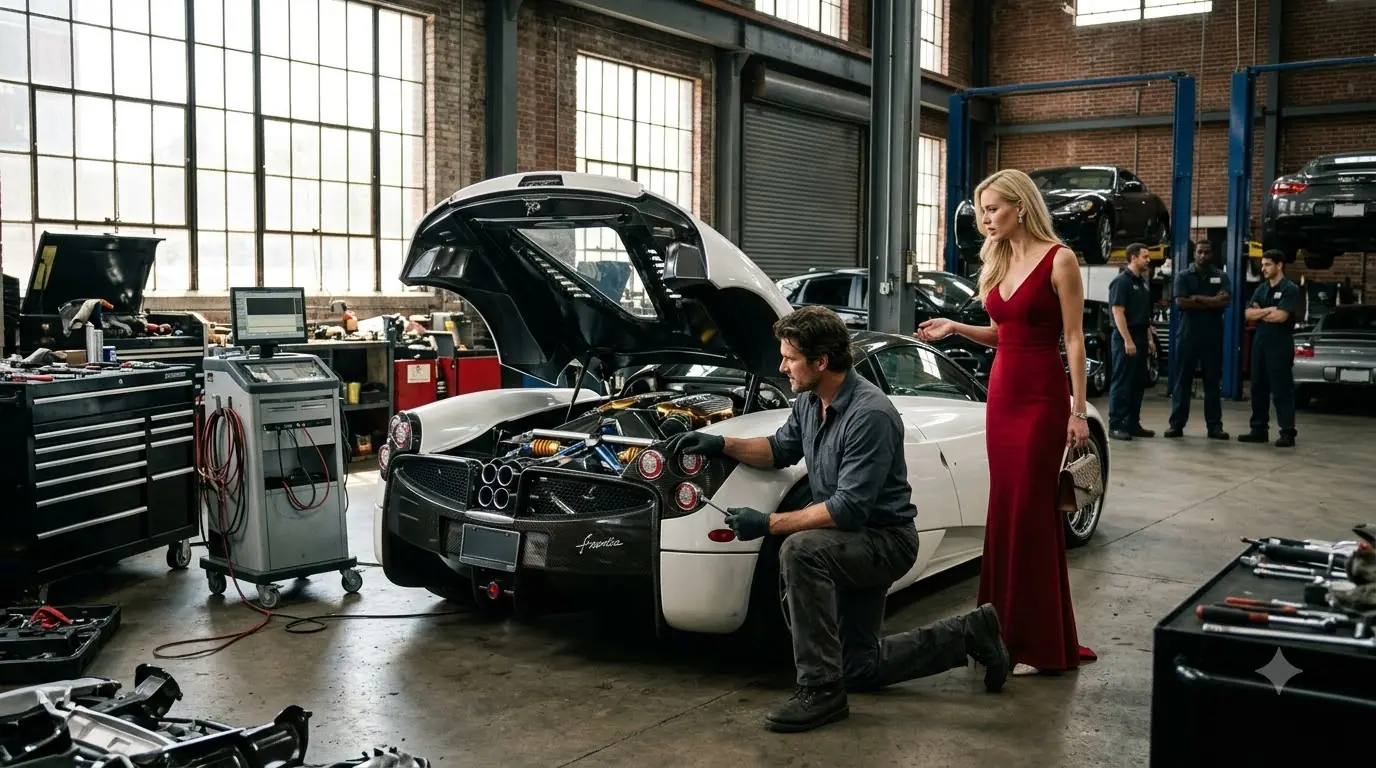
The white Italian supercar had been delivered less than six months earlier, after nearly a year on a waiting list. Evelyn had not bought it because she collected cars. She did not. She had bought it because her father once kept an old photograph of a similar machine taped above his workbench in Queens. He had spent forty years repairing industrial equipment and had never owned anything remotely exotic.
When Evelyn was twelve, she asked why the photograph was there.
Her father had answered, “Because somebody looked at a pile of metal and asked what it could become.”
He died before seeing what his daughter eventually became.
At forty, Evelyn was the founder and chief executive of Hartwell Infrastructure Group, a privately held engineering and logistics company employing more than eight thousand people across the United States. She spent most days surrounded by contracts, construction schedules, investors, compliance teams, and executives who could turn a three-minute answer into a fifty-slide presentation.
The car was one of the few things she had bought simply because she wanted it.
That was why the warning irritated her.
It did not frighten her.
Not yet.
The traffic light turned green.
Evelyn touched the accelerator.
The car moved perhaps twenty feet.
Then every warning on the dashboard illuminated at once.
Engine system.
Transmission.
Drivetrain.
Electrical failure.
Stability control.
Battery management.
A red warning appeared beneath all of them.
STOP VEHICLE SAFELY.
The engine died before Evelyn could do anything.
The steering became heavy.
The white supercar rolled to a stop in the middle lane of Fifth Avenue while Manhattan continued moving around it.
A taxi behind her leaned on the horn.
Then another.
A delivery van driver threw both hands into the air.
Evelyn pressed the ignition.
Nothing.
She tried again.
A mechanical click.
Silence.
“Seriously?”
Another horn screamed.
She reached for the hazard lights.
The dashboard continued glowing like a disaster report.
A bus crawled past close enough that Evelyn could see passengers looking down through the windows. One man raised his phone.
Wonderful.
By lunch, someone would probably post a video of a woman in a red designer dress sitting inside a dead six-figure car while thirty taxi drivers reconsidered every decision that had brought them to New York.
Evelyn pulled out her phone.
Her executive assistant answered immediately.
“Claire.”
“I have a problem.”
There was a pause.
Claire Navarro had worked for Evelyn for eight years and had learned that her employer rarely opened conversations that way.
“What kind?”
“I am sitting in the middle of Fifth Avenue.”
Another pause.
“Are you injured?”
“No.”
“Is someone threatening you?”
“Only approximately four hundred New Yorkers.”
Claire understood.
“The car.”
“The car.”
“I thought that thing cost—”
“Do not finish that sentence.”
“I’ll call roadside assistance.”
“Dealer first.”
Evelyn looked at the dead instrument cluster.
“And Claire?”
“Yes?”
“Find out whether humiliation qualifies as a warranty repair.”
Claire laughed.
Evelyn did not.
Not yet.
The dealership sent a flatbed within forty-eight minutes, which Evelyn later learned was considered extraordinarily fast.
It did not feel fast while she stood on the sidewalk watching strangers photograph her car.
The driver was professional, apologetic, and careful. He loaded the vehicle without incident and told Evelyn it would be taken directly to Bellamy Prestige Motor Group’s flagship service center on West Fifty-Second Street.
Bellamy had sold her the car.
Their showroom resembled an art museum more than a dealership. Limestone floors. Floor-to-ceiling glass. Espresso machines that probably cost more than Evelyn’s first apartment. Sales consultants wearing tailored suits. Vehicles presented beneath individual pools of light as if they were sculptures.
The service center was even more polished.
Evelyn arrived shortly after four.
A young receptionist greeted her by name before she reached the desk.
“Ms. Hart, we’ve been expecting you.”
“Good. Then somebody can explain why the car died.”
“Of course.”
The woman’s smile remained perfect.
“Our regional technical team is already reviewing it.”
“Regional?”
“Yes. Because of the vehicle’s low mileage and the severity of the diagnostic codes, the service director escalated the case.”
That sounded reassuring.
It should have.
Instead, Evelyn noticed something strange.
Nobody seemed surprised.
Not worried.
Not curious.
The car had supposedly experienced a catastrophic failure at fewer than five thousand miles, yet the atmosphere felt less like emergency diagnosis and more like paperwork processing.
She followed the receptionist into a conference room overlooking the service floor.
Her car sat below with the rear engine compartment open.
Seven men gathered around a diagnostic cart.
Seven.