The first truck arrived at Whitlock Farm at 7:12 on a Tuesday morning, carrying twenty tons of what nearly everyone in Gaines County considered garbage.
Peanut hulls.
Dry, pale, papery shells rose above the truck bed in a mound almost level with the cab.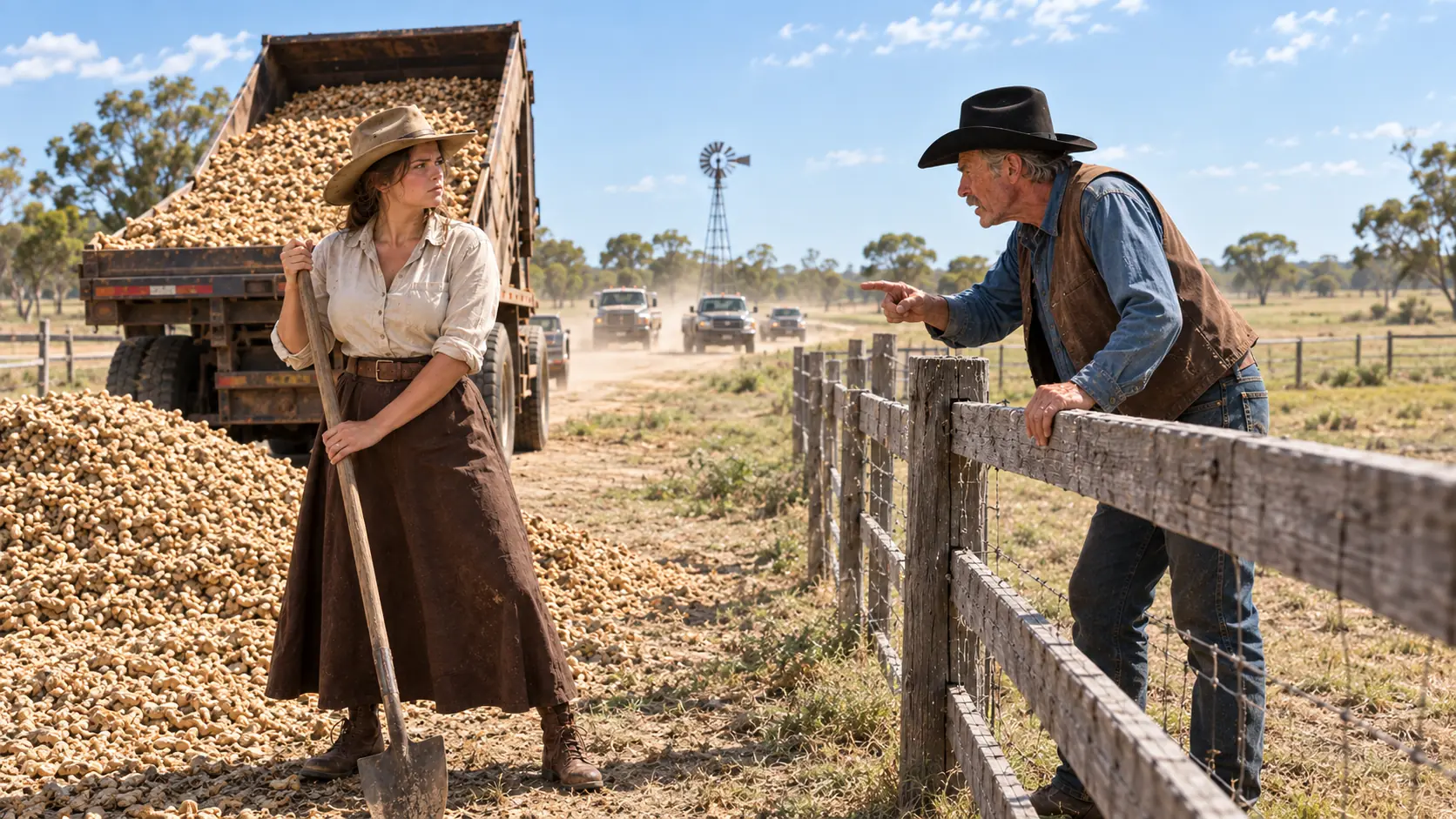
When the driver lifted the hydraulic bed, they poured onto Clara Whitlock’s south field with a rushing sound like brittle rain.
Clara stood twenty feet away with both hands wrapped around the handle of a wooden shovel.
At twenty-nine, she was younger than almost every farmer who owned land along County Road 214.
She was also one of the few women farming alone.
People noticed both facts.
They noticed everything else too.
Her long brown hair was tied into a messy braid beneath a faded tan work hat. Her face had been browned by the West Texas sun despite the sunscreen she habitually forgot to reapply, and her cream work shirt was already stained with dust before breakfast.
She had an athletic, balanced build earned from hauling feed bags, lifting irrigation pipe, climbing tractor steps, and working too many hours because hiring another full-time employee remained something the farm could not afford.
She had inherited one hundred eighty-three acres.
On paper, that sounded like wealth.
In reality, Clara had inherited one hundred eighty-three acres of exhausted soil, a forty-year-old equipment shed, two tractors in different stages of mechanical decline, a farmhouse needing a roof, and enough debt to make every sunrise feel financed.
Her father had died fourteen months earlier.
Heart attack.
Fifty-eight years old.
He had been repairing a broken cultivator when it happened.
Clara found him beside the machine.
For months afterward, she could not walk past that corner of the equipment yard without noticing exactly where his boots had been.
People in town expected her to sell.
The bank expected her to consider it.
Her father’s friends expected her to admit that running the farm alone was unrealistic.
Clara had done none of those things.
Instead, she had spent the winter studying dirt.
Not crops.
Dirt.
That distinction confused people.
Farmers in the county had spent generations discussing cotton prices, peanut contracts, diesel, herbicides, irrigation wells, fertilizer, labor, hail, insurance, and weather.
Soil usually entered the conversation as something crops grew in.
Clara had started treating it as something alive.
That was why the first truckload of peanut hulls was spreading across her field when Silas Crowe pulled his pickup onto the shoulder.
Silas was sixty-four.
He owned nearly twelve hundred acres adjoining Clara’s western boundary.
Lean, weathered, and permanently suspicious, he wore a black felt cowboy hat, faded denim shirt, brown leather vest, dusty jeans, and boots polished only by use.
He leaned one forearm across the top rail of the old cedar fence separating their properties.
Then he stared at the pile.
“What in God’s name is that?”
Clara continued shoveling.
“Morning, Silas.”
“I asked what that is.”
“You know what peanut hulls look like.”
“I know what trash looks like too.”
Clara drove the shovel into the pile.
Silas watched another truck appear in the distance.
His eyebrows rose.
“There’s more?”
“Eight loads today.”
“Eight?”
“Maybe nine if the shelling plant finishes early.”
Silas laughed.
Not kindly.
“Your father would climb out of his grave if he saw this.”
Clara’s hands stopped.
Only for a second.
Then she continued.
Silas noticed.
He should have apologized.
He didn’t.
Instead, he pointed across the field.
“You understand this is farmland, don't you?”
“Yes.”
“Looks like you're building a landfill.”
“Good thing you're not paying for it.”
Silas’s mouth tightened.
“Banks are.”
Clara looked toward him.
“What?”
“You still owe First Plains.”
“So?”
“So they tend to care when collateral gets covered in waste.”
Clara rested both hands on the shovel.
“They’re peanut hulls, Silas.”
“They're agricultural refuse.”
“They're carbon.”
“They're garbage.”
“They're both, depending on whether you understand what happens after you spread them.”
Silas grinned.
“There she is.”
Clara frowned.
“Who?”
“The college girl.”
“I didn't go to agricultural college.”
“No, but you read enough books to talk like one.”
Clara looked toward the field.
The land had been planted in cotton for years before her father converted sections to peanuts and sorghum.
Heavy tillage.
Synthetic fertilizer.
Bare soil through most winters.
Each method had made sense individually.
Together, repeated for decades beneath relentless West Texas heat, they had slowly reduced the ground to something closer to pottery clay than healthy topsoil.
Clara had tested it herself.
Organic matter below one percent in some sections.
Water infiltration miserable.
Compaction beginning less than six inches beneath the surface.
Microbial activity low enough that the laboratory technician asked whether the sample had come from an active field or construction fill.
Clara had laughed when he asked.
Then cried in her truck.
Silas pointed toward the pile.
“What exactly do you think that's going to do?”
“Slow evaporation.”
“Eventually break down.”
“Feed microorganisms.”
“Add carbon.”