Maeve Gallagher had crossed an ocean for a man she did not know.
By the time the ship from Liverpool reached New York, she had learned that courage did not always feel like courage. Sometimes it felt like nausea, sleeplessness, and the stubborn refusal to admit that turning back was no longer possible.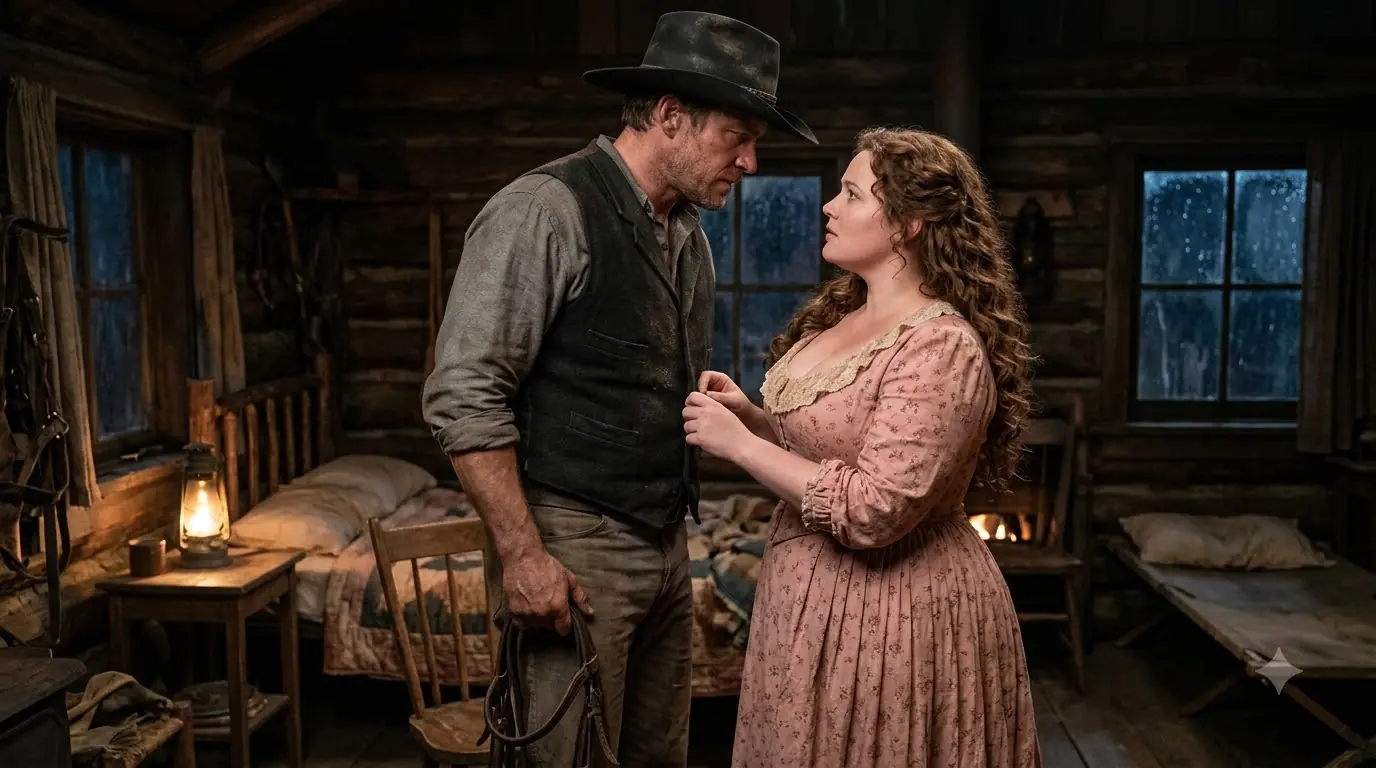
She had spent most of the voyage clutching the handle of a battered brown trunk that contained nearly everything left of her old life in Ireland. Two dresses. Her mother’s silver hair comb. A wool shawl patched at one corner. A small Bible she rarely opened but could not bring herself to leave behind. Three letters from the American West.
And one photograph of her father.
Maeve had been twenty-nine when the last familiar thing in County Clare disappeared from beneath her feet.
Her mother had been gone for years. Her father had died the previous winter after a short illness that had taken most of his strength before Maeve understood how serious it was. The cottage they rented belonged to another family, and when the lease ended, so did the illusion that grief would be allowed to wait politely while she decided what to do next.
Work was scarce.
Money was scarcer.
And Maeve had grown tired of hearing what people believed a woman like her should accept.
She was too large for this man.
Too outspoken for that family.
Too old to still be unmarried.
Too proud to take a position beneath a woman who had once been her schoolmate.
Too impractical to imagine that life might hold something beyond quietly shrinking herself until she became convenient.
Then came the letter from America.
The paper was thick, the handwriting restrained and surprisingly neat.
The man who wrote it called himself Callaway.
He lived on a cattle ranch in the mountains of Montana Territory, several days from the nearest railroad station and farther still from anything Maeve would have called a proper town. He was thirty-eight, unmarried, financially secure by frontier standards, and looking for a woman willing to share the work and perhaps, if both chose it after meeting, build a marriage.
There were no declarations of love.
No exaggerated promises.
No lines about beauty or destiny.
The plainness of it caught her attention.
He wrote that the ranch had a solid roof, good water, enough cattle to survive a bad winter, and more silence than most people could tolerate.
He wrote that he would pay her passage if she decided to come.
He wrote one sentence twice, once in the original letter and again in the final one before she sailed.
Nothing will be expected of you merely because you arrive.
Maeve had read that sentence so often the fold in the paper had nearly split through the words.
She had wondered whether it was kindness.
She had also wondered whether it was the kind of thing a man wrote because he knew it sounded safe.
In the end, desperation made the decision before trust did.
She sailed.
New York became Chicago, Chicago became a train headed west, the train became a stagecoach, and the stagecoach finally left her standing beside a snow-edged road with her trunk at her feet and mountains rising like walls around her.
That was where she first saw Callaway.
He was leaning against a dark bay horse beside a weathered wagon.
Tall.
Broad through the shoulders.
Sun-browned even in late autumn.
His hat shadowed a face that looked carved more by weather than age. Dark hair curled slightly beneath the brim. His jaw carried several days of stubble, and his eyes were a muted gray-green that seemed to take in everything before deciding whether any of it deserved comment.
He looked at Maeve.
Maeve looked at him.
Neither spoke.
Then his gaze moved to her trunk.
“You Maeve Gallagher?”
His voice was lower than she expected.
She lifted her chin.
“Unless another Irishwoman has crossed an ocean to freeze beside this road.”
Something almost happened at one corner of his mouth.
Not quite a smile.
“I’m Callaway.”
“I assumed so.”
He stepped forward and lifted her trunk as if it weighed little.
Maeve watched him carry it toward the wagon.
“You could at least pretend it’s heavy.”
He glanced back.
“Would that make you feel better?”
“Yes.”
He shifted the trunk dramatically and grunted.
Maeve stared at him.
Callaway stared back.
Then, to her surprise, she laughed.
The sound felt strange after months of grief.
Callaway looked away first, but she saw the brief curve of his mouth.
That was how it began.
Not with romance.
Not with passion.
With a bad performance over a trunk beside a frozen road.
The journey to the ranch took almost four hours.
Maeve had expected conversation.
Callaway offered very little.
He asked whether she was warm enough.
She said yes.
Ten minutes later, without mentioning it, he stopped the wagon and took an extra wool blanket from beneath the seat.
She noticed he did not place it around her shoulders himself.
He merely handed it over.
She took it.
“Thank you.”
He nodded.
Later he pointed toward a ridge.
“Storm comes over that side first.”
Maeve followed his gaze.
“Is that useful information or are you trying to frighten me?”
“Useful.”
“Good. I’ve had enough frightening information for one year.”
His hands tightened almost imperceptibly around the reins.
He did not ask what she meant.
Maeve found herself oddly grateful for that.
By dusk, the ranch appeared between the pines.