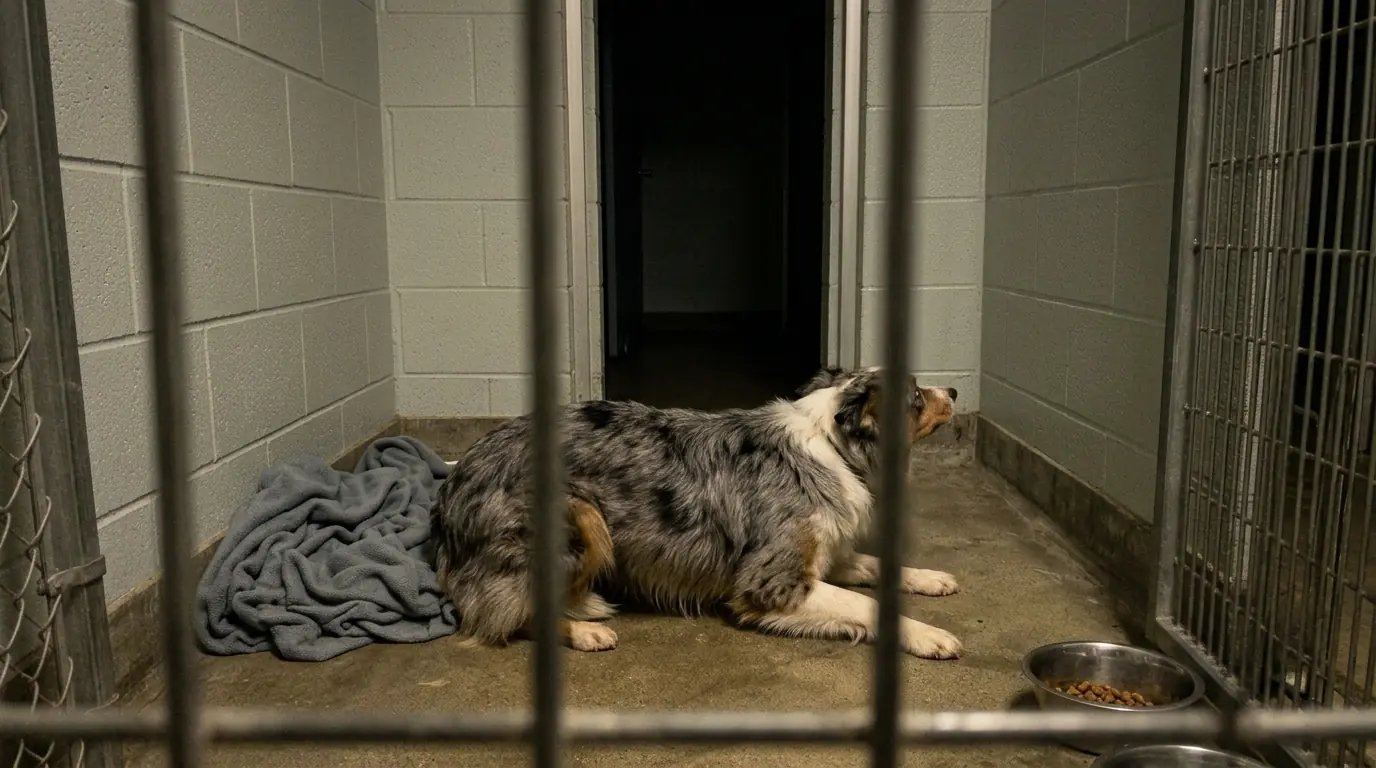
During the day, the Australian Shepherd can almost disappear into the back of her kennel.
She is four years old, but she does not move through the shelter with the restless curiosity people often associate with a young adult dog.
Instead, she curls herself tightly into the farthest corner.
Her body stays low.
Her back presses toward the wall.
Voices pass through the hallway.
Kennel doors open and close.
Metal bowls scrape against concrete.
And she remains where she is.
Sometimes food sits untouched only a short distance away.
Then evening comes.
The hallway empties.
The voices stop.
The metal noises disappear.
And only after the shelter becomes almost completely quiet does the Australian Shepherd begin to move.
Slowly, she crawls out of the corner.
She approaches the food.
She eats.
Then she turns around and retreats to the wall again.
At First, Staff Had to Wonder Whether She Was Eating at All
During busy hours, the bowl seemed to change very little.
A meal could be placed inside the kennel while the dog remained folded into the back corner.
She did not rush forward.
She did not circle the person carrying the food.
She did not approach as soon as the kennel door closed.
Instead, she waited.
Staff could leave.
Other people could pass.
The hallway could settle temporarily.
Still, she often remained hidden.
Then someone checking later would discover that the food had finally been eaten.
The question became obvious.
When?
The Pattern Became Clear After the Shelter Quieted Down
The Australian Shepherd was not simply refusing every meal.
She was waiting for a particular kind of environment.
During the day, the shelter was full of unpredictable stimulation.
Footsteps.
Conversation.
Dogs barking.
Latches moving.
Bowls being handled.
Doors opening.
Cleaning equipment.
People appearing and disappearing outside the kennel.
At night, much of that stopped.
That was when she emerged.
She Didn't Suddenly Become a Different Dog
The change was easy to exaggerate.
She did not wait until everyone left and then begin playing around the kennel.
She did not race toward her food.
She did not explore every corner with her tail wagging.
Her nighttime movement remained cautious.
First, her head appeared.
Then her shoulders.
Her body stayed low.
She moved a little farther.
Paused.
Listened.
Then continued toward the bowl.
Even in silence, she behaved as though she wanted the option to retreat immediately.
After Eating, She Usually Did Exactly That
She did not remain near the front of the kennel.
She did not settle beside the empty bowl.
Once she finished, she turned around.
Then she went back.
The same wall.
The same rear corner.
Her body pressed close to it again.
By morning, someone entering the medical or kennel area might see what looked like the same dog in the same position as the previous day.
Only the empty bowl showed that something had happened overnight.
Her History Made the Pattern More Understandable
Before entering the shelter, the Australian Shepherd had reportedly spent years living in near isolation inside a house crowded with belongings.
That background mattered.