Thirty-eight-year-old Naomi Carter moved into Willow Glen, a quiet suburban neighborhood outside Charlotte, North Carolina, because she wanted a place where her life could finally feel predictable. She owns her house, works as a project coordinator for a commercial landscaping company, and spends Saturday mornings maintaining the small yard herself.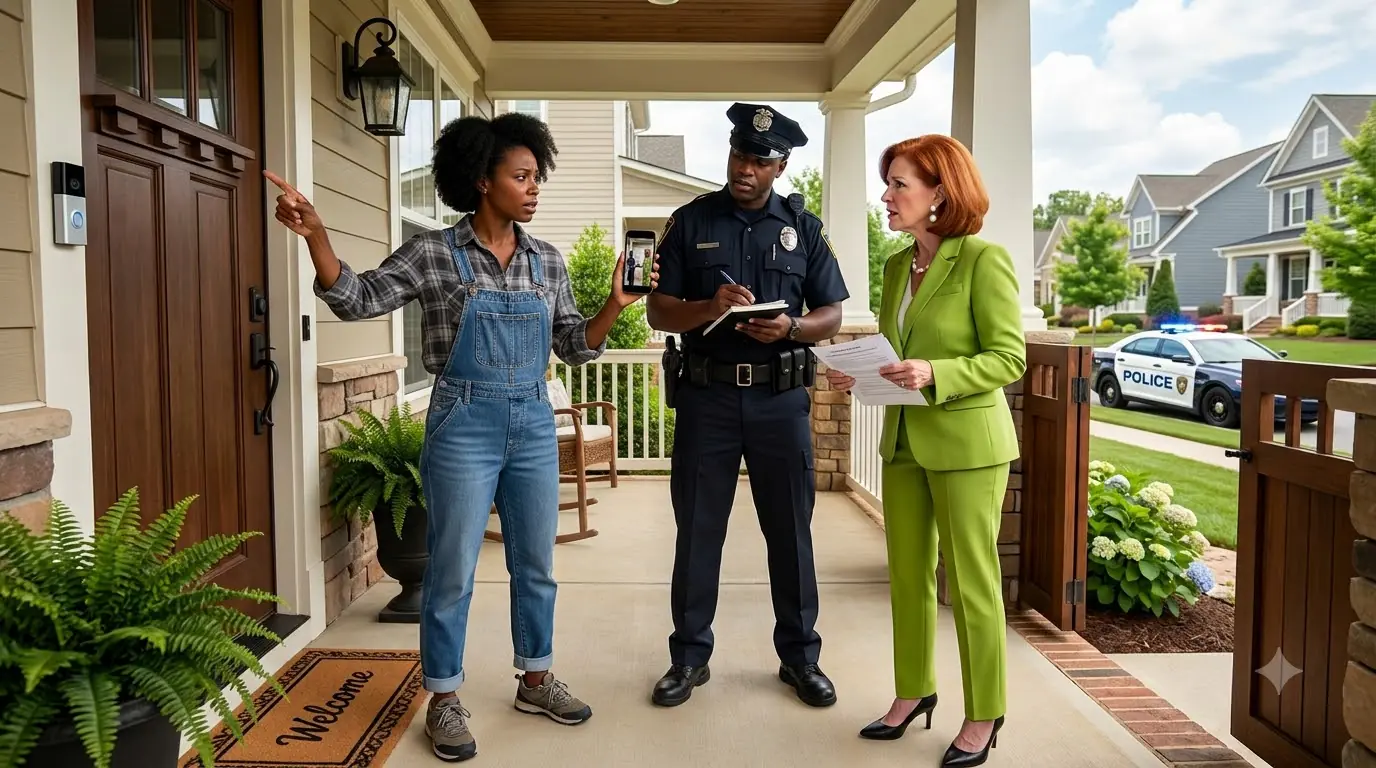
That routine puts her in conflict with Marjorie Vale, the red-haired president of the Willow Glen Homeowners Association.
Marjorie is known for enforcing neighborhood standards aggressively. She photographs trash cans left out after collection day, measures hedges, questions contractors, and has developed a habit of appearing at residents’ doors whenever she believes something needs immediate correction.
Naomi’s problem begins with something almost absurdly ordinary.
A leaf blower.
One Saturday morning, Naomi spends less than twenty minutes clearing leaves from her front porch and driveway. The neighborhood rules permit yard equipment during the morning hours, but Marjorie has recently begun pushing for a stricter noise policy that has not yet been approved by the HOA board.
Marjorie hears Naomi’s blower from two houses away.
Instead of filing a complaint, she walks directly to Naomi’s property wearing a bright lime-green suit and carrying an HOA notice she prepared herself.
Naomi turns off the blower and tells her that she is operating within the published rules.
Marjorie refuses to accept that answer.
She follows Naomi through the front gate, climbs onto the porch, waves the notice inches from her face, and demands that she surrender the leaf blower until an HOA hearing can be scheduled.
Naomi orders her to leave.
Marjorie becomes furious.
Then she strikes Naomi across the upper arm and shoulder and shoves her backward near the porch railing.
Naomi does not retaliate.
She steps away and tells Marjorie to get off her property.
Instead, Marjorie calls 911 and claims Naomi attacked her.
Officer Darius Cole arrives expecting a heated neighborhood dispute. Marjorie immediately positions herself as the victim, insisting Naomi became violent after receiving an HOA violation.
Naomi says very little.
She simply points toward the doorbell camera.
The footage changes the entire scene.
It shows Marjorie standing outside Naomi’s gate, entering without permission, following Naomi onto the porch, striking her first, and then calling police.
Officer Cole asks Marjorie to put her hands behind her back.
But the incident does not end with one arrest.
Naomi later discovers that Marjorie had no authority to issue the leaf-blower notice in the first place. The stricter noise proposal she cited had never been adopted.
Other homeowners begin checking their own notices.
They find a pattern of Marjorie entering yards without permission, personally confronting residents, and using proposed HOA rules as though they were already enforceable.
Naomi refuses to turn the situation into revenge.
She insists that the HOA separate real violations from Marjorie’s personal interpretations, review every questionable notice, and establish a rule that board officers cannot physically enter private property simply because they believe a homeowner is noncompliant.
The confrontation forces Willow Glen to reconsider how authority had gradually become concentrated in one person.
Marjorie loses her position.
Improper fines are refunded.
Inspection procedures are rewritten.
Months later, Naomi is standing on the same porch with the same leaf blower.
The difference is that nobody enters her gate.
And when the HOA needs to communicate with her, the new president does something Marjorie once considered unnecessary.
She knocks.
Naomi Carter had been using the leaf blower for exactly eleven minutes when someone began pounding on the side gate.
Not knocking.
Pounding.
Three hard strikes against cedar.
Naomi released the trigger.
The electric motor wound down.
For the first time that morning, she heard birds again.
Then came the voice.
“Turn that thing off!”
Naomi stood in the driveway with one hand still wrapped around the blower handle.
She was thirty-eight, athletic without trying to look athletic, with deep brown skin and black hair pulled back into a practical low bun.
Saturday was yard-work day.
She wore faded denim overalls over a gray-and-white plaid shirt, work gloves, and old brown boots she had owned long enough that one sole had started separating near the heel.
Nothing about the morning had been unusual.
That was what annoyed her most later.
She had awakened at seven.
Made coffee.
Called her younger sister.
Cleaned the kitchen.
At eight-thirty, she started outside.
Willow Glen’s landscaping guidelines permitted ordinary yard maintenance between eight in the morning and six in the evening on Saturdays.
Naomi knew because she had checked.
She checked everything.
When she bought the house nine months earlier, the closing attorney had handed her a thick packet of HOA documents.
Most people probably put them into a drawer.
Naomi read them.
Not because she loved rules.
Because she had spent fourteen years working in commercial project coordination and had learned one lesson repeatedly:
People remembered rules differently when money, responsibility, or embarrassment became involved.
Paper did not.
The pounding came again.
“Naomi!”
She sighed.
Only one person in Willow Glen said her name like it was a violation code.
Naomi walked toward the gate.
She did not open it.
“Marjorie.”
“Turn that machine off.”
“It is off.”
“You know what I mean.”
Naomi leaned the blower against the garage wall.
“What do you need?”
“I need you to open the gate.”
“Why?”
Silence.
Then:
“Because I am speaking to you.”
Naomi stared at the cedar boards.
That answer almost impressed her.
“I can hear you.”
“Open the gate.”
“No.”
Another pause.
Marjorie Vale hated one word more than any other.
No.
Not insults.
Not accusations.
No.
Because no required her to recognize that someone else controlled the next action.
Naomi heard the latch rattle.
Her expression changed.
“Don't.”
The latch moved again.
Naomi stepped closer.
“Marjorie.”
A hand appeared above the gate.
Fingers.
Red nails.
Searching.
The latch was mounted inside but close enough to the top that a determined person could reach it.
Naomi had been planning to replace it.
Apparently she had waited one Saturday too long.
“Do not open my gate.”
The fingers found the latch.
Click.