The woman across the street had been living in the blue-gray house for nine days before Jack Sullivan finally spoke to her.
Until then, she had existed mostly as movement behind glass.
A silhouette carrying cardboard boxes.
Long dark hair disappearing through a doorway.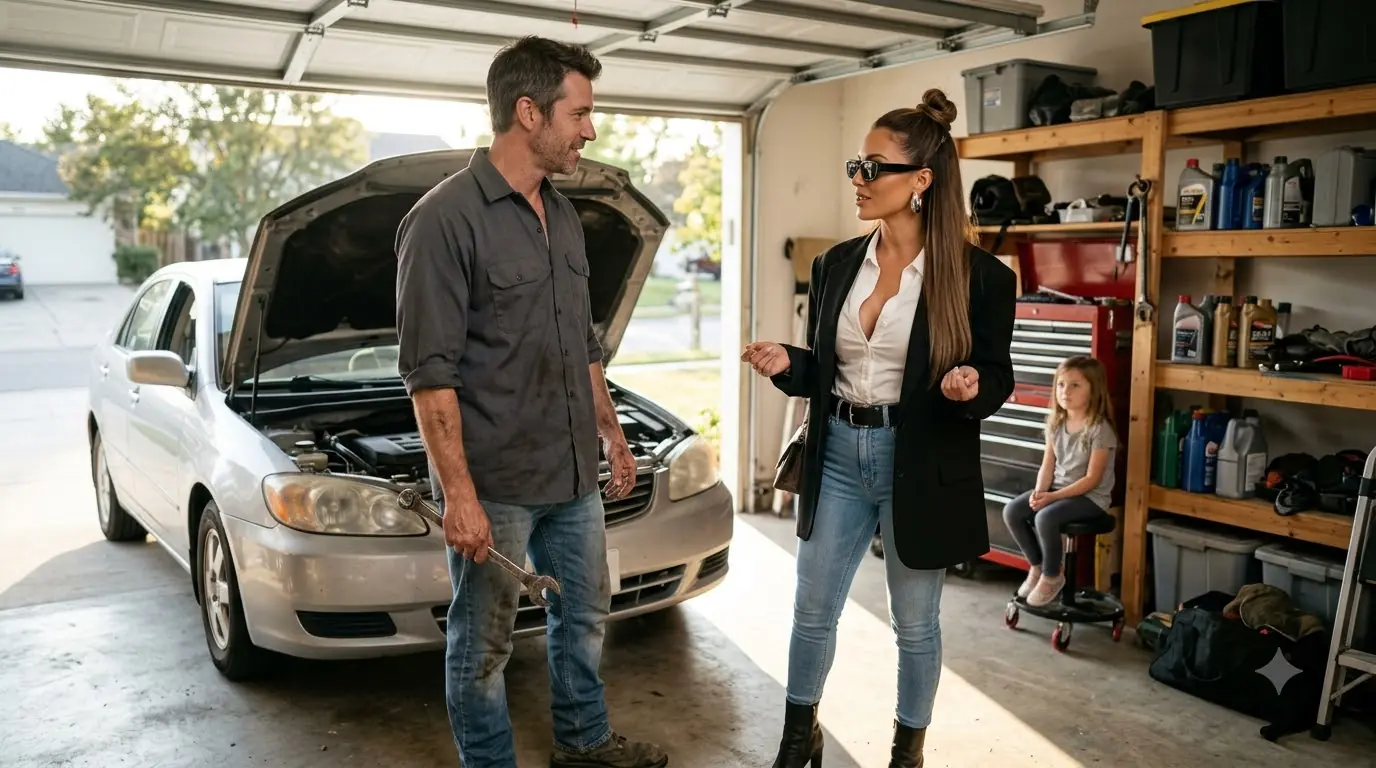
A slim figure standing beneath the porch light after midnight as though she had forgotten what she had gone outside to do.
Jack noticed because mechanics noticed things.
Sounds.
Patterns.
Parts that did not fit.
He had spent twenty years diagnosing engines by listening to them idle, and seven years raising a daughter by learning that silence could mean anything from sleep to tears to a permanent marker being used somewhere it absolutely should not be.
He noticed his new neighbor.
He simply had no reason to care.
Then her car refused to start.
It happened on a warm Saturday afternoon in Cedar Glen, Colorado, a clean suburban neighborhood of maple trees, attached garages, basketball hoops, and people who pretended not to watch each other through front windows.
Jack was inside his garage rebuilding the alternator from an old pickup when he heard the starter across the street.
Click.
Nothing.
A pause.
Click.
Nothing.
Another pause.
Click-click-click.
Jack closed his eyes.
“Battery,” he muttered.
His seven-year-old daughter Sophie sat on a stool near the workbench drawing purple stars around a picture of a rabbit.
She looked up.
“What?”
“Nothing.”
Click.
Jack continued tightening a bolt.
Click-click.
Sophie tilted her head.
“That sounds bad.”
“It sounds expensive if she keeps doing it.”
“Are you going to help?”
“No.”
Click.
Sophie stared at him.
Jack ignored her.
“Dad.”
“She has a phone.”
“Dad.”
“She can call roadside assistance.”
Sophie continued staring.
He finally looked at her.
She had inherited her mother’s eyes.
That thought still arrived unexpectedly sometimes.
Seven years should have made it easier.
It had not.
Sophie raised one eyebrow in an expression that was entirely Jack’s.
“You always help people.”
“That is how people end up owing me favors, and then they come over during football.”
“You don’t watch football.”
“Exactly.”
Click.
Jack threw the rag onto the workbench.
“Fine.”
Sophie smiled triumphantly.
“You manipulated me.”
“I asked a question.”
“You inherited that from someone dangerous.”
She returned to her rabbit.
Jack stepped outside.
The woman was leaning into the driver’s side of a white crossover parked in her driveway.
She wore knee-high taupe suede boots despite the warm weather, a white button-down shirt loose at the collar, and an oversized knitted cardigan the color of oatmeal. Thick dark-brown hair fell in polished waves almost to her waist.
She looked less like someone whose car had broken down and more like someone photographed accidentally while walking through an expensive catalog.
Jack disliked that observation.
He disliked the next one more.
Something about her was familiar.
Not face exactly.
Not enough to place.
Just enough to make his chest tighten.
The woman looked up.
Their eyes met.
She froze.
Actually froze.
Jack stopped halfway across the street.
For one uncomfortable second, neither moved.
Then she closed the driver’s door.
“Hi.”
Her voice did it again.
Something.
A memory scraping against a locked door.
Jack frowned.
“You having trouble?”
She looked at the car as if she had forgotten it existed.
“Yes.”
“What’s it doing?”
“Not starting.”
“Excellent diagnosis.”
A nervous smile appeared.
Jack regretted the joke immediately because that smile felt familiar too.
He walked toward the vehicle.
“Mind if I take a look?”
“No.”
Too quickly.
She corrected herself.
“I mean, yes. Please.”
Jack lifted the hood.
Battery terminals looked clean.
He checked voltage with the pocket meter he habitually carried from the garage.
“Battery’s fine.”
The woman stood behind him.