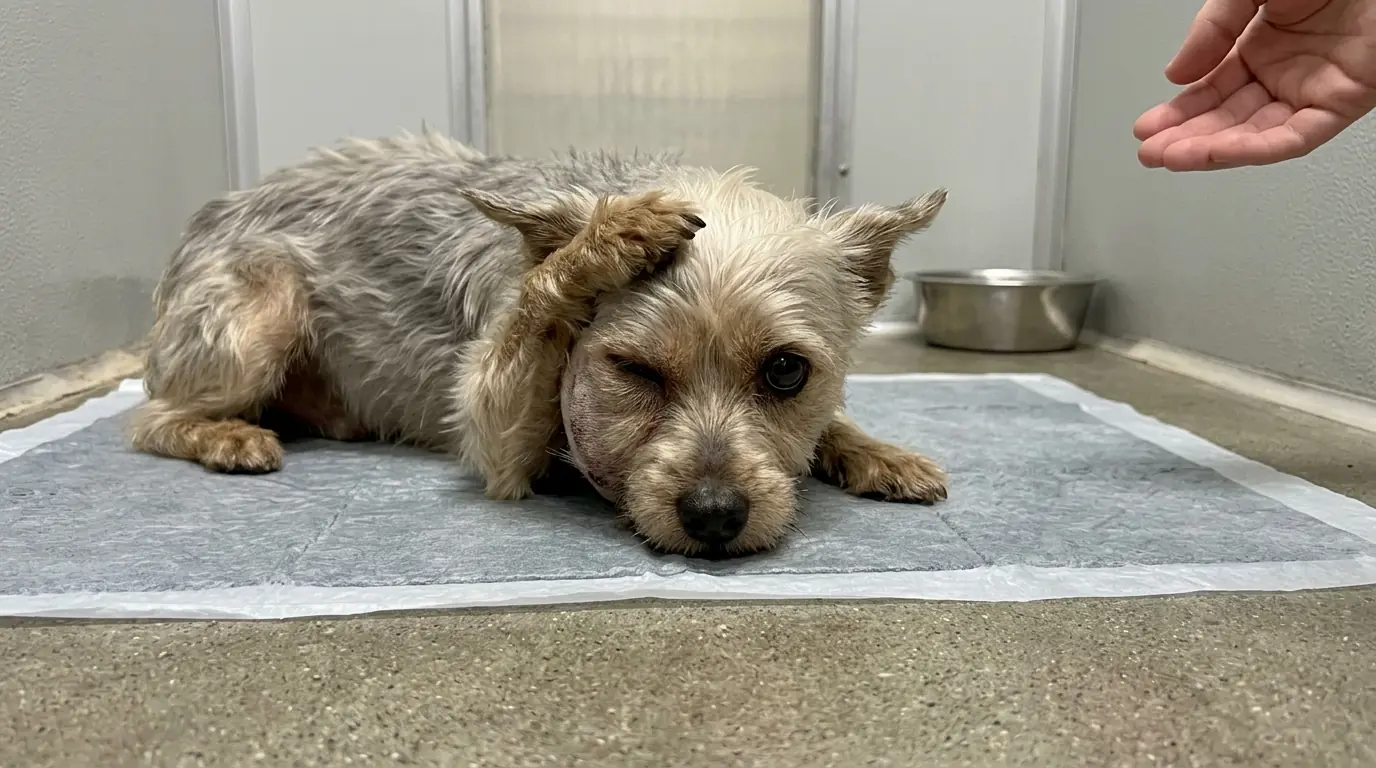
Teddy is already too weak to spend much time standing.
The six-year-old Yorkshire Terrier mix arrived at the shelter with one side of his jaw badly injured, an eye swollen nearly shut, and several areas around his face shaved so the wounds underneath could be examined and treated.
Most of the time, Teddy stays low on the bedding in his medical kennel.
Then a hand moves toward his face.
His reaction is immediate.
Before the fingers even touch him, Teddy drops.
His chest hits the bedding.
His chin disappears between his front legs.
Then both paws pull tightly toward his head as he presses himself as flat as he can.
He does not snap.
He does not run.
He simply stays there.
Even after the hand stops moving, Teddy may remain folded over his own face for several seconds before cautiously lifting his head again.
The reaction is so fast and so consistent that it raises an unavoidable question.
What is Teddy responding to—the pain he feels now, or something that happened before anyone at the shelter ever met him?
Teddy’s Face Needed Immediate Medical Attention
The visible injuries alone were concerning.
One eye was so swollen that only a narrow opening remained.
The tissue around his face was inflamed.
One side of his jaw had been injured.
Several patches of fur had to be clipped away to allow closer examination and treatment.
With facial trauma, what can be seen externally may be only part of the problem.
The eye itself needs assessment.
So do the mouth, teeth, jaw, surrounding soft tissue, and other structures depending on the examination findings.
Teddy cannot explain which movement hurts.
His body has to provide some of those clues.
Even Eating Can Put Pressure on the Injured Area
A damaged jaw can make ordinary actions difficult.
Opening the mouth may hurt.
Chewing may hurt.
Picking up food may require an uncomfortable angle.
Even lowering the face toward a bowl can place the head in a position Teddy does not want to maintain.
So food texture, bowl placement, appetite, chewing ability, and swallowing all become important observations.
His weakness makes the problem harder.
Teddy does not have much energy to compensate.
But the Most Striking Reaction Happens Before Anyone Touches Him
A caregiver reaches toward Teddy slowly.
There is still space between the hand and his face.
Teddy sees the movement.
His legs fold.
His entire body drops.
The speed of the response makes it look almost automatic.
There is no time for prolonged hesitation.
Hand approaches.
Teddy goes down.
His Front Legs Move Toward His Head
That detail is difficult to miss.
Once Teddy is on the floor, his front legs pull inward.
His paws come close to his face.
His head stays low between them.
From above, much of his injured face becomes hidden behind his own body.
Then Teddy waits.
It Would Be Easy to Give That Posture a Story
A dog with facial injuries who drops when a hand approaches invites assumptions.
People may wonder whether someone hurt him.
They may look at his paws covering his head and imagine exactly what happened before he was found.
But Teddy's reaction cannot prove a specific history.
Pain alone can create strong avoidance.
A frightening veterinary experience can affect responses.