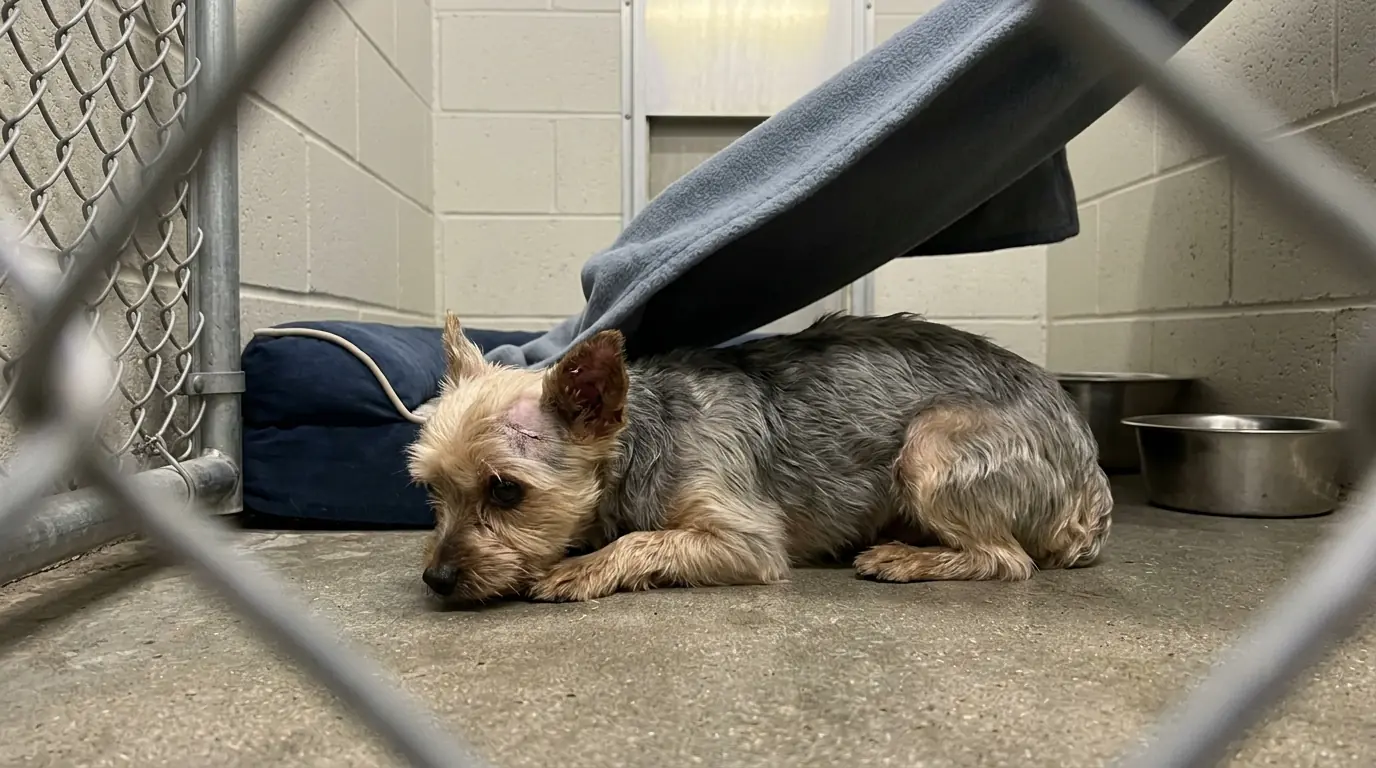
Nothing has to touch Teddy.
That is the part shelter staff notice first.
The four-year-old Yorkshire Terrier can be standing quietly inside his kennel when someone lifts a blanket nearby.
Before the fabric comes anywhere close to him, Teddy drops.
His head ducks sharply.
His belly presses against the floor.
His legs fold beneath his tiny body.
Then he stays there.
A leash moving overhead can trigger the same response.
So can an arm passing above him.
Sometimes even a person's shadow moving across the floor and over his body is enough.
Teddy flattens himself as though something is about to happen.
But nothing does.
No one strikes him.
No object lands on him.
The blanket passes.
The leash moves away.
The shadow disappears.
Teddy remains pressed to the floor for several more seconds before cautiously raising his head.
The little dog was found beside a road with a head injury that has since stabilized and permanent damage to one ear.
Those injuries are real.
What no one knows is whether they have anything to do with the behavior staff are seeing now.
Because Teddy cannot explain why movement above his head makes him react before anything has even touched him.
Teddy Arrived With Injuries That Needed Immediate Attention
When Teddy was found beside the road, his behavior was not the first concern.
His physical condition was.
He had suffered trauma to his head.
One ear was badly damaged and would never return completely to normal.
The exact circumstances leading to those injuries were unknown.
Being found roadside naturally creates possibilities.
Perhaps there had been a vehicle-related incident.
Perhaps something else had happened before Teddy reached the road.
Without evidence, those possibilities had to remain possibilities.
The veterinary priority was Teddy himself.
His head injury needed assessment and stabilization.
His ear needed evaluation.
Pain had to be addressed.
Only after his immediate physical condition became more stable did another pattern become impossible to miss.
Teddy Was Watching Everything Above Him
Small dogs naturally live in a world where much of human activity happens overhead.
Hands reach down.
Leashes are clipped from above.
Blankets are lifted.
Doors move.
People bend over them.
For many dogs, these are ordinary parts of daily life.
For Teddy, certain overhead movements seemed to carry a completely different meaning.
A blanket lifted over his bed could make him collapse toward the floor.
A leash swinging gently as someone approached could do the same.
Sometimes the trigger was not even an object.
A moving silhouette was enough.
Teddy seemed to notice motion above him with extraordinary intensity.
His Reaction Happened Before Contact
That detail mattered.
Teddy was not ducking because an object bumped his injured ear.
He was not dropping after a leash accidentally touched his head.
He reacted in anticipation.
The movement began.
Teddy saw it.
Then he flattened himself.
Whatever his body was responding to, the response started before physical contact occurred.
That distinction made the behavior especially striking.
The First Drop Could Have Been Mistaken for a Startle
Dogs startle.
A recovering dog in an unfamiliar shelter may be particularly sensitive.
One sudden movement producing one fearful reaction would not necessarily establish a pattern.
But Teddy repeated it.
Someone repositioned bedding.
Down went his head.
A leash passed through his field of view.
Teddy folded toward the floor.
An arm reached across the kennel without reaching for him.
Again, he ducked.
Soon staff began anticipating Teddy's response before they performed ordinary tasks around him.
He Didn't Immediately Get Back Up
The drop itself happened quickly.
Recovery was slower.
Teddy might remain flattened even after the object had moved away.
His belly stayed against the floor.
His chin remained low.
His ears—one permanently damaged—sat close to his head.
His muscles stayed tense.
Staff could step away and give him space.
For several seconds, Teddy still did not move.
Then his eyes shifted.
His head rose slightly.
Only after checking the environment did he begin unfolding himself.
The danger Teddy appeared to anticipate had never arrived.
His body needed time to discover that.
No One Could Responsibly Say Teddy Had Been Hit
His reaction could easily lead people to one conclusion.
Someone must have struck him.
It is an emotionally powerful interpretation.
It is also something his behavior alone cannot prove.
Dogs may develop sensitivity to overhead movement for many reasons.
Past frightening experiences are one possibility.
Pain can alter responses.
Vision or neurologic changes may affect how movement is perceived.
A dog with an injured head or ear may become particularly protective of that region.
Temperament and limited prior experience can also influence behavior.
Teddy's response told staff that he was frightened or highly defensive about certain movement.
It did not provide a video recording of his past.
His Known Head Trauma Made Medical Follow-Up Especially Important
Teddy's history meant his behavior could not automatically be treated as purely emotional.
Head trauma can involve more than visible wounds.
Depending on severity and location, veterinary teams may consider neurologic function, vision, balance, pain, hearing, and other factors.
Teddy's injury had stabilized, but monitoring remained important.
Did both eyes track movement normally?
Was his balance appropriate?
Did he show discomfort when the head or neck was handled?
Could the damaged ear affect his response to sound?
Were there neurologic abnormalities?
Those questions required veterinary assessment.
Behavior provided clues.
It did not replace medicine.
His Damaged Ear Changed the Way He Experienced the World
One of Teddy's ears had been permanently injured.
The visible change alone did not reveal exactly how much hearing function remained or whether the damage affected him in other ways.
But ears are important for more than appearance.
They help dogs localize sounds.
They are sensitive structures.
An animal who has experienced painful ear trauma may also become protective around the head.
Again, none of that proved why Teddy ducked.
It simply meant his physical history had to remain part of the picture.
A Blanket Became One of the Clearest Examples
The blanket itself was harmless.
Teddy could lie comfortably on one.
He could sniff it when it was stationary.
He could walk across fabric on the floor.
The problem appeared when the blanket moved above him.
A staff member might lift one edge to reposition it.
Teddy noticed the rising fabric.
His head dropped.
If the blanket passed overhead, his whole body flattened.
Then, once the blanket was back on the ground, Teddy could eventually approach it again.
That contrast was useful.
The object was not necessarily the problem.
The movement and position seemed to matter.
The Leash Created the Same Contradiction
A leash could mean something positive.
It could lead outside.
It could accompany a walk.
But if it swung above Teddy while being clipped or moved, his posture changed.
He ducked before it touched him.
That meant staff needed to change how they handled ordinary equipment around him.
Instead of allowing a leash to dangle overhead, they could keep movements low and predictable.
Instead of reaching straight down over Teddy's head, they could approach from an angle he could see more clearly.
Tiny adjustments could prevent unnecessary fear.
Teddy Was Small Enough That Almost Everything Happened Above Him
At Yorkshire Terrier height, the human world towers overhead.
A person's hand.
A jacket.
A towel.
A cleaning tool.
A kennel door.
Objects that seem low to a person may still pass well above Teddy's head.
That meant avoiding every overhead movement was impossible.
The goal could not be to build a world where nothing ever moved above him.
The goal was to help Teddy experience those movements without immediately feeling that he needed to flatten himself.
Staff Started Moving Differently
People approaching Teddy became more deliberate.
Hands stayed visible.
Movements slowed.
Whenever possible, staff avoided suddenly reaching directly over his head.
Equipment was brought in from the side rather than swung above him.
If Teddy showed early tension, the person could pause.
The idea was simple.
Make ordinary interactions easier to predict.
For a dog reacting before contact even occurred, predictability was especially valuable.
Touch Was Not the First Goal
It would have been easy to focus on petting Teddy.
Show him that hands are safe.
Touch his head gently.
Prove nothing bad happens.
But if Teddy was already flattening himself before the hand arrived, forcing touch could overwhelm him.
A more useful first lesson was that a hand could exist nearby without touching him at all.
Someone could move.
Teddy could watch.
Nothing happened.
The hand moved away.
That experience might seem insignificant.
For Teddy, it could be exactly the kind of repetition he needed.
His Earliest Warning Signs Were Smaller Than the Full Drop
Before Teddy completely flattened himself, staff sometimes noticed a brief change.
His eyes tracked upward.
His mouth closed.
His neck shortened.
His weight shifted downward.
Then came the duck.
Recognizing those early signs created an opportunity to stop or reduce the movement before Teddy became fully overwhelmed.
Behavioral care often happens in those tiny moments.
Not after the dog is already terrified.
Before.
A Moving Shadow Was Harder to Control
Objects could be handled carefully.
Shadows were different.
Someone walking past a light source could send a shape across Teddy's kennel.
Sometimes Teddy looked up sharply.
If the shadow crossed over him, he might drop.
Nothing physical had entered his space.
That made staff consider how strongly visual movement itself could be influencing the reaction.
It also reinforced the importance of medical evaluation.
A dog with a history of head trauma and unusual responses to visual stimuli deserves careful observation rather than assumptions.
Teddy Could Be Relaxed When Nothing Moved Above Him
This was another important clue.
He did not spend the entire day flattened.
When the environment was calm, Teddy could stand normally.
He could sniff.
He could eat.
He could investigate bedding.
He could move around the kennel.
At times, his posture softened enough that he looked like a completely different dog.
Then something passed overhead.
His body changed in an instant.
That pattern suggested there were specific conditions under which Teddy felt much safer.
Those calmer moments gave staff somewhere to begin.
Food Could Help Create New Associations
When Teddy was comfortable enough to eat, small rewards could accompany gentle, predictable movement at a safe distance.
The process would need to remain below the point where he dropped to the floor.
A small movement.
Food.
Pause.
Another manageable movement.
Food.
The goal would not be to test how much Teddy could tolerate.
It would be to create repeated experiences where movement predicted something neutral or positive rather than something that required immediate defensive posture.
If Teddy stopped eating or flattened himself, the situation had become too difficult.
Progress Could Be Measured in Inches
At first, success might mean Teddy kept his belly off the floor.
He could still lower his head.
He could still look worried.
But if he remained standing, that was different.
Later, perhaps an object could move slightly higher.
Maybe a blanket could be lifted without Teddy collapsing.
Eventually, a leash might pass through his upper field of vision while he simply watched.
Those changes would not look dramatic to most people.
For Teddy, they could represent an entirely different response to the world around him.
One Afternoon, the Blanket Moved and Teddy Didn't Drop
A staff member was adjusting bedding several feet away.
One corner of a blanket lifted.
Teddy saw it.
His head lowered immediately.
Everyone expected the rest.
Belly down.
Legs folded.
Freeze.
But Teddy stopped halfway.
He remained standing.
His neck was low.
His body was tense.
Yet his belly never touched the floor.
The blanket came down.
Nothing happened.
Teddy stared at it.
Then, after several seconds, he sniffed the ground.
It lasted only a moment.
But for once, Teddy had seen something move above him and his body had not completed the entire familiar response.
The Next Overhead Movement Still Flattened Him
Later, someone moved a leash too quickly.
Teddy ducked.
His chest hit the floor.
His belly followed.
He remained there even after the leash stopped moving.
The old response was still very much present.
That did not erase what had happened earlier.
Fear recovery is rarely linear.
The speed of movement mattered.
Distance mattered.
Teddy's stress level mattered.
One successful moment did not mean the problem was gone.
It meant another response was becoming possible.
His Physical Comfort Had to Remain Part of Every Interaction
Teddy's head and damaged ear could not become mere background details.
If certain handling caused discomfort, fear could persist for good reason.
Pain management and medical reassessment were therefore essential.
A dog cannot learn that touch is safe if touch actually hurts.
Before expecting Teddy to become comfortable with handling around his head, caregivers needed confidence that they understood his physical condition as well as possible.
There Was No Need to Test Him
No one needed to wave objects overhead just to see whether Teddy still reacted.
His fear was already documented.
Repeatedly provoking the response would offer little benefit.
Instead, everyday interactions could become opportunities for careful, controlled learning.
The shelter environment naturally contained movement.
That was enough.
The question was how to help Teddy experience it at tolerable levels.
The Most Important Change Would Be Giving Teddy Time to Think
Right now, his reaction appeared almost immediate.
Movement overhead.
Drop.
There was little visible pause between perception and response.
A meaningful step forward might be nothing more than hesitation.
Teddy sees the blanket rise.
He looks.
He waits.
That one second creates space for another possibility.
Maybe nothing happens.
Maybe the object moves away.
Maybe Teddy remains standing.
The goal is not to make him fearless.
It is to give him enough security that his body no longer has to make the decision before he has had a chance to understand what is happening.
Teddy's Injuries Are Easier to See Than This Part of His Recovery
The damaged ear is obvious.
His medical records can document the head trauma.
Those are concrete.
The other problem appears only in certain moments.
Someone lifts a blanket.
A shadow crosses his body.
A leash swings overhead.
Suddenly Teddy is flat against the floor.
Then the movement disappears and he slowly becomes a dog who can stand again.
That transition is where his current struggle becomes visible.
Healing the Injury Doesn't Automatically Teach the Body That It Is Safe
Teddy's head injury has stabilized.
That is important.
But physical stabilization and behavioral recovery do not always happen on the same timeline.
The body can heal while defensive patterns remain.
And sometimes medical and behavioral factors overlap in ways that require continued evaluation.
Teddy does not need anyone to choose a dramatic explanation for him.
He needs people to pay attention to what he is actually showing.
For Now, Teddy Still Ducks Before Anything Happens
The kennel is quiet.
Teddy is standing near his bedding.
His small body is relaxed enough to sniff the floor.
Nearby, someone picks up a leash.
It rises slightly.
Teddy sees the movement.
His head disappears downward.
His legs fold.
His belly presses against the floor.
The leash never touches him.
It moves away.
Teddy stays down.
Several seconds pass.
Then his eyes lift first.
His head follows.
Slowly, he pushes himself back onto his feet.
Nothing hurt him.
Nothing even reached him.
But Teddy's body prepared for it anyway.
And that is the question his caregivers cannot answer simply by looking at his healed injuries:
What happened—whether during his known trauma or somewhere else in a history no one can reconstruct—that taught Teddy to protect himself from something before it even touches him?