The black 1986 Harley-Davidson FXR sat beneath the fluorescent lights of Apex Iron Works like a machine that had decided it was finished cooperating with the living.
For nearly forty years, the motorcycle had survived California heat, winter rain, bad gasoline, questionable repairs, club wars, road debris, three crashes, two engine rebuilds, and one legendary run across Nevada that older riders still talked about whenever somebody opened a second bottle after midnight.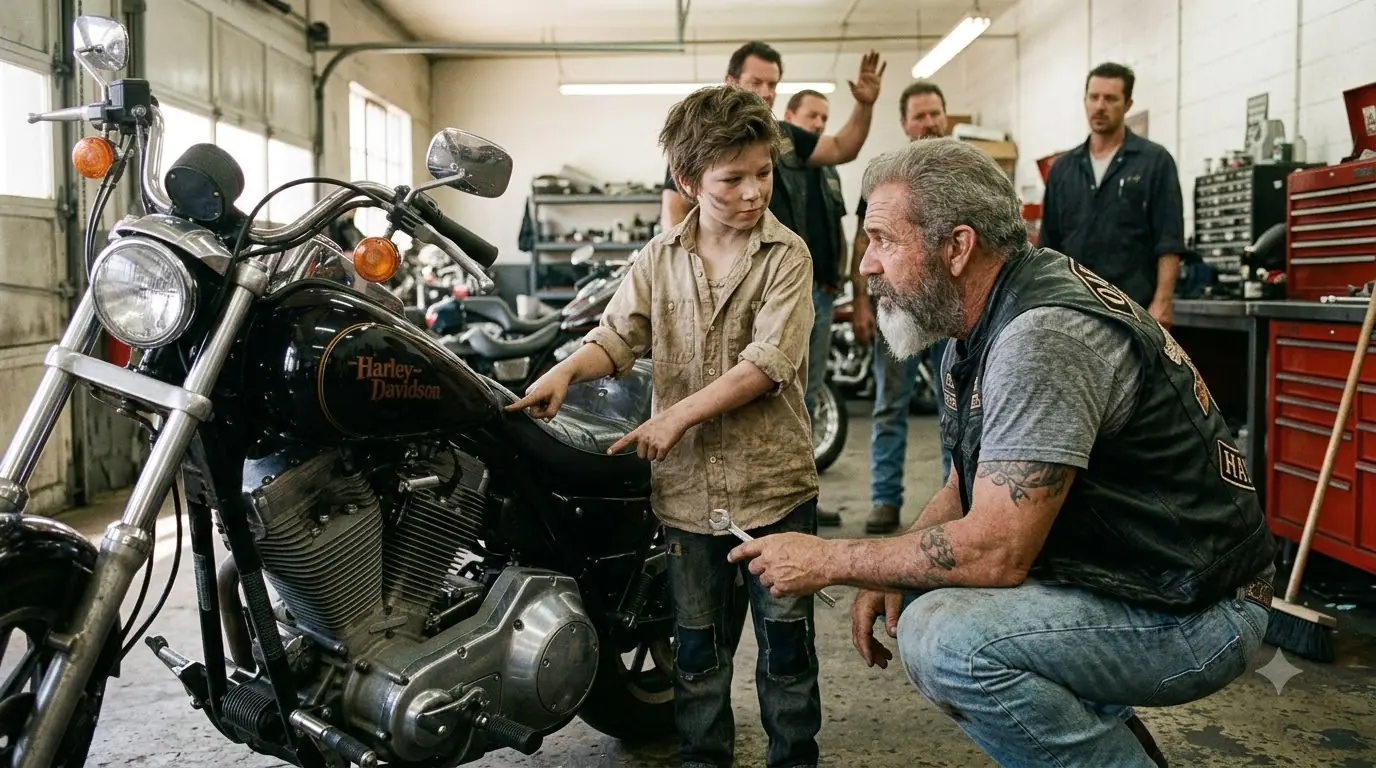
Now it refused to start.
The starter turned.
The pistons moved.
Compression was good.
Fuel reached the carburetor.
The battery was new.
The wiring looked correct.
Yet every attempt ended with the same hollow mechanical churn followed by silence.
Then, somehow, the battery would begin losing charge far faster than it should.
Rusty stood beside the motorcycle with both hands planted on his hips.
He had owned Apex Iron Works in Oakland for twenty-three years.
His hands were thick, scarred, and permanently dark around the fingernails no matter how much industrial soap he used. A faded shop shirt stretched across his broad stomach, and reading glasses hung from a cord around his neck even though he almost never remembered to put them on.
He hated mysteries.
Machines were not supposed to have mysteries.
Machines had causes.
A broken wire.
A clogged jet.
A failed bearing.
A bad seal.
A warped surface.
A cracked insulator.
A motorcycle did not wake up one morning and decide to become haunted.
But after two weeks with Dutch Sullivan’s FXR, Rusty was beginning to reconsider the possibility.
Big Dave leaned over the workbench and stared at a meter.
“Voltage drop again.”
Rusty did not turn.
“How much?”
“Enough.”
“That’s not a number.”
“It becomes a number when I stop being mad.”
Rusty finally looked over.
Big Dave unplugged the meter.
“Twelve-point-seven resting. Crank it three times and we’re already under eleven.”
“That battery came out of the box yesterday.”
“I know.”
“Load tested?”
“Twice.”
“Ground?”
“Clean.”
“Starter draw?”
“Normal.”
Rusty swore quietly.
Another mechanic, Milo, wiped his hands on a rag.
“Maybe the new battery’s bad.”
Big Dave gave him a look.
“Three batteries?”
Milo shrugged.
“I’ve seen stranger.”
“No, you haven’t.”
At the far end of the garage, an eight-year-old boy pushed an oversized broom across the concrete floor.
His name was Leo Hayes.
He was so thin that his faded beige work shirt seemed to hang from his shoulders instead of fit them. His jeans had been patched at both knees, and the rubber along the sides of his shoes had begun peeling away.
Grease marked one cheek.
Another smudge ran along his forehead where he had pushed messy brown hair away with a dirty hand.
He swept quietly.
That was what Rusty paid him to do after school.
Not because an eight-year-old belonged in a working motorcycle garage.
Rusty knew he did not.
But Leo’s mother worked evenings at a nursing home, and childcare had become more expensive than she could manage after Leo’s father died.
Arthur Hayes had once worked in the same shop.
Not every day.
Not officially toward the end.
But often enough that Rusty still sometimes expected to see him appear through the side door carrying a coffee and complaining about modern replacement parts.
Arthur had died two years earlier after a sudden heart attack.
Forty-three years old.
Too young.
Much too young.
Rusty had gone to the funeral.
He had watched Leo stand beside his mother in a black shirt that was too large for him, staring at the casket without crying.
Three months later, Rusty offered the boy a place to sit after school.
Eventually sitting became sweeping.
Sweeping became sorting sockets.
Sorting sockets became reading manuals while waiting for his mother.
Leo rarely caused trouble.
He listened.
He watched.
And he remembered nearly everything.
Rusty appreciated that.
What Rusty did not appreciate was children inserting themselves into conversations involving angry bikers, dead motorcycles, and expensive reputations.
Which was why, when Leo stopped sweeping and stared toward the black FXR, Rusty noticed immediately.
“You miss something?” Rusty asked.
Leo looked down.
He resumed sweeping.
The motorcycle had arrived fourteen days earlier on a trailer.
It had not arrived alone.