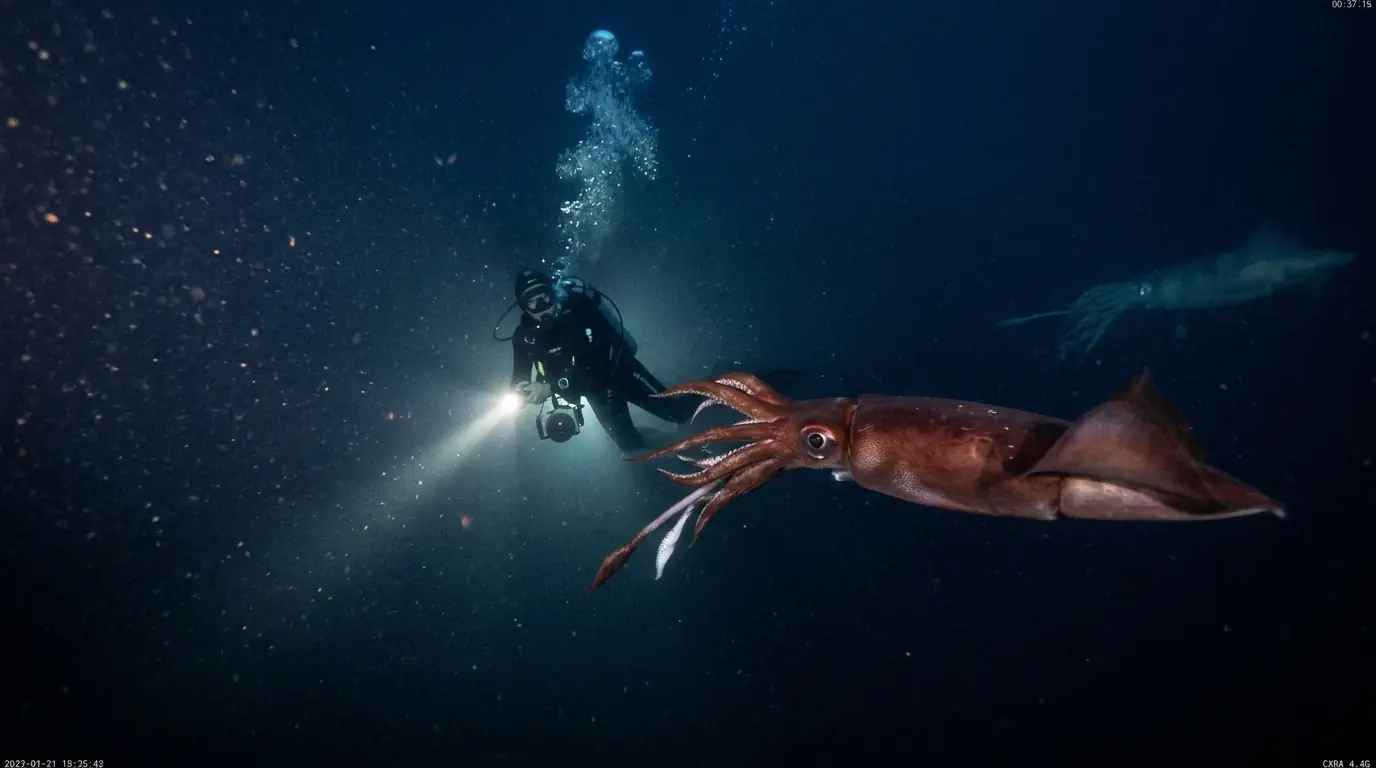
Far out in Mexico’s Sea of Cortez, darkness changes the ocean.
During the day, the surface can look almost inviting. Sunlight flashes across blue water. Fishing boats move through the Gulf of California, and from above there may be little indication of what is moving hundreds—or thousands—of feet underneath them.
But after sunset, fishermen in parts of the region have traditionally gone looking for something very different.
Bright lights are switched on over deep water. Beneath those lights, shapes begin rising out of the darkness.
They are squid.
Not the small squid most people picture on a dinner plate, but powerful open-ocean predators known as Humboldt squid, or Dosidicus gigas. Individuals can reach roughly six feet in length and around 100 pounds, according to PBS. Along the Mexican coast, fishermen gave them a far more memorable name:
Diablos rojos.
The Red Devils.
Underwater cameraman Bob Cranston knew the stories before he entered their world.
He had been warned that the animals could be unpredictable. Fishermen told stories of squid grabbing people and even pulling men into the sea. Cranston was already an experienced underwater cinematographer accustomed to working around sharks and other potentially dangerous marine animals.
But the Humboldt squid presented a different kind of challenge.
They did not necessarily keep their distance.
They came closer.
Sometimes much closer.
And when Cranston finally descended into the black water to film them, he discovered that the stories about the “Red Devils” concealed something arguably more unsettling than a simple monster tale.
These animals appeared to be examining him.
Something Was Waiting Beneath the Fishing Boats
One of Cranston’s early encounters began after local fishermen reported catching unusually large squid at night.
Cinematographer Mark Conlin later described how he, Cranston and filmmaker Howard Hall were working in Mexico’s Sea of Cortez when fishermen repeatedly approached their boat with reports of big squid.
At first, “big” was relative.
The filmmakers were familiar with much smaller squid. What local fishermen were describing was something else entirely.
Eventually, the crew followed the fishermen offshore.
They stopped above extremely deep water—more than 1,000 feet deep in the account published by PBS—and deployed powerful lights. The bulbs illuminated the surface water around the boat, creating an artificial island of brightness in an otherwise black ocean.
Then they waited.
This fishing technique exploits the nighttime movements of Humboldt squid.
The animals spend significant periods in deeper water and can move upward at night to hunt. PBS described fishermen using bright lanterns to attract squid near the surface before catching them with specialized equipment.
For a diver, however, that creates an extraordinary situation.
You are not descending toward a reef.
There is no comforting seafloor immediately beneath you.
Instead, you can be suspended in open water with hundreds or thousands of feet of darkness below.
And somewhere underneath, large predators are moving upward.
Cranston wanted to see them in that darkness.
The fishermen had already told him why that might be a terrible idea.
“Don’t Get in the Water”
According to Cranston’s recollection published by PBS, fishermen warned him against swimming with the squid. Some repeated stories claiming Humboldt squid had pulled fishermen into the water and eaten them.
Those claims should be treated as fishermen’s accounts rather than established evidence of fatal Humboldt squid attacks on humans.
But the physical capabilities behind the legends were real enough.
A Humboldt squid is built to capture moving prey.
Its body is streamlined for rapid propulsion. It can move using powerful jets of water. Its arms and two longer feeding tentacles can seize prey, while suckers help maintain a grip. At the center of those arms is a hard beak capable of cutting tissue.
Humboldt squid are also cannibalistic.
PBS documented that individuals may eat other squid of their own species, while later research and underwater observations have shown them to be sophisticated, active predators rather than indiscriminate creatures attacking everything they encounter.
Then there is their skin.
Humboldt squid can rapidly alter their appearance using specialized pigment cells called chromatophores. To a human observer underwater, the result can be extraordinary: their bodies appear to flash between pale and reddish tones.
In a black ocean illuminated by artificial light, an entire group of large squid can therefore appear to flicker.
Red.
White.
Red again.