The wheelchair moved backward so suddenly that the ten-year-old girl’s hands flew from her lap to the armrests.
The rubber tires squealed against the painted school court.
For one frightened second, she thought the chair was tipping.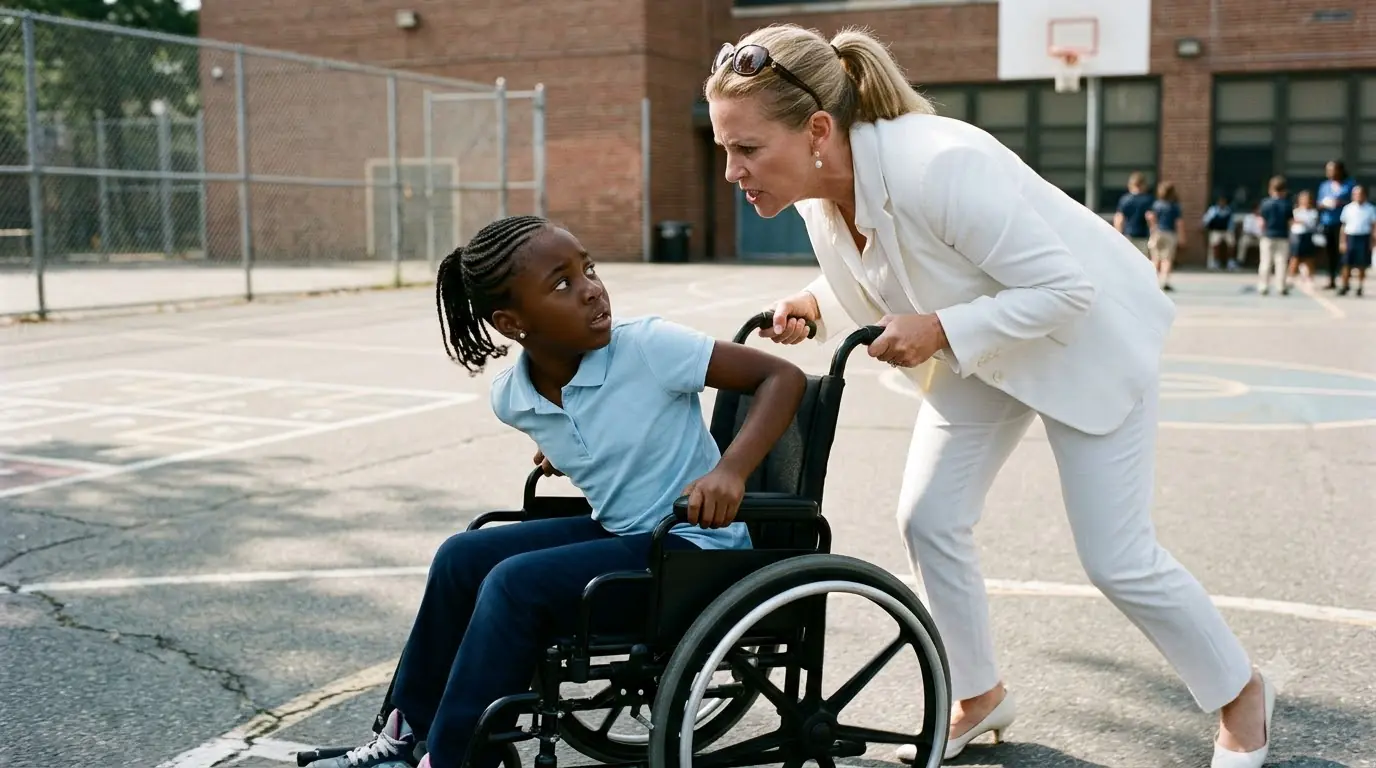
It did not.
Her custom anti-tip bars caught the shift exactly the way they were designed to, and the chair settled beneath her. But the jolt was enough to make every muscle in her shoulders lock.
Behind her, the HOA president tightened both hands around the push handles.
“Get up,” the woman snapped. “My son needs this more than you do right now.”
The girl slowly turned her head.
She was a Black American child with deep-brown skin, neat cornrow braids pulled into a short ponytail, small silver earrings, and wide brown eyes that had learned, much too early, how to study adults before deciding whether they were safe.
She wore the light-blue polo shirt required by her elementary school, navy pants, and white sneakers.
The wheelchair beneath her was not school equipment.
It was not a spare chair from the nurse.
It was not something another child could borrow because an adult decided fairness meant taking it away from the person using it.
It had been fitted to her body three months earlier.
The seat depth matched her legs.
The lateral supports helped keep her spine aligned.
The cushion reduced pressure when she spent long school days seated.
The wheel angle had been adjusted so she could propel herself efficiently without exhausting her shoulders.
A small storage pouch beneath the seat held emergency medication, a folded transfer strap, and a bright yellow key chain her father had given her when the chair arrived.
Nothing about it was interchangeable.
The HOA president knew that.
That was what made the girl’s voice shake when she answered.
“This is my chair.”
The woman wore a crisp white blazer over a white blouse, tailored white pants, pearl earrings, low heels, and expensive sunglasses pushed above her forehead.
She looked as if she had arrived for a luncheon rather than an elementary-school recreation period.
Her blonde hair was pulled tightly away from her face.
Her jaw was tighter.
“Don’t start with me.”
The girl stared at her.
Twenty feet away, the HOA president’s eleven-year-old son sat on a bench with an ice pack resting across his left ankle.
He had twisted it during a morning playground game.
The school nurse had examined him.
Nothing suggested a severe injury.
He could put weight on it, but it hurt.
The nurse had offered crutches.
Then a standard school transport wheelchair if his mother preferred to take him to urgent care without making him walk across campus.
The boy had said he was fine with crutches.
His mother was not.
She had looked at the plain gray transport chair outside the nurse’s office and frowned.
“That thing looks like it came from a hospital basement.”
The nurse had blinked.
“It’s school medical equipment.”
“My son is not sitting in that.”
The nurse had almost asked what, exactly, she thought wheelchairs were supposed to look like.
Instead, she kept her voice professional.
“Then the crutches are available.”
That should have ended it.
But the HOA president had stepped outside, seen the Black girl’s sleek custom chair near the adaptive recreation court, and made a decision that seemed reasonable only inside the private logic she had been building for months.
Her son was injured.
The girl could sometimes stand.
Therefore the girl could surrender the chair.
The adults who disagreed were, in her mind, once again making things difficult.
A physical-education teacher hurried toward them.
“Take your hands off her chair.”
The HOA president turned.
“I’m borrowing it.”
“No.”
“Her class ends in a few minutes.”
“That has nothing to do with it.”
“She can stand.”
The teacher stopped three feet away.
“So?”
“So my son cannot walk properly.”
The boy on the bench said, “Mom, I can walk.”
She ignored him.
The girl’s fingers were still wrapped around her armrests.
She hated that the other children had stopped playing.
She hated that everyone was looking.
She especially hated that this woman had found a way to make a piece of equipment that usually gave her freedom feel like something she had to defend.
The teacher stepped closer.
“Release the wheelchair.”
The HOA president’s face hardened.
“You people have turned this into a ridiculous situation.”
The girl flinched at the phrase.
You people.
The teacher heard it too.
“What people?”
The HOA president rolled her eyes.
“People who make every accommodation into a crisis.”
The girl looked toward the gate.
She wanted her father.
Not because she believed he could magically fix everything.
Her father had taught her the opposite.
Adults could be wrong.
Teachers could make mistakes.
Policies could fail.