By the time the November supply wagon reached Blackwater Camp, the daylight was already fading behind the cedar-covered mountains.
Audra Whitfield had spent the last seventeen miles gripping the edge of the wooden bench while the wagon lurched through mud, frozen ruts, and the first hard snow of the season. Her shoulders ached. Her lower back felt as if someone had beaten it with a broom handle. Cold air had found every weak seam in her coat.
She had stopped asking the driver how much farther they had to go.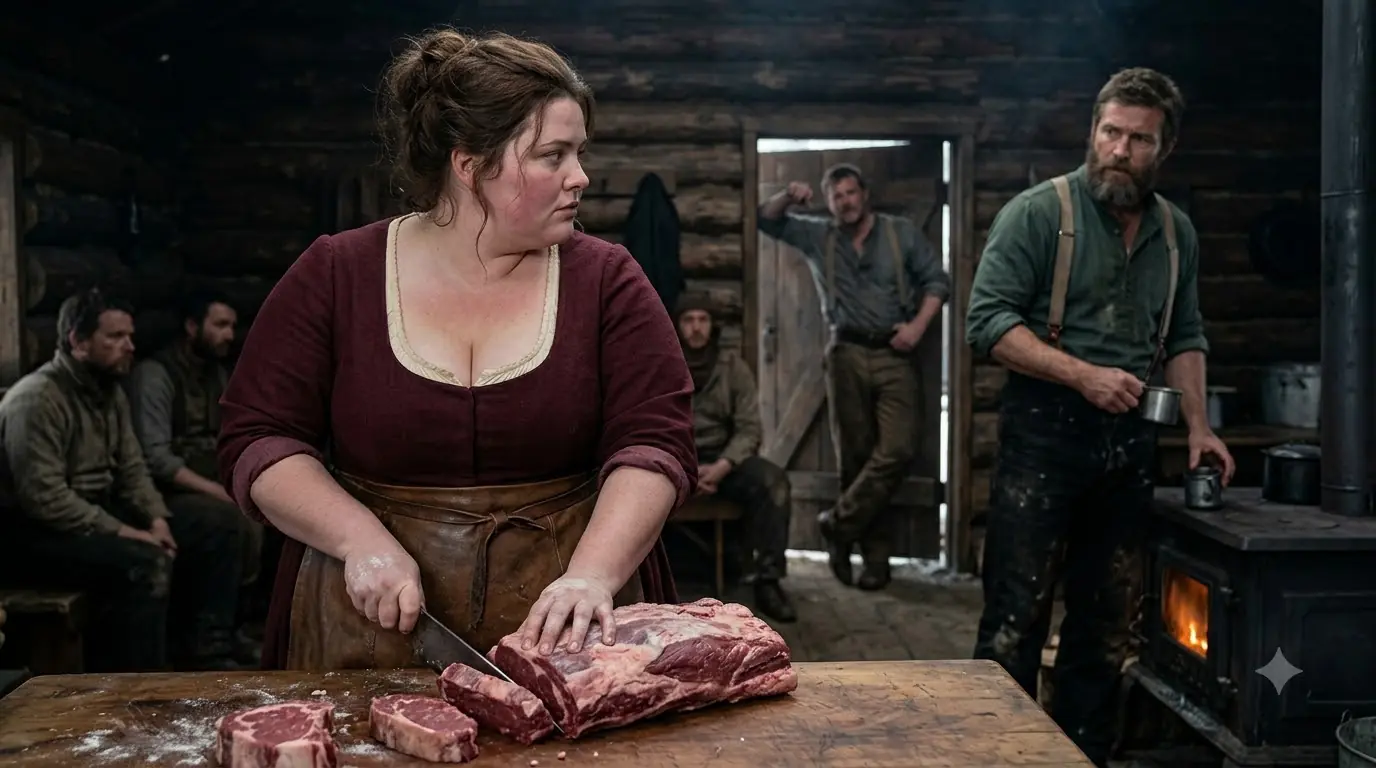
The answer was always the same.
“Not much.”
The phrase had lost all meaning three hours earlier.
Then the trees suddenly opened.
Blackwater Camp appeared beneath a wall of gray sky.
Audra straightened.
The camp sat in a narrow valley somewhere deep in the British Columbia interior, though the mountains made direction difficult to understand. A dozen rough bunkhouses and storage sheds surrounded a muddy clearing. Smoke rose from iron chimneys. Massive felled cedar trunks lay stacked beside a frozen creek. Beyond them, dark timber climbed toward slopes already whitening beneath fresh snow.
Men stopped working when the wagon rolled in.
Not one.
Nearly all of them.
Axes lowered.
A saw went silent.
A pair of horses snorted beside a timber sled.
Audra felt every pair of eyes turn toward her.
She knew that silence.
She had known it since she was fifteen.
First came surprise.
Then calculation.
Then amusement if the observers believed she could not hear them.
Audra was twenty-nine years old and weighed far more than any woman most of the men at Blackwater Camp had probably seen working in a logging camp.
Her body was exceptionally large and soft, with broad hips, heavy thighs, full arms, a round stomach, and a full chest that no dressmaker had ever managed to disguise no matter how many hooks, panels, or supposedly flattering seams were added.
Her face, however, was not easily overlooked once people bothered to reach it.
Warm brown eyes.
Full lips.
Softly rounded cheeks.
Thick chestnut hair pinned loosely beneath a dark bonnet.
Her late husband had once told her that she looked as if somebody had painted a lady onto a harvest moon.
It had been a ridiculous compliment.
She had treasured it anyway.
The wagon stopped.
The driver jumped down.
“Blackwater.”
Audra looked at the mud.
Then at the distance between the wagon step and the ground.
One of the lumberjacks leaned toward another.
“Think she needs a crane?”
The second man snorted.
Audra heard.
Of course she heard.
People always believed cruelty became inaudible if spoken sideways.
She gathered the skirts of her plain burgundy traveling dress and stood.
The wagon shifted slightly beneath her weight.
Several men exchanged looks.
Audra stepped down carefully.
Her boots hit frozen mud.
No collapse.
No catastrophe.
No crane.
She turned toward the wagon.
“My trunk.”
The driver hesitated.
“It’s heavy.”
“Yes.”
“I know.”
A voice came from the side.
“I’ll get it.”
Audra turned.
The man approaching was not the one who had joked.
He was tall, perhaps forty, with the wide shoulders and forearms of someone accustomed to lifting things that ought to require two men. His dark hair had begun to gray near the temples. A thick brown beard covered most of his jaw. He wore a dark green work shirt beneath leather suspenders, black trousers, and boots caked with mud.
He looked at Audra once.
Not long enough to be insulting.
Not short enough to be polite.
Assessing.
She knew immediately.
The owner.
“Reed Mackay?”
“Yes.”
“Audra Whitfield.”
“I assumed.”
She raised one eyebrow.
“From the enormous trunk?”
“From the fact that the supply wagon brought exactly one woman.”
Better answer.
Reed climbed onto the wagon and pulled her trunk toward the edge.
He grunted.
Audra smiled faintly.
“I warned you.”
“What’s in here?”
“Clothes.”
“Books.”
“Knives.”
“Pans.”
“A mortar.”
“Spices.”
“A baking stone.”
Reed stared at her.
“You brought a stone?”
“The camp letter said your oven runs unevenly.”
He looked toward the cook shack.
“Who told you?”
“The previous cook.”
“You spoke to him?”
“I found him in Victoria.”
Reed’s expression changed.
“What did he say?”