The coffee had gone cold twenty minutes before the police chief entered.
The Black man sitting alone near the rear window knew that because he had deliberately allowed it to happen. Every Tuesday morning for the past four months, he had ordered the same black coffee, opened the same newspaper, and taken the same seat at the corner table of Common Grounds, a small but popular coffee shop on the eastern side of downtown Ridgemont.
He liked the corner because it offered a clear view of the front entrance, the service counter, and the narrow hallway leading toward the bathrooms.
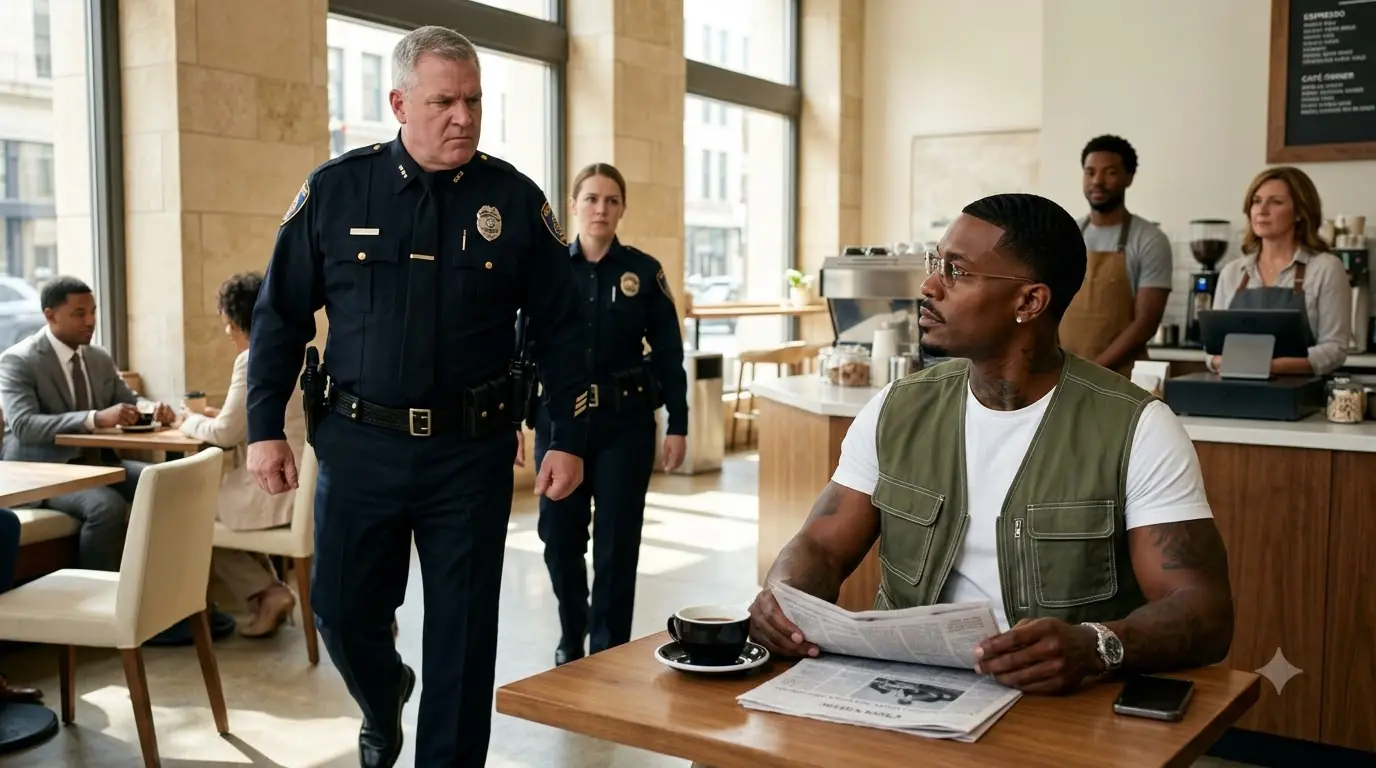
He also liked it because nobody paid much attention to him.
At forty-four, he was a handsome, athletic Black American man with deep-brown skin, broad shoulders, a neatly shaped haircut with close waves, a carefully trimmed goatee, and discreet tattoos visible along his neck and forearms. Thin-framed tinted glasses rested on his nose. A fitted white T-shirt showed beneath an olive-green sleeveless utility vest with contrasting white stitching and oversized pockets. Loose black tailored trousers fell neatly over polished black leather loafers.
A silver watch rested against his left wrist.
He looked like a successful man enjoying a quiet morning before returning to work.
That was partly true.
The expensive watch was real.
The clothing was his.
The coffee was paid for.
But the identity he had given his neighbors was not.
To the people living along his quiet residential street, he was a retired school administrator who had moved to Ridgemont to enjoy a simpler life.
His name, according to the identification he carried, was Aaron Cole.
That much was true.
What he had not told them was that he served as deputy director of the State Bureau of Professional Standards, an independent investigative agency responsible for examining serious allegations of law-enforcement misconduct.
Before joining the bureau, he had spent a decade working on federal civil-rights investigations.
He understood police procedures.
He understood the laws governing detention, searches, and arrests.
And perhaps more importantly, he understood the enormous distance that could exist between what an officer wrote in a report and what actually happened on the street.
That distance was why he had come to Ridgemont.
For three years, his office had been investigating a pattern of troubling complaints against the city's police department.
Some involved questionable traffic stops.
Others involved searches without adequate justification.
Several concerned Black customers being ordered out of local businesses even when the business owners had never complained.
Each incident seemed small when considered separately.
A driver delayed for twenty minutes.
A teenager questioned on a sidewalk.
A customer told to leave a coffee shop.
But as investigators examined the records, the same names appeared again and again.
One of those names belonged to Police Chief Gerald Thornton.
Thornton was fifty-six years old, white, broad-shouldered, and accustomed to entering rooms as though his rank gave him ownership of everything inside them.
He had served as Ridgemont's police chief for nearly eleven years.
His public reputation was built around discipline, order, and strong enforcement.
His private reputation was more complicated.
Residents described being intimidated.
Former officers described retaliation.
Business owners described pressure to cooperate with informal police demands.
And the department's internal complaint system had an astonishing record of finding insufficient evidence even when multiple witnesses supported the same allegation.
Aaron had studied those records for years.
He knew Thornton's habits.
He knew the chief frequently visited Common Grounds on weekday mornings.
He knew the chief preferred the same parking space outside.
He knew Thornton ordered a large coffee without sugar.
And he knew that several Black customers had described being questioned or told to leave when Thornton entered the shop.
What Aaron did not know was whether Thornton would behave the same way when confronted with a man who refused to be intimidated.