“I don’t want Eliza. I want Lena.”
For a moment, the only sound inside the Hail family parlor was the soft ticking of the walnut clock above the fireplace.
Eliza Hail stood beneath the mantel in an ivory gown that had taken her mother nearly two months to finish. The sleeves were trimmed with imported lace. Her golden curls had been arranged twice that morning because the first arrangement had not looked effortless enough. A pale ribbon circled her throat, and tiny pearl earrings caught the afternoon light every time she turned her head.
She had been smiling when Dawson Reed entered the room.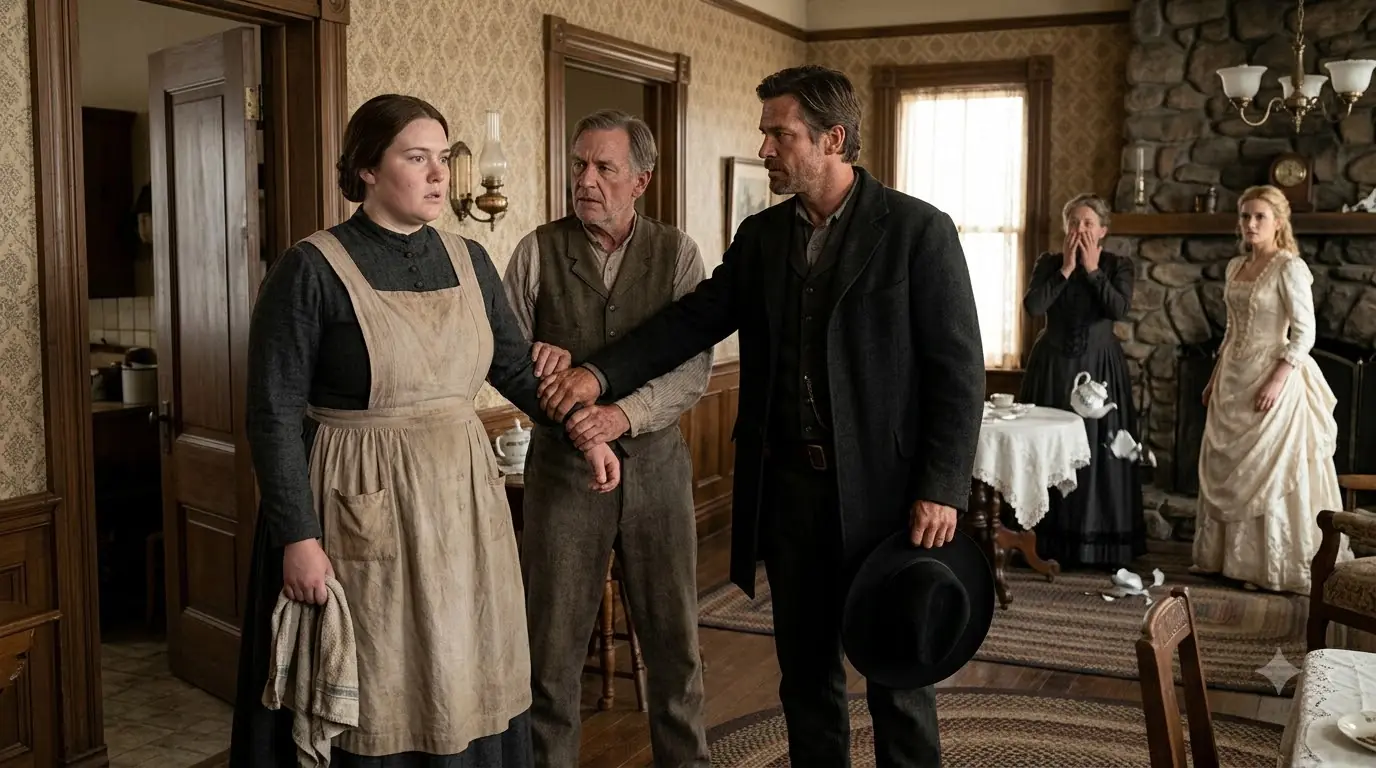
She was not smiling now.
Across from her, her mother, Evelyn Hail, held a porcelain teapot halfway above a cup. Her fingers had gone so still that even the steam seemed unnatural.
Harold Hail stood beside the best chair in the room, one hand resting against its carved wooden back. He had spent the morning behaving as though Dawson’s arrival were not only expected but already understood.
Dawson Reed was thirty-six years old, unmarried, wealthy beyond anything the Hails could realistically match, and owner of nearly nine thousand acres spread across two valleys north of Helena.
He had cattle.
He had horses.
He had water rights other ranchers had been trying to purchase for fifteen years.
He had no debt anyone knew about.
More importantly, his word was worth something.
Men who disliked him still trusted him.
That was rarer than money.
So when Dawson had sent word three days earlier asking whether he might visit the Hail household on Sunday afternoon to discuss “a matter of serious personal intention,” nobody needed Harold to explain what he believed was coming.
Eliza had spent the next seventy-two hours pretending not to know.
She had tried three dresses.
Evelyn had polished the silver twice.
Harold had purchased a bottle of brandy he had been saving for a future occasion important enough to justify the cost.
And Lena had risen at four that morning to bake bread, roast a chicken, clean the parlor hearth, wash the tea service, mend a tear in one curtain, and press Eliza’s ivory dress.
Nobody had asked Lena what she thought Dawson was coming to say.
Nobody ever did.
She was standing in the kitchen doorway now.
A worn dish towel hung between both hands.
Her faded beige pinafore was dusted with flour near the waist. Beneath it she wore the same charcoal-gray homespun dress she wore most Sundays after church when there was work still to do.
Her brown hair was center-parted and pulled into a simple low knot at the nape of her neck.
No ribbons.
No jewelry.
No lace.
Her cheeks were flushed from the kitchen stove.
At twenty-six, Lena was four years older than Eliza and nearly everything the family had spent years suggesting a young woman ought not be.
She was broad.
Heavy.
Strong through the shoulders and arms.
Soft through the face and hips.
She had spent most of her life being told, directly or indirectly, that her usefulness was the best thing about her.
Useful hands.
Useful strength.
Useful patience.
Useful silence.
She could hitch a team faster than Harold’s hired boys.
She could repair a split rail fence.
She knew which cow would calve early by watching it cross a pasture.
She could cut and stack hay.
She could turn four pounds of beef into supper for ten people.
She could keep a household ledger without losing a penny.
She could mend shirts, stitch harness leather in an emergency, clean a wound, set bread before sunrise, and bring a frightened newborn calf through a freezing night by rubbing circulation back into its legs for three straight hours.
All of that made her useful.
None of it, according to the small social world surrounding the Hail ranch, made her desirable.
Eliza was desirable.
That distinction had been taught so consistently that Lena had stopped resenting it years ago.
Or told herself she had.
Now Dawson Reed stood in the middle of the parlor looking directly at her.
Not Eliza.
Her.
Lena’s first thought was that she had misheard him.
Her second was worse.
He was making some kind of joke.
But Dawson was not smiling.
He held his black hat against one thigh.
His expression was steady.
Certain.
He wore a white shirt beneath a dark-brown waistcoat, black trousers, polished boots, and a long ranch coat he had removed only after Evelyn insisted.
A neatly trimmed beard covered his jaw.
His brown hair had been brushed back, though one piece had already fallen forward near his temple.
Lena had seen him muddy, bleeding, furious, laughing, rain-soaked, half-frozen, and once carrying a calf across both arms as though it were a sleeping child.
She had never seen him nervous.
He looked nervous now.
Eliza finally found her voice.
“You said Lena?”
Dawson turned only slightly toward her.
“Yes.”
The word was not cruel.
That almost made it worse.
Eliza’s face changed color.
Harold cleared his throat.
“Reed.”
Dawson looked at him.
“I believe there’s been some confusion.”
“There hasn’t.”
Harold gave a strained laugh.
“You asked to come here regarding a serious personal matter.”
“Yes.”
“And naturally—”
“You assumed I meant Eliza.”
A silence followed.
Dawson continued.
“I did not.”
Evelyn lowered the teapot too quickly.