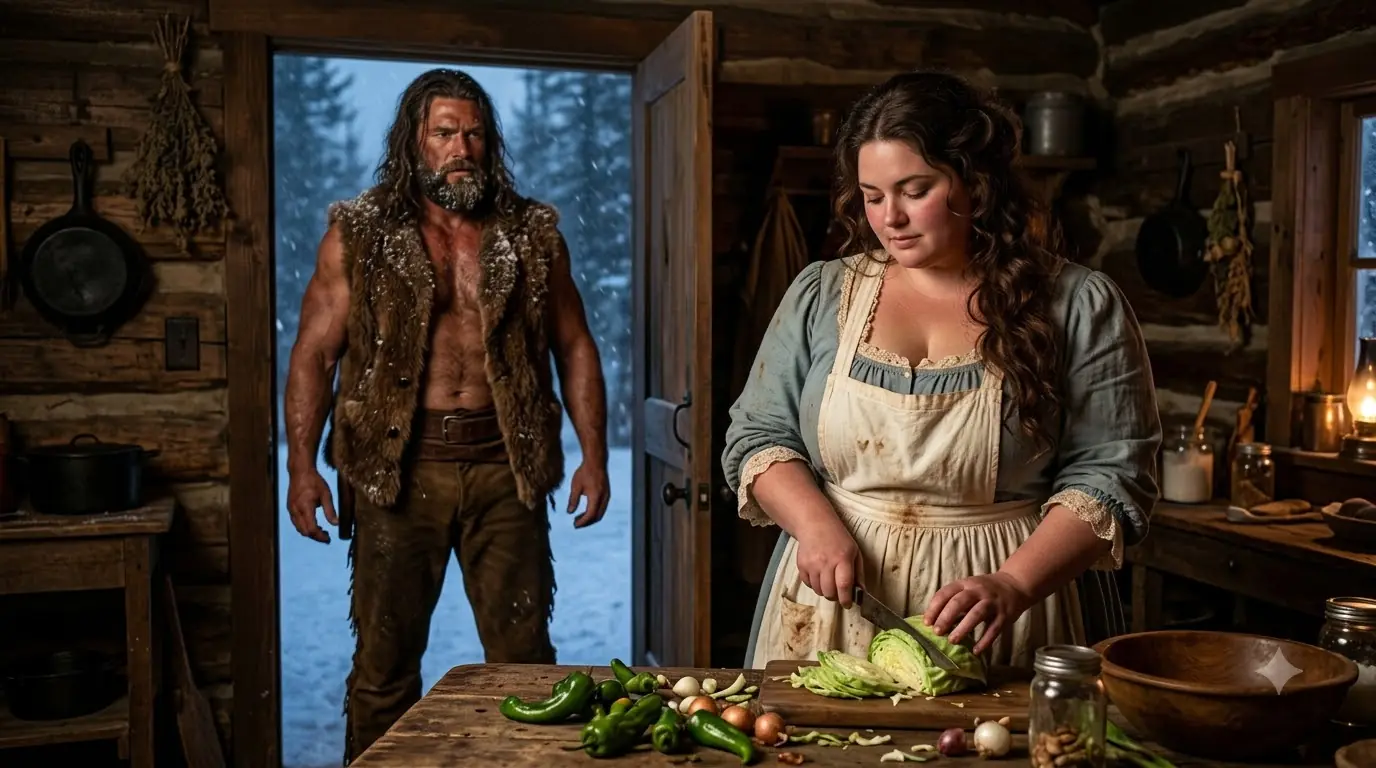
Not because Clara Bennett was holding it dangerously, but because she had been using the same dull kitchen knife for nearly three hours, chopping vegetables that everyone else in Pine Hollow had decided were worthless.
The blade moved steadily through a pale-green cabbage.
Chop.
Scrape.
Chop.
Scrape.
Tiny pieces scattered across the scarred wooden table, mixing with crooked green peppers, undersized onions, and leaves that had survived the first bite of autumn frost.
Outside the cabin, the Colorado mountains were disappearing beneath an early evening storm.
Inside, the woodstove burned orange.
A kerosene lantern hung from a ceiling beam, illuminating shelves of preserved fruit, hanging iron cookware, and the broad figure of a woman who had spent most of her life being underestimated.
Clara was thirty-two years old, with a beautifully rounded face, soft rosy cheeks, expressive brown eyes, and thick dark-chestnut hair twisted into a loose bun. Strands had escaped around her temples, curling in the heat from the stove.
She weighed close to three hundred pounds, with a strong, substantial figure shaped by years of hauling water, carrying firewood, turning stubborn mountain soil, and keeping a small homestead alive when nearly everyone had expected her to fail.
Her pale dusty-blue dress was faded at the elbows. Ivory lace trimmed its square neckline, and a large cream-colored apron covered the front of her skirt.
The apron was stained with flour, vegetable juice, and the evidence of a long day's work.
She had forgotten to eat lunch.
Again.
Caleb stood in the open doorway watching her.
He was forty-four, nearly six feet five inches tall, with heavy shoulders, muscular arms, weathered skin, and long dark-brown hair falling around his face. His beard was thick, with a few silver strands beginning to show near his chin.
A sleeveless brown fur vest hung open over his chest, and his dark buckskin trousers were secured by a broad leather belt.
Snowflakes clung to his hair and shoulders.
He had come down from the upper timber trail after checking the weather and repairing the latch on Clara's woodshed.
Now he watched her work with an expression caught somewhere between concern and admiration.
"You're still at it?"
Clara did not look up.
"Almost finished."
"You said that before noon."
"That was before I discovered another basket behind the shed."
Caleb glanced toward the vegetables.
The cabbage was misshapen.
Some peppers had grown twisted.
The onions were hardly bigger than walnuts.
He picked up one of the crooked peppers and turned it between his fingers.
"Mrs. Pike said those weren't worth carrying home."
Clara took the pepper from him.
"Mrs. Pike has never had to make supper out of two potatoes and an onion."
Caleb looked toward her.
"She heard you say something like that at the market."
"Good."
A faint smile appeared beneath his beard.
Clara returned the pepper to the cutting board.
"People think a vegetable stops being food when it stops being pretty."
She brought the knife down again.
"It doesn't."
Outside, a gust of wind sent snow swirling through the doorway.
Caleb stepped inside and closed it.
"The pass will be white by morning."
"Then I'd better finish."
He approached the table.
"Want help?"
Clara gave him a sideways look.
"You know how to chop cabbage?"
"I've cut timber thicker than that."
"Timber doesn't need to fit inside a preserving jar."
He examined the knife.
"Your blade needs sharpening."
"I know."
"Give it here."
Clara hesitated.
Then handed it over.
Caleb took a whetstone from the shelf beside the stove and began working carefully.
Clara watched his enormous hands guide the blade.
For all his rough appearance, he handled tools with astonishing gentleness.
That was one of the things she liked about him.
Not that she had ever admitted it.
Not even to herself on the loneliest evenings.
Caleb had been coming by the homestead for nearly a year, repairing what needed repairing, splitting firewood when his own work permitted, and occasionally leaving fresh trout or venison on her porch.
He never made a performance of helping.
He never asked her to be grateful.
And he never treated her large body as a reason she should be unable to manage her own land.
Still, Clara had learned long ago that kindness could carry expectations.
So she kept careful boundaries.
She paid him when she could.
Traded preserves when she could not.
And avoided wondering why he sometimes lingered after the work was finished.
Caleb tested the knife against a small scrap of wood.