When Toby was a puppy, everyone wanted to hold him.
His family brought him home at ten weeks old, when he was small enough to sleep across someone’s lap. Photographs later recovered from his microchip records showed a fluffy tan puppy wearing a bright blue collar and sitting among new toys.
He grew up inside that home.
He learned where his food was kept, which couch he was allowed to climb onto and what time his family usually returned each evening. He followed them from room to room and waited beside the door whenever he heard their car outside.
For nearly seven years, Toby believed that was where he belonged.
Then his back legs began to weaken.
At first, the changes were easy to overlook. His rear paws occasionally slipped on the kitchen floor, and he hesitated before climbing stairs.
His family assumed he was tired.
Several weeks later, Toby began dragging the nails of one rear paw during walks. He stumbled when turning and needed more time to stand after sleeping.
The problem continued getting worse.
One morning, Toby tried to rise from his bed, but his hindquarters remained on the floor. He pulled himself forward with his front legs while both rear paws dragged behind him.
His family took him to a veterinary clinic.
The examination suggested that the weakness originated in his spine or nervous system. The veterinarian recommended diagnostic imaging and explained that Toby needed immediate activity restriction to prevent further injury.
His family declined the additional testing.
They brought him home with medication, but his condition continued to deteriorate. Within days, he could no longer support any weight through his rear legs.
He also began losing control of his bladder.
Toby needed help with nearly every part of his daily routine. Someone had to support his hindquarters during bathroom breaks, keep his skin clean and reposition him so pressure sores would not develop.
His family decided they could not manage it.
They contacted a municipal shelter and said they wanted to surrender him.
At intake, they described Toby as “too much work now.” They explained that he could no longer walk, was having accidents inside the house and required more care than they expected.
A shelter employee asked whether they would consider temporary assistance while his medical condition was evaluated.
They refused.
Toby was placed on a blanket in the shelter lobby. His family handed over his records, signed the paperwork and walked toward the exit.
He immediately tried to follow them.
His front paws scrambled against the smooth floor while his paralyzed rear legs dragged uselessly behind him. The movement twisted his body to one side, but he continued pulling himself toward the door.
His family did not turn around.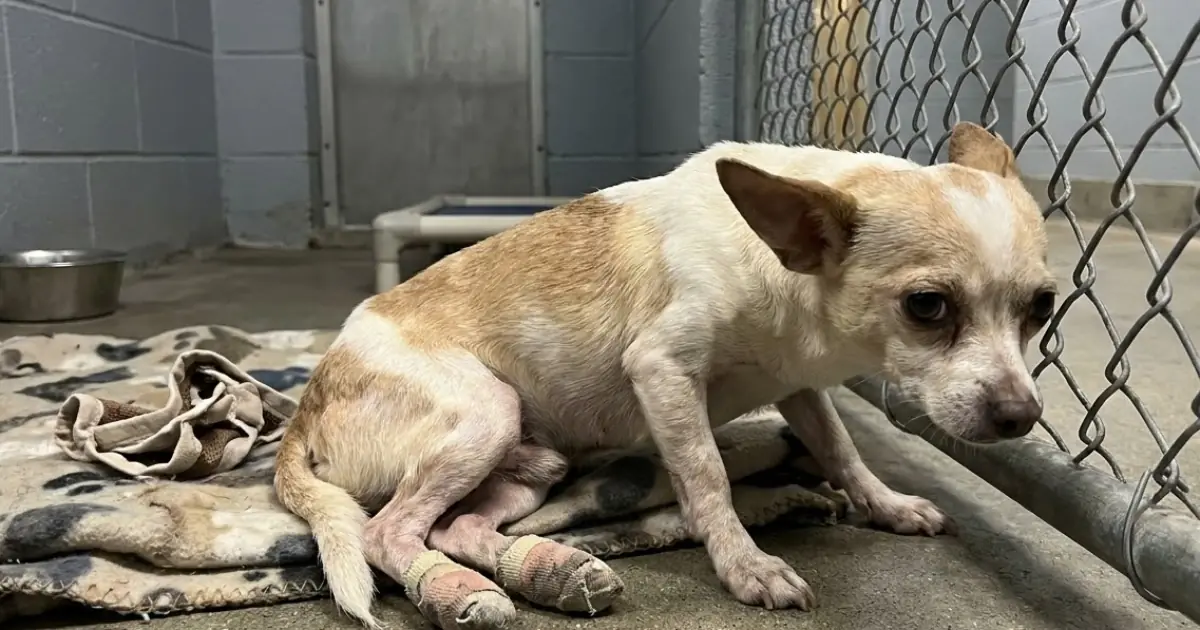
A staff member knelt and placed both hands beneath Toby’s chest to stop him from injuring himself. He struggled for several seconds, keeping his eyes fixed on the closing door.
Then he became still.
The shelter began calling him by the name listed in his veterinary records. It was one of the few familiar things he still had.
Toby was moved to the medical area and placed on thick, clean bedding. His rear legs were thin, particularly around the thighs, suggesting that the weakness may have been developing longer than the family had described.
The tops of his paws were scraped from dragging across hard surfaces. Urine had irritated the skin along his abdomen and hindquarters, and a small pressure sore was beginning to form near one hip.
He was frightened but gentle.
During the examination, Toby kept turning his head toward the hallway. Every time the outer door opened, his ears lifted.
He still expected familiar footsteps.
The shelter’s veterinarian performed a neurological examination. Toby could not stand or move his hind legs voluntarily, and his response to sensation was reduced.
Imaging revealed damage in the lower section of his spine.
The exact cause remained uncertain. A ruptured disc was possible, although chronic degeneration or an earlier injury could also have contributed. More advanced imaging would be needed before the team could fully understand the damage.
One thing was already clear.
Toby had not chosen to stop walking.
He was not misbehaving when he urinated indoors, and he was not refusing to stand because he had become lazy. His body was no longer carrying messages normally between his spinal cord and hind legs.
He needed medical care—not punishment or rejection.
The shelter contacted a veterinary specialty partner willing to evaluate him. Until the appointment, staff focused on preventing additional injuries.
Toby was carried outside on a padded stretcher for bathroom breaks. His bladder had to be checked and sometimes manually expressed because he could not empty it completely on his own.
The irritated skin was cleaned and protected, while soft bandages covered the abrasions on his paws.
Caregivers repositioned him throughout the day.
Toby did not understand why they kept moving him. At first, his body became rigid whenever someone reached beneath his abdomen.
But he never snapped.
Once the caregiver finished and stepped back, Toby returned his attention to the door.
He refused his first meal.
He smelled the food and turned away. A staff member offered small pieces by hand, but he kept his head resting on the blanket.
Late that evening, the same employee sat quietly beside him without asking him to eat.
After several minutes, Toby shifted closer and rested his chin against her leg.
When she offered another piece of food, he swallowed it.
Then he accepted a second.
It was the first sign that he might allow someone new to help him.
At the specialty hospital, additional imaging confirmed serious compression around Toby’s spinal cord. Because too much time had passed since he lost the ability to walk, surgery could not guarantee that movement would return.
The team discussed the options carefully.
Toby was not in uncontrollable pain, and his front legs remained strong. His blood tests showed that his major organs were functioning normally.
Paralysis alone did not mean he had no quality of life.
However, caring for him would require consistency. His bladder needed monitoring, his skin had to remain clean and he would need rehabilitation to preserve strength and prevent stiffness.
The rescue chose to continue treatment.
Toby began a structured rehabilitation program.
The first sessions were simple. A therapist gently moved his rear legs through a safe range of motion while supporting his joints. His paws were checked for sores, and his skin was examined closely.
A wide sling supported his hindquarters during standing exercises.
At first, Toby did not understand what was expected. His front legs pushed forward while the sling held the rest of his body upright.
He looked behind him as though searching for the legs he could no longer feel normally.
The therapist kept each session short.
No one promised that Toby would walk again. The goal was to learn what function remained, keep him comfortable and help him move through the world as independently as possible.
His emotional recovery progressed slowly.
For several days, Toby reacted to every vehicle outside. He raised his head when voices entered the lobby and watched the doorway until they disappeared.
No one from his family returned.
The shelter attempted to contact them for more information about when his symptoms had started. Calls were not answered.
Toby eventually stopped looking up at every sound.
Instead, he began responding to the people caring for him.
He learned the schedule of his meals and medical checks. When his regular caregiver approached, his tail moved across the blanket.
He also began eating normally.
One morning, staff placed a small stuffed toy beside him. Toby held it between his front paws and rested his chin across its back.
From then on, the toy remained near his bed.
Two weeks after his surrender, Toby received a custom-fitted mobility cart.
The lightweight frame supported his hindquarters while two wheels replaced the function of his rear legs. His front legs would provide the movement.
The first fitting did not go smoothly.
When staff secured him inside the cart, Toby froze. He looked from side to side and refused to move.
A caregiver placed a treat a few inches in front of him.
Toby stretched his neck toward it but kept his paws still.
The therapist moved the treat slightly closer and allowed him to take it without walking. There was no attempt to force him forward.
During the next session, Toby moved one front paw.
The cart rolled slightly.
Startled, he stopped again.
A few minutes later, he took another step.
By the end of the week, Toby could cross the rehabilitation room.
His movements were slow and occasionally uneven, but he quickly learned that the wheels followed wherever his front paws went. With each session, he became more confident about turning and stopping.
The first time he entered the outdoor yard in his cart, Toby remained near the doorway.
Then he smelled the grass.
He moved forward, paused and lowered his nose. Within minutes, he was rolling along the edge of the yard, investigating places he had been unable to reach since his paralysis began.
His tail lifted slightly behind him.
The shelter employee who had received him on surrender day watched as Toby crossed the yard without dragging his body.
He was not walking in the way he once had.
But he was moving by himself.
Toby still required daily assistance.
The mobility cart could not be worn constantly. Indoors, he rested on padded surfaces and used a soft drag bag to protect his skin when moving short distances.
Caregivers continued checking his bladder, cleaning him after accidents and monitoring for urinary infections.
His rear legs remained paralyzed.
Yet his personality began returning.
He barked when meals took too long. He carried his stuffed toy between rooms and nudged familiar staff for attention.
When placed in his cart, he hurried toward the yard instead of waiting for encouragement.
The dog his family had described as too difficult still enjoyed food, sunlight, toys and human company.
He still formed attachments.
He still had preferences.
He still had a life.
Several employees struggled to understand how the family who had raised him from puppyhood could leave precisely when he became most dependent upon them.
Toby had spent years trusting those people.
When his body changed, his loyalty did not.
Only theirs did.
A medical foster caregiver eventually offered Toby a quiet place to continue recovering. Her home had nonslip flooring, no stairs to the yard and enough space for his mobility cart.
During his first evening there, Toby remained close to the front door.
Whenever the caregiver walked into another room, he pulled himself after her with his front legs. He seemed afraid that being left behind for even a moment might mean she would not return.
She moved his bed closer to where she was sitting.
Toby settled only after one of his front paws touched her foot.
Over the following days, he learned the routine.
His caregiver left the room and came back.
She opened the front door and returned with his leash.
She lifted him into his cart each morning and placed him back on clean bedding afterward.
Nothing about his care was effortless.
But none of it made him useless or unlovable.
Toby may never regain movement in his rear legs. The damage to his spinal cord is serious, and his long-term health will require ongoing attention.
Still, paralysis did not erase the puppy his family once adored.
He remains the same dog who wants to stay close to people, carry a toy and explore every patch of grass within reach.
They welcomed him when he was tiny, healthy and easy to love.
Then his body failed him, and the people he trusted decided to leave.
Toby still watches the door sometimes.
But he no longer spends the entire day waiting for the family who abandoned him.
Now, when his foster caregiver lifts his mobility cart from the wall, Toby pulls himself forward, places his front paws beneath his chest and waits eagerly to move again.