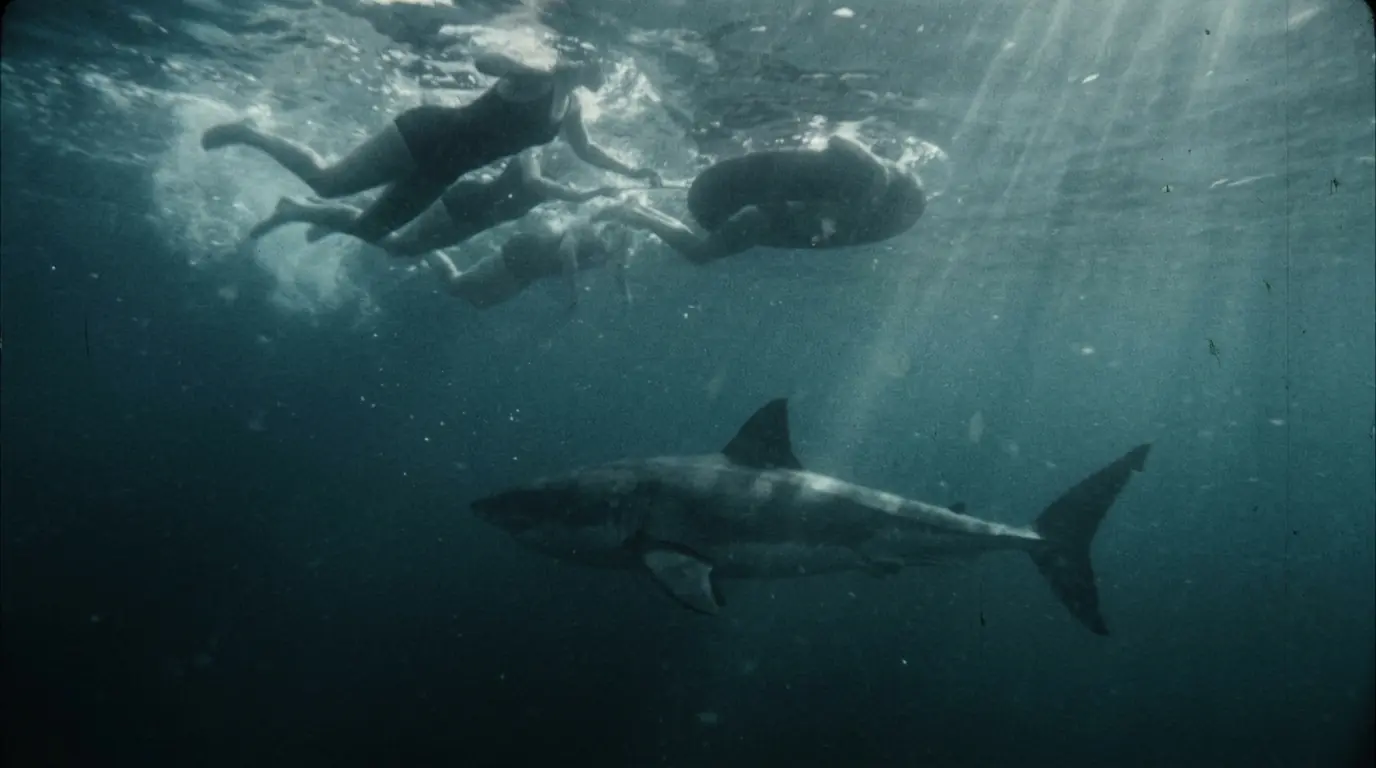
The rescuers already had Barry Wilson out of the shark’s jaws.
That should have been the end of the attack.
It wasn’t.
On the afternoon of December 7, 1952, the 17-year-old was swimming just offshore at Lover’s Point in Pacific Grove, California, when witnesses saw a large shark strike him. Wilson disappeared beneath the surface, came back up terribly wounded, and cried for help.
Other swimmers went toward him.
They managed to reach the teenager, get him onto an inflatable inner tube, and begin the exhausting journey back through rough water toward shore.
Then they realized something terrifying.
The shark had not left.
It remained near the rescue party as they struggled toward land.
For roughly half an hour, the men had to move an injured teenager through heavy surf while the same large predator continued to circle and, according to the scientific investigation published afterward, made repeated approaches toward the group.
Wilson would not survive.
But the circumstances of his death made the case historically important for another reason. The incident became one of the earliest California shark attacks subjected to a detailed scientific investigation. Marine biologist Rolf L. Bolin of Stanford’s Hopkins Marine Station interviewed witnesses, reconstructed the attack, studied the environmental conditions and examined Wilson’s injuries.
His 1954 report concluded that the attacker was a white shark.
And because several witnesses remained in the water during the prolonged rescue, they provided an unusually detailed picture of what the shark did after its initial strike.
The result reads less like a distant historical record than a nightmare unfolding in slow motion.
Because Wilson was close to shore.
People could see him.
Help reached him.
And still, getting those last few yards back to safety became a fight of its own.
A Sunday Swim at Lover’s Point
December on California’s Monterey Peninsula does not suggest warm recreational swimming.
The water that afternoon was cold.
Bolin’s investigation recorded a temperature of approximately 12.9°C—about 55°F—earlier that morning at nearby Hopkins Marine Station. Later measurements near Point Aulone were slightly colder.
The ocean was also far from calm.
Bolin reported surf reaching perhaps eight feet, while visibility underwater was extremely poor—only around six to eight feet. Rain runoff from the previous night and plankton in the water contributed to the murky conditions.
Yet swimming in those waters was something Barry Wilson and his companions were accustomed to doing.
Wilson was a Pacific Grove teenager. Historical accounts describe him as an active swimmer, and that afternoon he entered the water with his friend Brookner Brady Jr., who was 15.
They were swimming near Point Aulone, better known locally as Lover’s Point.
The attack occurred just beyond the breakers.
Bolin placed Wilson approximately 25 yards offshore, above water roughly 30 feet deep.
That detail matters.
Wilson was not miles out at sea.
He could still be watched from shore.
One of the people watching was Lloyd Bassford.
Bassford had moved to an elevated position on the rocks overlooking the swimmers.
From there, he noticed Wilson suddenly behaving strangely.
The teenager jerked around in the water.
He began looking in different directions.
Then Bassford saw his expression.
Something had frightened him.
Moments later, Bassford saw what it was.
A shark was approaching.
The First Strike Lifted Him Out of the Water
According to Bolin’s reconstruction, the shark came toward Wilson at the surface and struck him from the front.
The impact was powerful enough that Wilson was lifted partly out of the water.
For an instant, Bassford could see the teenager struggling directly against the animal.
Wilson placed both hands against the shark’s back and pushed, apparently trying to free himself.
Then he fell sideways.
And disappeared.
Bassford believed Wilson had not simply fallen underwater from the impact.
The shark appeared to pull him down.
Above the surface, there was suddenly no Barry.
Just rough, murky Pacific water.
Then he came back up.
He was badly injured.
And now people around him understood what was happening.
There was a shark in the water.
Wilson began calling for help.
The obvious instinct for anyone nearby should have been to get out.
Several men did the opposite.