The first laugh came before Clara Bennett had even taken her purse from her apron.
It rolled across the autumn market like a stone thrown downhill, picked up by one farmer, then another, until half the men standing beside the livestock pens had turned to see what foolish thing the large woman in the faded blue dress had done now.
Clara ignored them.
She stood beside a wooden crate containing twelve of the sorriest chickens in Laurel Ridge.\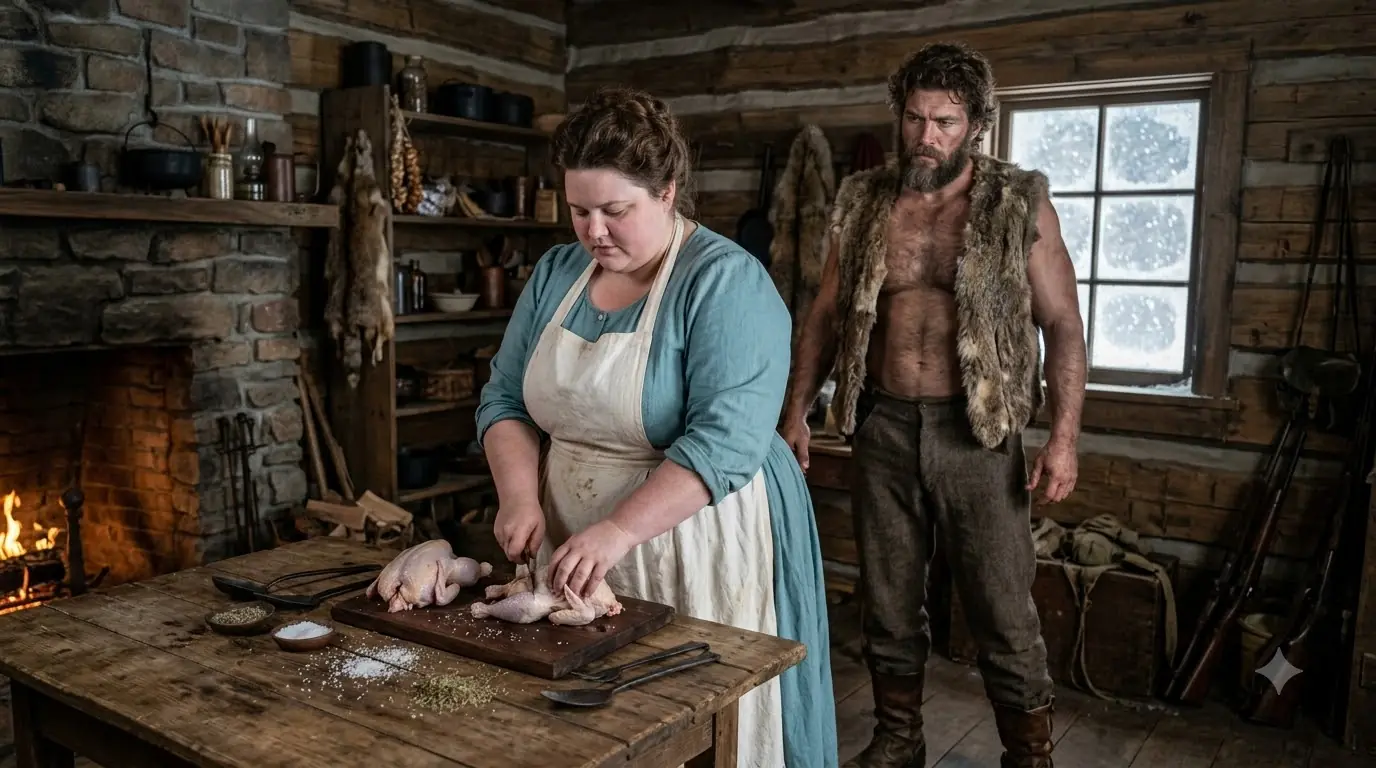
Some had bare patches along their necks.
One had lost most of its tail feathers.
Two were so thin that the sharp lines of their breastbones showed beneath pale skin and ragged plumage.
Another sat in the corner of the crate with its eyes half closed, looking as though surviving the afternoon would require more effort than it wished to give.
The livestock seller, an embarrassed little man named Mr. Coyle, rubbed the back of his neck.
“You don’t have to take the whole lot.”
Clara counted the coins in her palm.
“I know.”
“I could give you the six strongest.”
“I want all twelve.”
The laughter grew louder.
A farmer named Silas Broome leaned against a wagon wheel and called across the lane.
“Planning a feast, Clara?”
Several men laughed.
Clara glanced at him.
Silas was forty-five, red-faced, broad in the stomach, and owner of more bottomland than anyone else in the settlement.
He also had a habit of mistaking ownership for intelligence.
Another farmer lifted his hat.
“Feast? There ain’t enough meat on those things to flavor a spoon.”
More laughter.
Mr. Coyle looked uncomfortable.
Clara placed her coins on his table.
“How much for the broken grain sack?”
He blinked.
“The one behind the crate?”
“Yes.”
“That’s mostly cracked kernels and dust.”
“How much?”
“You can have it.”
Clara nodded.
“Thank you.”
Silas called:
“You buying chicken feed after buying chickens too weak to survive eating it?”
Clara looked at the torn grain sack.
Then at the birds.
Then back at Silas.
“No.”
“What’s it for?”
“You wouldn’t want it.”
“Why not?”
“It’s mostly cracked kernels and dust.”
The men laughed again, but not with Silas this time.
His expression tightened.
Clara lifted the crate.
It was heavy.
She was heavier.
At nearly three hundred pounds, Clara had long ago become accustomed to people assuming her size made ordinary labor difficult.
Some things were difficult.
Climbing steep ladders.
Crawling beneath fences.
Finding dresses made for anyone broader than the women whose measurements merchants seemed to imagine when ordering fabric from the valley.
But hauling feed, cutting wood, lifting water buckets, kneading thirty pounds of dough, splitting carcasses, and carrying sacks had built strength into her arms that few people noticed until they needed something moved.
She settled the crate against one hip.
A man near Silas whistled.
Clara kept walking.
The autumn market filled the open field beside Laurel Ridge Meeting House once each October.
For three days, every family within twenty mountain miles came down from the hollows and high ridges to trade livestock, flour, salt, hides, iron fittings, seed, dried apples, smoked pork, soap, wool, candles, and whatever else might help them survive until spring.
The settlement itself consisted of fewer than fifty permanent cabins scattered along two narrow valleys where the streams met.
The main road crossed a mountain pass four miles north.
Everything Laurel Ridge could not produce came through that pass.
Salt.
Coffee.
Metal.
Medicine.
Lamp oil.
Flour when the corn crop failed.
There had not been a truly catastrophic winter in eleven years.
That fact had made people careless.
Clara was not careless.
Her mother had been.
Once.
Only once.
Clara remembered being nine years old and watching her mother boil shoe leather.
Not because anyone wanted to eat leather.
Because the February snow had blocked the pass for twenty-six days, and three families had already slaughtered every animal worth keeping.
Her father had walked nine miles through snow to find corn.
He returned with frostbite in two toes and half a sack of meal.
Clara never forgot the sound her mother made when she saw him alive.
She never forgot the empty pantry either.
Her mother had taught her something after that winter.
A pantry was not a room full of food.
It was time.
Every jar was time.
Every sack of flour.
Every smoked ham.
Every dried apple.