For three mornings in a row, all twelve goats stopped at exactly the same place.
Not approximately the same place.
Not somewhere along the same stretch of fence.
Exactly the same place.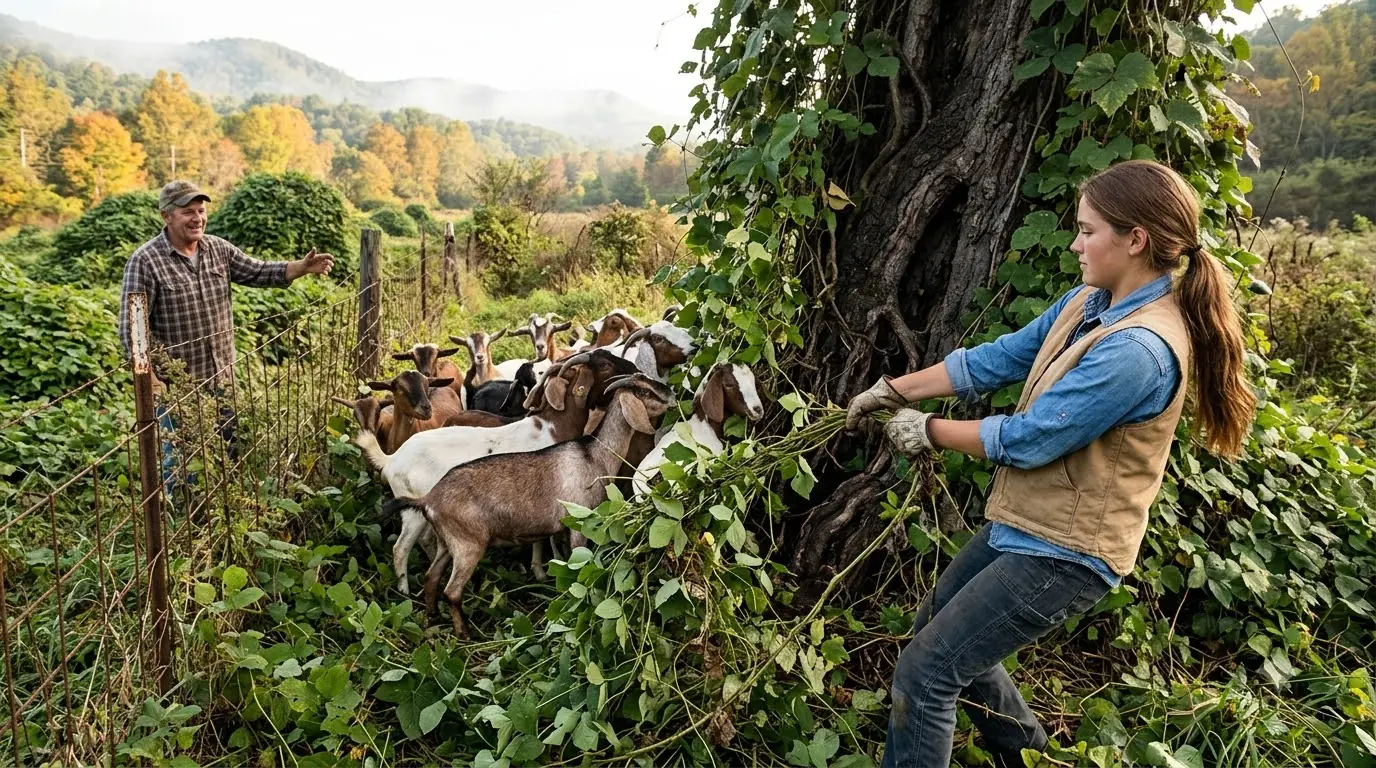
The nineteen-year-old farm girl noticed it because goats were not creatures known for respecting patterns when food was involved. They wandered. They tested fences. They climbed on things no reasonable animal would consider climbable. They ate blackberry leaves, poison ivy, cedar tips, cardboard if given the opportunity, and once, to her embarrassment, the corner of an unpaid electric bill she had left on the hood of the truck.
But for three mornings, when she opened the temporary gate and released them onto the eastern slope of the fifty acres everyone in the county had laughed at her for buying, the entire herd moved downhill, crossed the washed-out logging track, passed two perfectly good patches of honeysuckle, and stopped at the same wall of kudzu.
Then they stared.
Twelve goats.
Twenty-four ears angled forward.
Some pawing at the dirt.
Some stretching their necks.
All of them fixed on one tangled mound beneath an enormous green curtain of vines.
The first morning, she assumed they had smelled something.
The second morning, she thought perhaps a raccoon, a rabbit nest, or a mineral deposit in the soil had interested them.
By the third morning, she stopped calling it coincidence.
She rested one gloved hand against the sagging wire fence and watched.
The tallest doe rose onto her hind legs and reached into the vines.
Another pushed beneath her.
A third began tugging insistently at a thick kudzu runner that disappeared into the vegetation.
“What are you girls finding?”
The goats did not answer.
They rarely did.
Behind her, a pickup truck rattled along the old county road.
She recognized the engine before she saw it.
The older farmer from the neighboring property slowed near the broken fence line, leaned toward his open window, and looked from the girl to the goats.
He had been doing that almost every day since she bought the land.
Checking.
Observing.
Possibly waiting for the moment when he could say he had warned her.
He pulled the truck onto the shoulder and climbed out wearing muddy rubber boots, faded jeans, a plaid shirt, a brown work jacket, and the same tan cap he seemed to wear regardless of weather.
“Still feeding goats to the weeds?”
The farm girl did not turn.
“They're feeding themselves.”
“Looks like the weeds are winning.”
“They've cleared almost two acres.”
“Only forty-eight to go.”
She glanced at him.
“Good morning to you too.”
The older farmer smiled.
He was not cruel.
That almost made his teasing more irritating.
Cruelty could be dismissed.