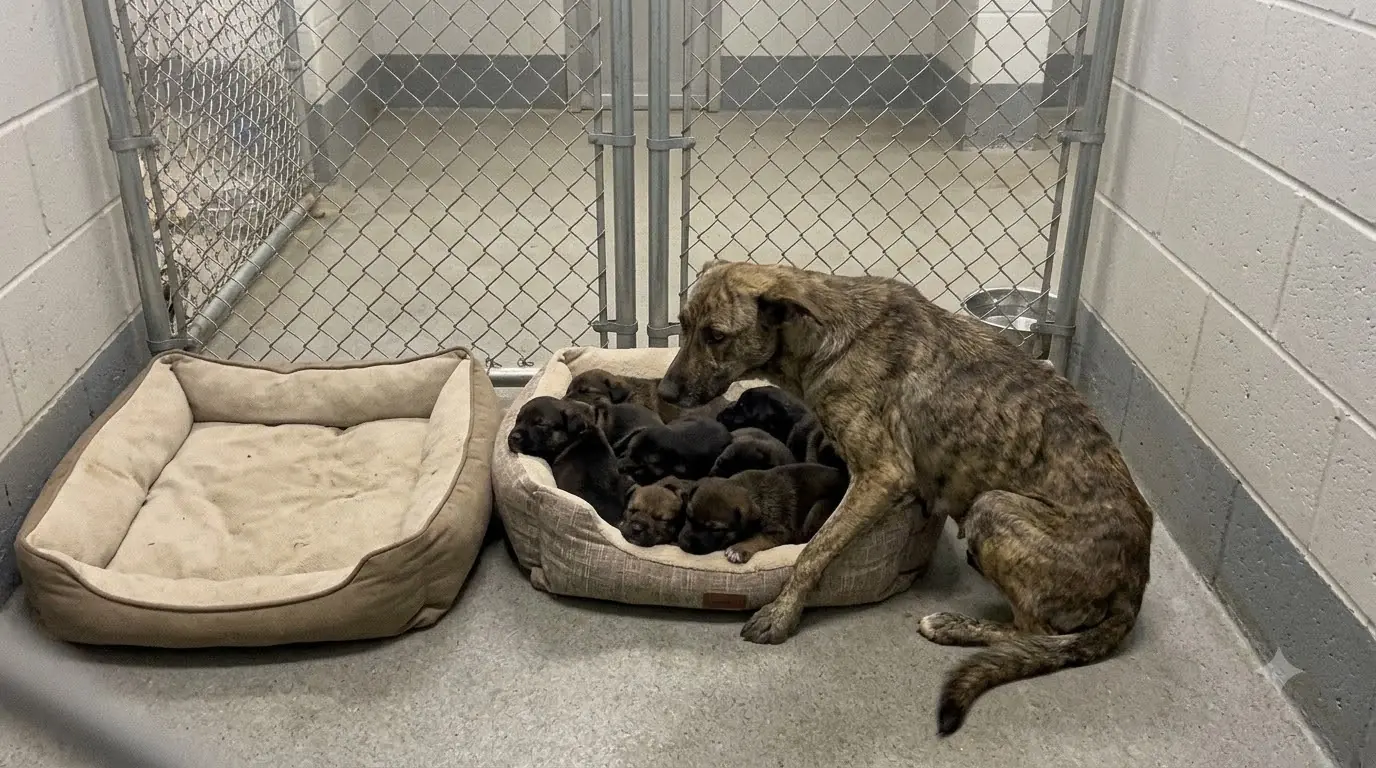
The Bed Was Already Full Before She Climbed In
The maternity kennel had two sleeping areas.
One was a small puppy bed with low padded sides.
The other was a larger mattress placed immediately beside it for the mother.
The Shepherd mix could have stretched out on the larger bed.
She rarely did.
Instead, when the puppies settled for the night, she walked toward the smaller bed.
The puppies were already packed inside.
One lay across another's back.
Two were pressed against the padded edge.
Another was asleep with its head resting near the mother's usual spot.
There was no realistic room for an adult Shepherd mix.
She stepped in anyway.
One front paw.
Then the other.
She turned carefully so she would not step on anyone.
Her hind feet barely fit.
Then she lowered herself around the outside of the puppy pile.
Most of her body remained beyond the edge.
Her hips rested on the kennel floor.
Part of her chest hung over the low side.
Only the curved line of her abdomen fit close enough for the puppies to press against her.
Within minutes, they did.
The small bodies shifted toward her.
The mother stayed there.
Her own larger bed remained empty less than a foot away.
She Had Already Been Raising Them Before Anyone Found Her
The Shepherd mix had been living as a stray with the litter before the family entered rescue care.
How long they had been outside was not known with certainty.
The rescue could not document every place they had slept or how often the mother had found food.
What staff could see was the condition in which she arrived.
She was underweight.
Her ribs were visible through her coat.
Muscle over her hips and thighs was reduced.
Her coat was dirty and uneven from life outdoors.
Her mammary glands showed that the puppies had been nursing heavily.
The puppies, by comparison, were small but active.
That difference mattered.
A nursing mother can maintain a litter while her own body condition declines.
Milk production demands calories, protein, water, and minerals.
If intake does not keep pace with those demands, the mother's reserves pay the difference.
By the time this Shepherd reached the shelter, there was not much reserve left.
Staff Examined Her Separately From the Puppies
The family arrived together.
They were cared for together.
But they were not treated as one medical patient.
The mother received her own examination.
Her hydration was assessed.
Her body condition and muscle condition were recorded.
Her heart and lungs were checked.
Her abdomen was palpated.
Her mammary glands were examined for pain, abnormal heat, firmness, discoloration, or discharge that could suggest mastitis.
Her skin and coat were evaluated.
Bloodwork and fecal testing were used as appropriate to assess overall health and rule out problems that could complicate weight restoration.
The puppies were examined individually.
Each pup was weighed.
Hydration and development were checked.
Their mouths, abdomens, hearts, lungs, skin, and general activity were assessed.
No puppy was assumed healthy simply because it could crawl toward the mother and nurse.
The Scale Became Important for Everyone
The puppies' weights were tracked regularly.
Young puppies can look active while still failing to gain appropriately.
A scale can reveal that sooner than appearance.
The mother was weighed too.
Her number mattered for a different reason.
The rescue needed to know whether her nutritional plan was helping her recover or whether lactation was still consuming nearly everything she took in.
The goal was never to keep the puppies dependent on her as long as possible.
The goal was healthy puppies and a recovering mother.
Both mattered.
At First, She Barely Left Them
During the earliest days, the Shepherd stayed close to the litter.
She ate.
Drank.
Went outside briefly when necessary.
Then returned.
When one puppy vocalized, her head lifted.
When several began moving, she repositioned.
During nursing, she often curved herself around them as tightly as the bedding allowed.
That posture was not unusual while the puppies were very young.
What became unusual was how long she continued trying to fit herself into their increasingly crowded bed.
The Puppies Grew Faster Than the Bed Did
Within a short time, the litter changed.
Their legs became stronger.
They crawled farther.
Then they started walking.
They took up more physical space.
The little maternity bed that had once seemed generous now looked crowded even without their mother.
Staff expected her to use the larger mattress more often.
She had room there.
The puppies could still reach her if she lay beside them.
Instead, she continued climbing into their bed.
The result looked increasingly impractical.
Her shoulders might fit.
Her abdomen might fit.
Her hips did not.
So her body spilled outward.
She Learned to Arrange Herself Around the Edge
The sequence became familiar.
Approach the puppy bed.
Look down.
Place her front feet between moving bodies.
Wait for a puppy to shift.
Turn carefully.
Lower one shoulder.
Curve her abdomen along the inside edge.
Let the rear half remain outside.
The low padded wall pressed beneath her side.
Her hips settled on the floor.
Sometimes one rear leg extended completely beyond the bed.
The position did not look comfortable to staff.
She chose it repeatedly.
The Larger Bed Was Not Unfamiliar
Staff made sure the mother understood she had another option.
The larger mattress was placed close.
She was fed near it.
She rested there during some daytime periods.
When the puppies were temporarily being weighed or examined, she sometimes lay on it without hesitation.
That told caregivers something useful.
She did not avoid the larger bed itself.
Her choice changed when the puppies were present.
That did not prove a human-like idea of sacrifice.
It did show a strong preference for physical proximity during rest.
Staff Did Not Romanticize Her Depletion
A thin mother dog continuing to let a growing litter press against her can easily be framed as endlessly selfless.
The rescue did not want that story to hide the medical reality.
She needed recovery.
Her body was depleted.
The puppies needed to begin taking more of their nutrition from developmentally appropriate supplemental food as they matured.
It was not kind to allow every calorie to continue passing through the mother simply because nursing looked emotionally powerful.
So the veterinary and foster teams supported weaning gradually.
Supplemental Feeding Reduced the Pressure on Her
As the puppies reached the appropriate developmental stage, soft puppy food was introduced.
At first, they mostly investigated it.
One stepped directly into the dish.
Another licked food from a sibling's face.
Some still preferred nursing immediately afterward.
That was normal.
Over time, solid food intake increased.
Nursing frequency decreased naturally.
The mother still allowed access.
But the puppies were no longer depending on her for every meal.
That change was important for her body.
Her Diet Was Adjusted for Lactation and Recovery
The mother needed a nutritionally complete diet with enough energy to support both healing and remaining milk production.
Her meals were measured but generous enough for her physiologic needs.
Staff monitored stool, appetite, weight, and body condition.
They did not simply fill a bowl endlessly and assume more was always better.
Nutrition had to be tolerated and useful.
As nursing decreased, her intake could be adjusted again.
The goal changed over time.
At first, support lactation while preventing further loss.
Later, restore her.
Her Mammary Health Was Monitored During Weaning
As the puppies nursed less, the mother's mammary glands needed observation.
Gradual reduction is safer than abrupt separation in many cases.
Staff watched for abnormal swelling, warmth, redness, pain, or discharge.
None of those changes were ignored simply because the puppies were thriving.
A healthy transition had to include the mother too.
The Small Bed Became More Crowded Every Week
The puppies did not care about geometry.
They climbed wherever they could.
Across their mother's front legs.
Onto her belly.
Between her chest and the padded edge.
The Shepherd would sometimes enter and realize there was almost no place to lower herself.
She waited.
A puppy moved.
She tried again.
Eventually, she found enough room to curve around the outer rim.
The larger bed remained untouched beside them.
Staff Tried Moving the Beds Closer Together
One simple possibility was that the mother wanted continuous contact and perceived the two beds as separate spaces.
So caregivers pushed them closer.
The edges nearly touched.
Now she could lie on her mattress while the puppies remained only inches away.
For a few naps, she did.
Then nighttime came.
She stepped off the larger bed.
Climbed into the smaller one.
Curled around the puppies.
Hips on the floor.
Again.
They Did Not Force Her to Stay Out
As long as the position was not injuring her and the puppies could move freely, staff allowed the choice.
But they improved the surrounding surface.
Extra padding was placed outside the puppy bed where her hips most often landed.
That way, the part of her body that did not fit was not repeatedly lying on bare kennel flooring.
The fix did not make the scene look more orderly.
It made it more comfortable.
That mattered more.
Her Body Needed Pressure Protection
Because she was underweight, her hips had little padding of their own.
Repeated contact with hard surfaces could create soreness.
Staff checked her skin regularly.
Elbows.
Hips.
Hocks.
Areas along the ribs.
The additional mat outside the puppy bed reduced pressure while still letting her position herself around the litter.
The shelter adapted around what the dog was actually doing.
The Puppies Began Leaving the Bed Before She Did
As they grew, the puppies started sleeping in more places.
One might fall asleep beside a toy.
Another on the larger mattress.
Two might remain in the puppy bed.
The mother still checked the small bed first.
That became almost funny in a quiet, bittersweet way.
Sometimes only one puppy was inside.
She still squeezed herself along the edge.
Other times the bed was empty.
Then she would lie in it almost completely, despite having a much larger option beside it.
The space had become part of her routine.
Her Weight Started Moving in the Right Direction
Once supplemental feeding reduced the nutritional burden of the litter, the mother's body began responding more clearly.
Her weight increased slowly.
Her ribs became less prominent.
Her shoulders filled out.
The hindquarters took longer.
That was expected.
Muscle rebuilding requires nutrition plus movement over time.
No one expected a dramatic transformation within days.
She Started Taking Longer Breaks From the Puppies
At first, every separation was brief.
A bathroom trip.
A meal.
A few minutes outside.
Later, the mother began lingering.
She sniffed the yard.
She rested in another section of the maternity area.
Sometimes the puppies slept while she remained several feet away.
That was healthy.
Maternal care should evolve as puppies mature.
A mother dog does not need to remain physically wrapped around a litter every hour of the day.
She Still Returned When They Became Noisy
If several puppies vocalized at once, she noticed.
She might stand.
Approach.
Sniff.
Sometimes she lay down nearby.
Sometimes she allowed nursing.
Her responses remained appropriately maternal.
But the constant urgency gradually decreased.
The puppies were becoming more capable.
So was she.
The First Time She Slept Entirely on Her Own Bed
It happened during an afternoon nap.
All of the puppies were sleeping.
Several were crowded into the small bed.
Others had sprawled across blankets.
The Shepherd walked past them.
She stepped onto her larger mattress.
Turned.
Lay down.
Her entire body fit.
Nothing hung over the edge.
No puppy was pressed against her abdomen.
She stretched one rear leg straight behind her.
Then fell asleep.
Staff left her alone.
The nap lasted less than an hour.
It was still a meaningful change.
That Night, She Climbed Back Into the Puppy Bed
Progress was not a clean transition.
The old routine returned.
After the lights dimmed, she walked toward the little bed.
The puppies were already packed inside.
She stepped in.
Turned.
Curled.
Half her body remained outside.
There was no reason to treat that as failure.
Behavioral routines do not vanish because a dog has demonstrated one alternative.
The important thing was that another option had appeared.
Foster Care Offered More Space
Once the family's medical status allowed it, they moved into an experienced foster home.
The setup included a safe puppy pen, multiple washable beds, and a separate adult-sized mattress for the mother.
The pups had enough space to explore.
The mother could step away without leaving the room.
That helped everyone.
The First Night in Foster Looked Exactly Like the Shelter
The puppies chose the smallest bed.
Of course they did.
They piled into it.
The mother investigated the room.
Drank.
Ate.
Then approached the puppy bed.
The foster caregiver watched her perform the familiar maneuver.
Step in.
Turn.
Wait.
Curve around the edge.
Hips outside.
Sleep.
The behavior had followed the family out of the shelter.
The Home Made Independence Easier
Without constant kennel activity, the mother could rest in other places without needing to monitor every surrounding sound.
She began using a rug near the foster caregiver.
Then the adult bed.
Then a shaded patch in the yard.
The puppies remained within a secure environment.
She did not have to keep her body physically around them to know where they were.
That practical change likely helped her relax.
The Puppies Became Less Interested in Sleeping Against Her
Development continued.
They played longer.
Ate solid food.
Explored farther within their safe area.
Some still curled against their mother.
Others preferred siblings.
One repeatedly chose the adult mattress even when the mother was not on it.
The litter was becoming a collection of individual dogs rather than one moving pile.
That was exactly what staff wanted.
The Mother Began Saying No Sometimes
As weaning progressed, she occasionally stood when puppies attempted to nurse.
She moved away.
Or remained standing instead of lying down.
That was normal maternal boundary-setting.
The foster caregiver did not force her to continue nursing just because the puppies wanted access.
The mother's choice mattered too.
Her Mammary Tissue Gradually Returned Toward Normal
As milk production decreased, her body changed.
The mammary glands became less full.
Staff continued monitoring for complications.
Her nutritional demands decreased.
That allowed more of her dietary intake to support weight restoration and muscle rebuilding.
She began looking less like a depleted nursing mother and more like an adult Shepherd again.
Her Energy Changed Before Her Sleeping Habit Fully Did
She started moving more readily.
Walks became slightly longer as medically appropriate.
She showed greater interest in scents.
She followed the foster caregiver occasionally.
She carried a toy once.
Yet at night, she still sometimes chose the small bed.
Her body was recovering faster than one of her most familiar routines.
Eventually, She Could No Longer Fit at All
The puppies kept growing.
The small bed did not.
There came a point when the Shepherd tried to step in and there simply was not enough room to turn safely.
She stood over the crowded puppies.
Looked down.
Shifted one front paw.
Waited.
No space appeared.
For a few seconds, she remained there.
Then she stepped back out.
She walked to the adult mattress.
Lay down.
Several puppies eventually left the small bed and joined her.
She did not need to squeeze herself into their space anymore.
They came into hers.
Staff Did Not Treat That as a Sad Ending to the Behavior
It was development.
The puppies were supposed to grow.
They were supposed to need less constant maternal contact.
The mother was supposed to regain her own physical space.
The emotional part of the story was not preserving the cramped bed forever.
It was watching the need for it fade.
She Started Sleeping Stretched Out
As her body condition improved, her resting posture changed.
She occupied more space.
Her back legs extended farther.
Her abdomen was no longer always curved inward around puppies.
She sometimes slept on her side with no dog touching her at all.
That kind of rest had likely been difficult during the most intensive nursing stage.
Now it became normal.
The Puppies Still Sought Her Out
Independence did not mean the relationship disappeared.
The puppies still approached her.
Some slept beside her.
They played near her.
She sniffed them.
Corrected overly rough behavior appropriately.
Rested nearby.
But the contact became flexible.
No one needed to fit every body into one tiny bed anymore.
Placement Planning Treated the Mother as Her Own Dog
As the puppies approached the age and medical readiness for individual placements, staff assessed the mother independently.
She did not automatically need to be adopted with one of them.
Maternal attachment during puppyhood is not the same thing as a lifelong bonded-pair relationship.
The rescue looked at her temperament.
Medical needs.
Activity level.
Comfort around other dogs.
Ability to rest independently.
Those traits would shape her future more than the image of her wrapped around a litter.
Her Underweight Condition Was No Longer the First Thing People Noticed
Months into care, her ribs were no longer the dominant feature of her body.
Muscle had begun returning.
Her coat looked healthier.
Her energy was better.
She still required appropriate nutrition and routine veterinary care.
But she was no longer spending every calorie supporting a litter while her own frame grew thinner.
The balance had changed.
The Little Bed Stayed in the Foster Room for a While
Even after the puppies began sleeping elsewhere, the small bed remained.
Sometimes one pup used it.
Sometimes none.
The mother occasionally sniffed it.
Once, she tried lying inside when it was empty.
Her front half fit.
Her rear half did not.
She shifted.
Then gave up and moved to the larger mattress.
The foster caregiver eventually retired the tiny bed when it was no longer useful.
No one needed to preserve it as a symbol.
What Staff Remember Is How Much of Her Was Always Outside
During those early nights, the image looked almost impossible.
A growing litter filled the bed.
Then a thin adult Shepherd tried to add herself.
Her body curved tightly around the puppies.
Her abdomen stayed close enough for them to nurse or sleep against her.
But her shoulders crowded the edge.
Her hips rested beyond it.
One or both rear legs stretched onto the floor.
She had an adult-sized mattress beside her.
Still, she kept returning to the smaller one.
She Has More Room Now
The mother no longer needs to wedge herself around a pile of puppies every night.
They have grown.
They eat on their own.
They sleep where they choose.
Some seek her out.
Some do not.
She can walk away.
Rest.
Return.
Her own body is stronger.
Her bed finally fits her.
And most nights, she uses it.
Sometimes a puppy climbs onto the edge beside her.
Sometimes two do.
When that happens, she may still curve herself around them in the familiar way.
But now there is enough space beneath everyone.
No hips hanging onto the floor.
No adult dog trying to squeeze herself into a bed built for babies.
The small maternity bed once showed exactly how determined she was to remain physically close to the litter she had kept alive while living as a stray.
Her recovery is visible in something quieter.
She can finally let the puppies take up their own space without giving away all of hers.