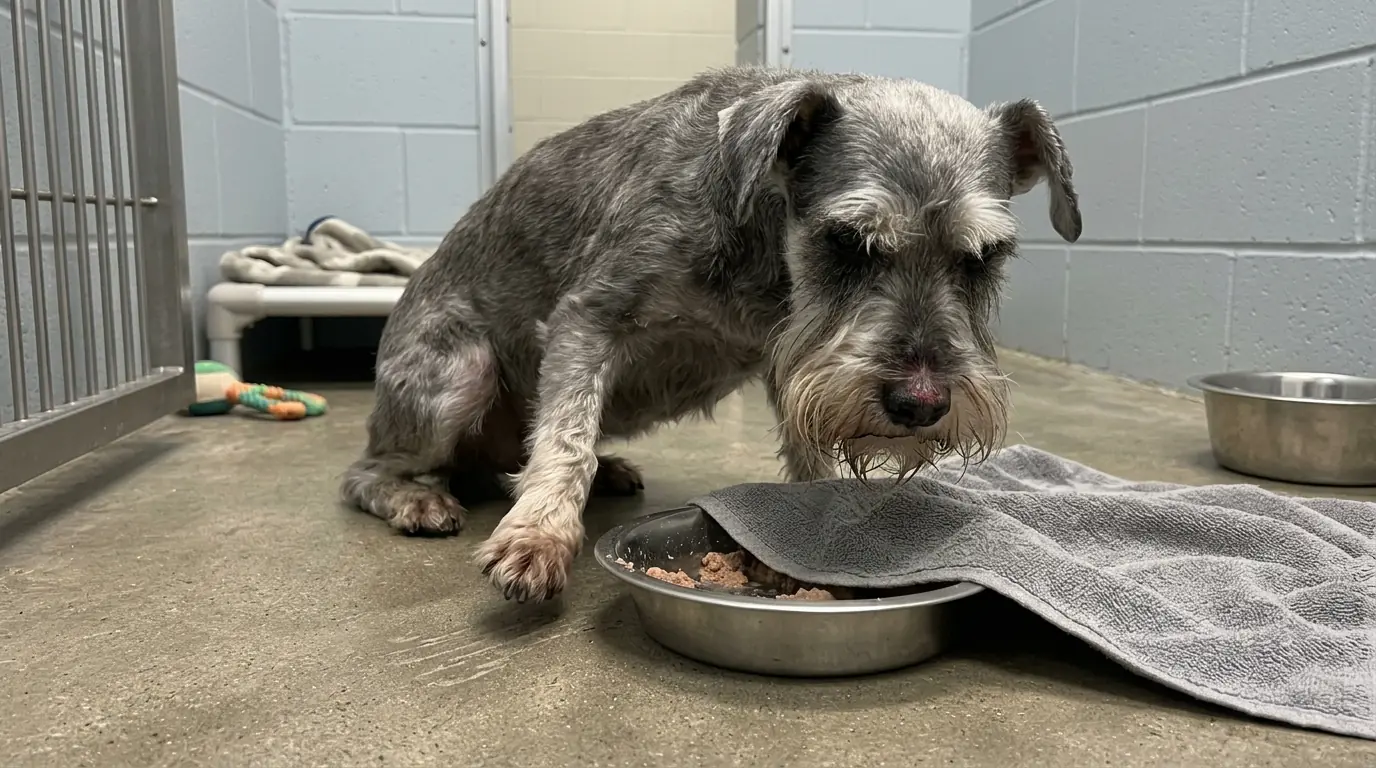
Winston never finishes his meal and simply walks away.
The ten-year-old Miniature Schnauzer eats a few bites of soft food, pauses, and looks down at what remains in the bowl.
Then the strange routine begins.
He lowers his gray muzzle toward the towel beside his food.
With his nose, Winston pushes at the fabric.
Once.
Again.
Then again.
Slowly, he works part of the towel toward the uneaten food as though he is trying to cover it.
But the towel rarely goes exactly where he wants it.
So Winston keeps trying.
When that does not work, his front paws begin scraping against the concrete kennel floor.
Scratch.
Pause.
Scratch again.
There is no dirt beneath him.
Nothing actually moves.
Still, Winston continues making the same digging motion around his meal as though somewhere beneath the hard concrete there might be enough loose ground to hide what he cannot eat.
Eventually, the skin across his aging nose becomes visibly red from rubbing against the floor and fabric.
Only then does Winston stop.
He curls up nearby.
The food remains exactly where it was.
And at the next meal, he often tries to bury it all over again.
For shelter staff, the behavior raised a question that became harder to ignore each time they watched it:
Why was an underweight dog working so hard to hide food he desperately needed?
Winston Arrived Thin, Tired, and With a Mouth That Needed Attention
At ten years old, Winston already had the unmistakable appearance of a senior Schnauzer.
Gray mixed through his facial furnishings.
His movements were slower.
His eyes had the softer expression common in older dogs.
But age alone did not explain his condition.
Winston was noticeably underweight when he entered the shelter after a period of inadequate care.
His body had lost condition, and his mouth presented another serious concern.
His teeth were badly deteriorated.
Some showed significant dental disease, and eating appeared uncomfortable.
That created a painful contradiction.
Winston needed nutrition.
But the very act of eating could be difficult.
Hard food was not an appropriate challenge to place in front of a dog already struggling with his mouth, so his meals were adjusted to make eating easier while his condition could be evaluated.
Soft food helped.
It did not solve everything.
He Was Hungry Enough to Start Eating
When a meal arrived, Winston usually showed interest.
He sniffed it.
Moved closer.
Then began eating.
At first, staff hoped he might finish the entire portion.
But after several bites, Winston often slowed.
His chewing became more deliberate.
He paused between mouthfuls.
Sometimes he repositioned food before attempting another bite.
Then he stopped.
The bowl still contained food.
For an underweight dog, leaving calories behind was concerning.
But Winston's damaged teeth meant staff could not simply assume he was being picky.
Dental disease can cause significant pain and can affect how willingly a dog chews.
If the mouth hurts, appetite and the physical ability to eat are not always the same thing.
Winston might want the food while still finding it difficult to continue.
And once he stopped eating, he did something even more unusual.
He tried to make the leftovers disappear.
The First Time He Used the Towel, It Looked Almost Accidental
Winston lowered his head beside the bowl.
His nose touched the towel.
He pushed.
The fabric folded slightly.
Then he pushed again.
A corner moved toward the food.
Winston continued until part of the meal was obscured.
At first, it could have looked like a dog simply rearranging bedding.
Then his paws started moving.
He scratched at the floor beside the bowl.
The motion looked remarkably similar to digging.
But there was nothing to dig.
His nails clicked against sealed concrete.
Winston stopped.
Sniffed the food.
Then resumed.
The behavior became much more interesting when staff saw him repeat it after another meal.
And another.
Dogs Sometimes Try to Cache Valuable Resources
Hiding or caching food is not an unheard-of canine behavior.