The black sedan stopped at the far end of the Savannah marina just before sunset.
Marcus Cole noticed it only because the polished body looked almost absurd against the working docks. Shrimp boats, center consoles, fuel cans, weather-beaten pilings, and men in faded shirts belonged here. The sedan looked like it belonged outside a glass tower with a valet standing beside it.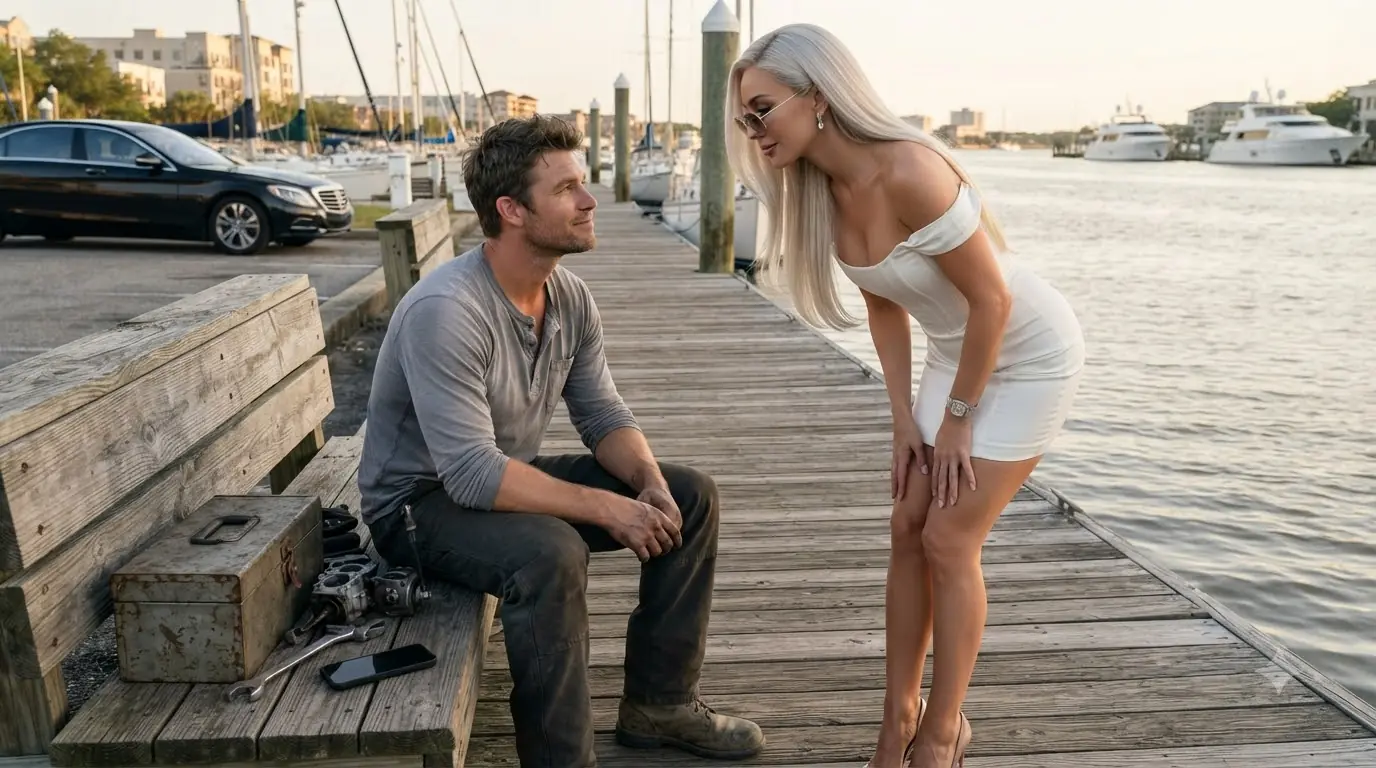
He went back to the outboard engine in front of him.
A socket wrench rested in his right hand. Grease covered the heel of his palm, two fingers, and part of his forearm. He had been trying to coax another season out of an engine that should have retired years ago, and unlike most people, old machinery did not become more interesting merely because a beautiful woman stepped out of an expensive car.
At least that was what Marcus told himself.
He heard heels against the dock.
Not fast.
Measured.
Then slower.
He continued tightening the housing bolt until a shadow fell across the workbench.
“Can I sit with you?”
Marcus looked up.
Serena Ashford stood three feet away in a fitted white dress, sunglasses lowered slightly along the bridge of her nose. Her platinum-blonde hair moved gently in the river breeze, and for the first time since Marcus had seen her in person, she did not have an assistant, donor, attorney, board member, or executive orbiting her.
She looked tired.
Not physically.
Tired in the eyes.
Marcus nodded toward the space beside him on the rough wooden bench.
“If you don’t mind grease.”
Her mouth curved.
“I’ve survived worse.”
She sat.
Close enough that he could smell expensive perfume beneath salt air and engine oil, but not so close that either of them had to acknowledge the fact.
For several seconds, neither spoke.
The Wilmington River moved slowly beyond the pilings. A yacht eased through the channel. Somewhere behind them, a gull screamed at something it believed belonged to it.
Serena looked toward his hands.
“You’re always fixing something.”
Marcus turned the socket wrench once more.
“Things break.”
“That sounds depressing.”
“It keeps me employed.”
“You could charge more.”
He smiled faintly.
“You’ve been studying my invoices?”
“No.”
“Then how would you know?”
“I know what skilled labor costs.”
Marcus wiped one hand against a rag.
“You know what corporations pay for skilled labor.”
She turned slightly toward him.
“That was almost hostile.”
“Wasn’t meant to be.”
“You always talk like this?”
“Like what?”
“Like you’re not impressed.”
Marcus finally looked directly at her.
“By what?”
That made her laugh.
It was not the polished laugh he had heard at donor receptions. That one was controlled and brief, designed to acknowledge humor without surrendering attention.
This one escaped.
Serena shook her head.
“You really don’t know how strange you are.”
Marcus returned to the engine.
“I hear that sometimes.”
She studied him.
The faded gray shirt. The old boots. The grease. The cheap metal toolbox. Nothing in his appearance suggested the man beside her once managed portfolios worth billions of dollars in Manhattan. Nothing suggested that five years earlier he had established a private philanthropic vehicle that had quietly become the largest single source of funding keeping Serena’s life’s work alive.
And nothing told her that the man sitting twelve inches away had already sent twenty-two million dollars into the Ashford Harbor Foundation without attaching his name to a single wall.
Serena leaned forward, forearms against her thighs.
“My staff thinks I’m losing my mind.”
“That serious?”
“I’m sitting on a dock talking to a mechanic.”
Marcus looked offended.
“Boat mechanic.”
“Important distinction?”
“To the boats.”
She smiled.
Then her phone rang.
Serena glanced down.
Her face changed instantly.
Not panic.
Executive focus.
She answered.
“Yes?”
Marcus kept his eyes on the motor, but her voice carried in the open air.
“What do you mean suspended?”
A pause.
“No. Read it exactly.”
Her shoulders straightened.
Another pause.
Marcus stopped moving.
Serena’s expression had gone still.
“How much?”
Silence.
Then:
“Eight million?”
Marcus’s jaw tightened almost imperceptibly.
Serena stood.
“Don’t call Grant yet. I’m on my way.”
She ended the call and stared toward the water as though the river had personally betrayed her.
Marcus knew exactly what had happened.
The Compass Fund’s attorneys had delivered the suspension notice.
His suspension notice.
He had ordered it forty-eight hours earlier after finding enough irregularities in Ashford Harbor’s construction accounts to make distance irresponsible.
Serena looked at him.
For the first time, the billionaire seemed uncertain.
“I have to go.”
Marcus nodded.
She took one step, then stopped.
“Marcus.”
“Yes?”
“Whatever this is…”