The laughter started before Caleb Mercer had even opened his toolbox.
It rolled through Hangar Four of Vance Aeronautics in polished waves, bouncing from the steel rafters and the silver fuselage of a two-hundred-million-dollar long-range executive jet that had been sitting motionless for eleven days.
Caleb heard it.
He simply did not react.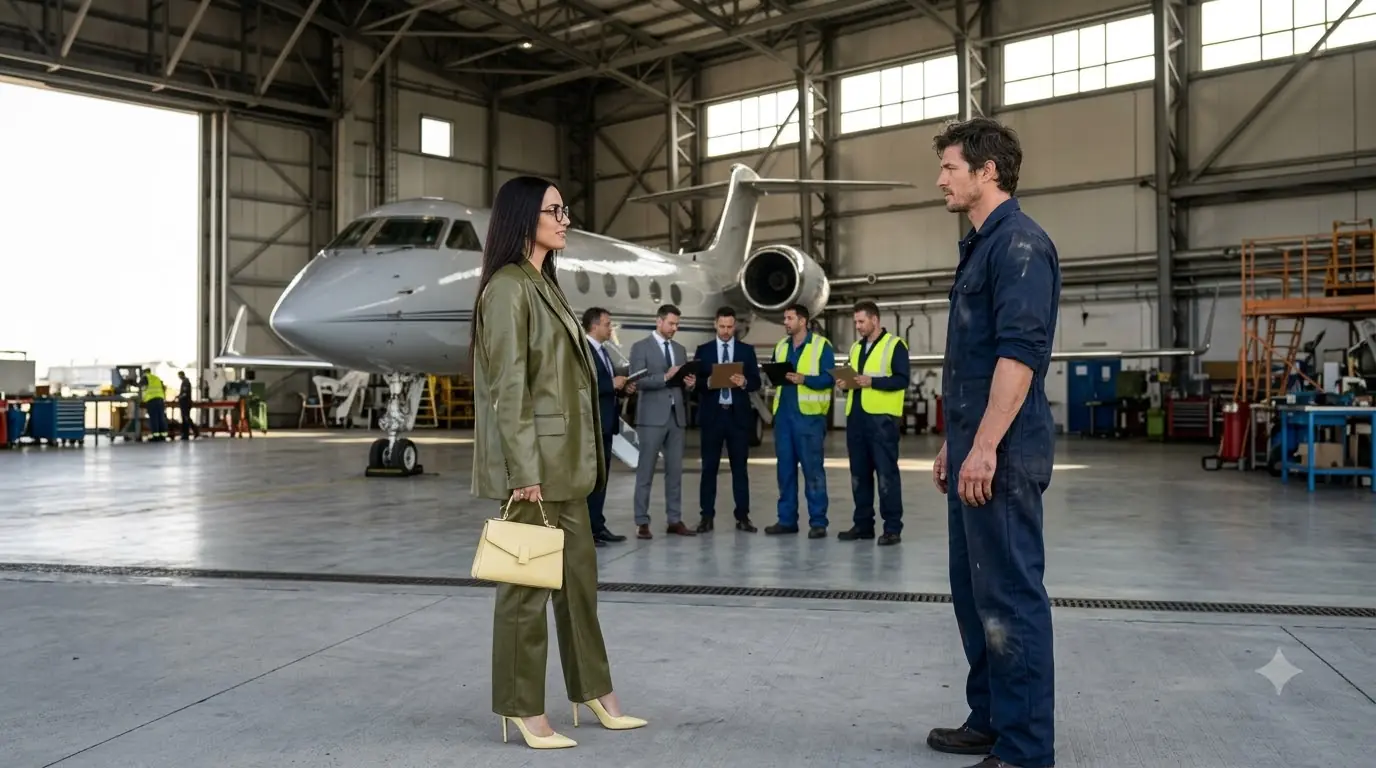
At forty-two, he had spent enough time around expensive machines and expensive people to know that the louder the room became, the less useful information it usually contained. He stood near the aircraft’s left wing in dark navy work trousers and an oil-stained mechanic’s shirt, carrying a battered black tool case that had belonged to his father.
Around him stood some of the most senior people in private aviation.
Chief engineers.
Regional maintenance directors.
Flight operations executives.
Board members.
Two attorneys.
A representative from the aircraft manufacturer.
And at the center of them all stood Eleanor Vance.
She was thirty-nine and had built Vance Aeronautics from a boutique charter company into one of the most recognizable private aviation brands in America. Her company managed thirty-seven aircraft, operated luxury terminals in six states, and was preparing to announce an expansion that analysts believed could value the company at more than four billion dollars.
Eleanor dressed like someone who understood exactly what happened when she entered a room.
That afternoon she wore an oversized olive-green leather jacket with sharp sculpted shoulders over matching wide-leg leather trousers, pale yellow pointed heels, dark glasses, and a structured yellow handbag tucked beneath one arm. Her long black hair fell smoothly past her shoulders.
Every photograph taken of her looked intentional.
Every sentence quoted from her sounded rehearsed even when it was not.
And every person in Hangar Four understood that the grounded aircraft behind her was threatening the largest contract in company history.
The jet had suffered an unexplained flight-control systems failure three days before it was scheduled to carry a delegation from New York to Singapore.
The original fault had appeared during engine start.
Then another.
Then nine more.
Primary flight-control computers lost synchronization.
Autothrottle dropped offline.
Navigation systems showed intermittent cross-talk.
Two hydraulic monitoring channels failed self-test.
Backup electrical control units began throwing contradictory values.
The engines themselves were healthy.
The aircraft could start.
It could taxi.
But nobody was willing to put passengers aboard.
The manufacturer had flown in specialists.
Vance Aeronautics brought in consultants.
Components had been swapped.
Software reloaded.
Harnesses tested.
Circuit boards inspected.
Nothing solved the cascade.
Every additional day on the ground cost money.
But the money was not Eleanor’s greatest concern.
Three weeks earlier, Vance Aeronautics had signed a preliminary agreement to provide aircraft and support for Meridian Global Partners, a private investment group whose executives traveled constantly between New York, London, Dubai, Singapore, and Hong Kong.
The contract could be worth hundreds of millions over five years.
Meridian’s chairman wanted proof Vance could maintain its own flagship fleet.
A grounded aircraft was exactly the wrong proof.
Caleb knew none of that when he arrived.
He knew only what the call had said.
Independent diagnostics.
One day.
Cash contract.
No guarantee.
His small company, Mercer Aviation Systems, usually repaired avionics for freight operators, charter pilots, and privately owned turboprops from a leased workshop near Teterboro Airport. He had worked on sophisticated systems before, but he did not have a glass lobby, corporate hospitality suite, marketing department, or receptionist.
He had three employees.
One aging service van.
And a twelve-year-old son named Noah who did homework at a metal desk beside the parts cabinet most afternoons because Caleb refused to let work become the reason his child ate dinner alone.
That was the man Eleanor Vance looked at when she smiled and said, “So you’re the miracle worker.”
Caleb placed his toolbox on the floor.
“No.”
Several executives chuckled.
Eleanor lifted an eyebrow.
“What are you, then?”
“A mechanic who hasn’t looked at your airplane yet.”
The laughter became louder.
Technical Director Alistair Finch stood beside Eleanor with both arms crossed.
Finch was fifty-six, silver-haired, immaculate, and carried the peculiar confidence of a man who had spent long enough managing engineers that he occasionally forgot he was no longer the one holding the tools.
“We’ve had manufacturer engineers here for a week,” Finch said. “Specialists from three states. Every flight-control module has been tested.”
Caleb glanced at him.
“Okay.”
Finch frowned.
“That doesn’t impress you?”
“It sounds expensive.”
A board member laughed.
Finch did not.
Eleanor stepped toward Caleb.
“And what exactly makes you think you can find something they couldn’t?”
“I don’t.”
That answer confused her.
“You accepted the job.”
“You asked me to inspect the aircraft.”
“Yes.”
“I can do that.”
“And fix it?”
“If I find what’s wrong.”
Eleanor smiled.
She liked confidence.
She liked it even more when she thought she could challenge it.
“How long?”
“No idea.”
The executives laughed again.
Caleb opened his tool case.
Eleanor studied him for a moment, then glanced toward the people around her.
Perhaps it was frustration.
Perhaps embarrassment.
Perhaps eleven days of hearing technical explanations from men who still had not returned her aircraft to service.
Whatever the reason, she suddenly raised one hand.
“Fine.”
The room quieted.
She looked directly at Caleb.