Nadia Brooks had spent exactly nineteen minutes enjoying her own front yard before somebody called the police on her.
She would remember that number later.
Nineteen minutes.
Long enough to carry two cardboard boxes from the garage.
Long enough to pull weeds beneath the crepe myrtle beside the driveway.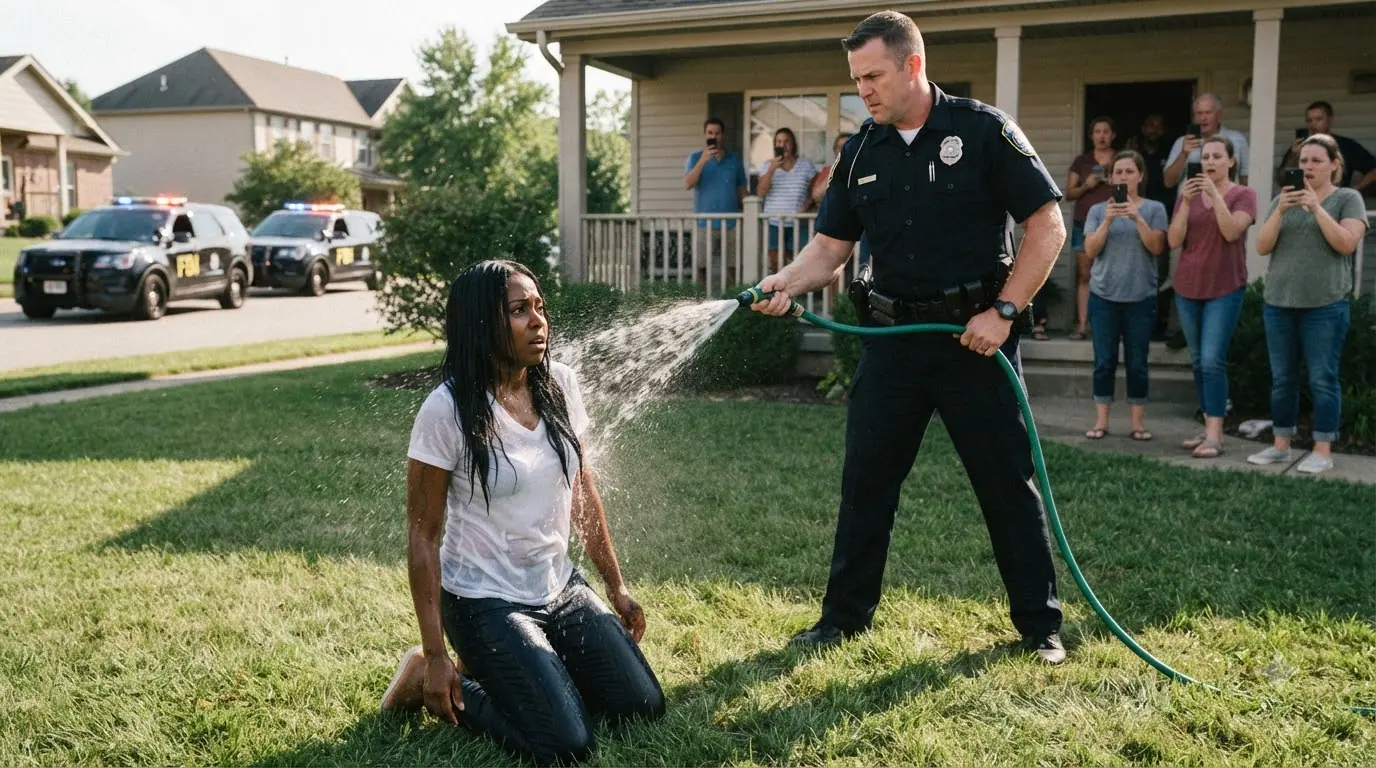
Long enough to connect a green garden hose to the brass spigot near the porch and rinse dirt from the front walkway.
Long enough for three different neighbors to look at her through their windows.
Long enough for one of them to decide that a Black woman in jeans and a white T-shirt could not possibly belong at 418 Hawthorne Ridge.
The house itself gave no reason for suspicion.
It was a two-story brick colonial in one of the quietest neighborhoods outside Dallas.
White columns.
Gray shutters.
Freshly trimmed hedges.
A wide porch.
Small maple trees lining the driveway.
The lawn had been cut the previous afternoon, leaving pale stripes across the grass.
The only unusual thing about the house that morning was that the moving truck had disappeared overnight and most of Nadia’s furniture remained stacked in rooms she had not yet organized.
She had bought the property three weeks earlier.
Closed on it six days ago.
Moved in Friday.
Saturday morning was supposed to be the beginning of something uncomplicated.
Coffee.
Boxes.
Maybe a hardware-store run.
Maybe finally hanging the framed photograph of her mother that had traveled through four apartments and two cities without ever staying on a wall longer than a year.
Nothing about the plan included police.
Nadia stood near the side of the porch wearing faded blue jeans, work sneakers, and a plain fitted white T-shirt darkened slightly at the shoulders from the summer humidity.
Her hair was pulled into a low ponytail.
No makeup beyond what had survived from breakfast.
No jewelry except a slim silver watch.
If anyone had seen her walking through an airport or office building, they might have assumed teacher, attorney, consultant, maybe doctor.
Nobody looking at her would have guessed what she actually did for a living.
That was intentional.
Nadia liked ordinary clothes.
Ordinary cars.
Ordinary conversations.
Her job already required too much attention to details other people hoped would remain invisible.
She crouched beside the flower bed and pulled another weed.
Then heard a car door slam.
Not unusual.
Another one.
Then a voice.
“Ma’am.”
Nadia looked over her shoulder.
A police cruiser sat partly angled along the curb.
Emergency lights flashed silently.
The officer walking toward her was tall, broad through the shoulders, and perhaps forty.
White.
Short dark hair clipped close along the sides.
Square jaw.
Dark navy uniform.
Body camera centered over his chest.
His expression had already settled into suspicion before he reached the edge of the lawn.
Nadia slowly stood.
“Good morning.”
The officer stopped on the sidewalk.
“Step away from the house.”
Nadia blinked.
“I’m sorry?”
“I said step away from the residence.”
His hand was raised now, palm facing her.
Nadia looked behind herself at the front door.
Then at him.
“This residence?”
“Yes.”
She almost smiled.
Not because it was funny.
Because sometimes the brain protects itself from absurdity by offering amusement first.
“Officer, is there a problem?”
“That’s what I’m figuring out.”
He moved one step closer.
“Come down to the sidewalk.”
Nadia remained on the lawn.
“I live here.”
The officer’s expression barely changed.
“Identification.”
“What is the reason for the stop?”
“I received a report of suspicious activity at this address.”
“What activity?”
“A possible trespass.”
Nadia looked toward the houses across the street.
Curtain movement.
A face vanished behind blinds.
Someone had called.
Of course.
She turned back.
“I’m the homeowner.”
The officer gave a short exhale through his nose.
Not quite laughter.
Close enough.
“Okay.”
Nadia’s eyebrows lifted.
“Okay?”
“You’re telling me you own this house.”
“Yes.”
“Then show me identification.”
Nadia glanced toward the open garage.