"Four hundred thousand dollars," he announced, loud enough for everyone in the private dining room to hear. "That's what I'll bet you can't speak a single proper sentence of Cantonese."
The menu struck the polished marble floor, bounced against my black work shoes, and landed beneath a neighboring table.
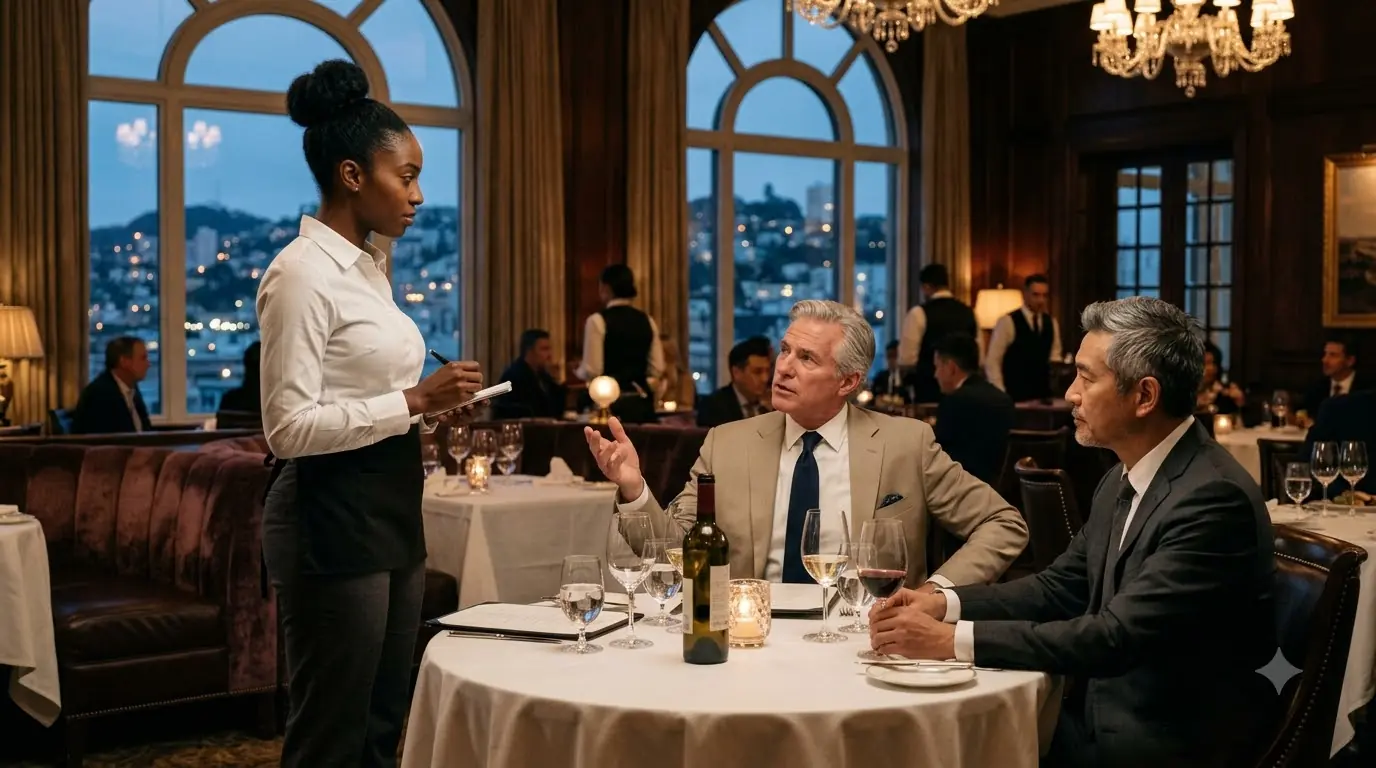
For a moment, I simply stared at it.
My name is Naomi Bennett. I was twenty-nine years old, a Black American woman with deep-brown skin, dark expressive eyes, and natural black hair pulled into a neat high bun. I wore a crisp white blouse, charcoal trousers, and a black waist apron because those were the uniforms required at the Sequoia Room, one of the most expensive private restaurants in downtown San Francisco.
I had been serving tables for eight months.
Before that, I had worked in corporate compliance.
Before that, I had studied accounting, financial regulation, and Chinese languages at the University of California, Berkeley.
And long before any of those things, I had learned Cantonese from a woman who made the best pineapple buns in Oakland and believed that language was a form of respect.
But the man sitting in front of me knew none of that.
He had decided what I was capable of the moment he saw my skin, my apron, and the little order pad tucked into my hand.
His name was Charles Whitmore.
He was sixty-four years old, silver-haired, and worth more money than my family had earned in three generations.
His beige designer suit probably cost more than my car. His navy tie was perfectly knotted. A platinum watch flashed beneath his cuff every time he gestured toward his business associates.
He was the chairman of Whitmore Global Holdings, a sprawling investment group involved in transportation infrastructure, cold-storage facilities, commercial property, and international logistics.
Financial magazines called him a visionary.
Business television programs praised his ability to recognize opportunities.
He appeared at charity galas beside governors, senators, and other men who smiled whenever a camera turned toward them.
But that afternoon, he was sitting at the finest table in the restaurant, laughing because he believed a Black waitress couldn't possibly understand the language spoken by his Chinese business partner.
"Well?" he demanded.
I looked up.
Whitmore smiled.
"Cat got your tongue?"
Across from him sat a distinguished Chinese businessman from Hong Kong.
He was fifty-two, with neatly combed black hair, a serious face, and an expensive charcoal suit. His English name was Raymond Lam, though I knew that his family and many of his colleagues called him Lam Wai-keung.
He was chairman of Jade Harbor Infrastructure, a privately held investment group with interests in shipping, clean-energy technology, warehouses, and transportation networks across Asia and North America.
Mr. Lam had barely spoken during the previous ten minutes.
He had been reviewing a leather-bound contract folder while Whitmore drank sparkling water and complained about the restaurant's service.
Now he watched me carefully.
I couldn't read his expression.
Perhaps he was embarrassed.
Perhaps he was curious.
Perhaps he was trying to understand why a man who wanted him to invest millions of dollars was wasting time humiliating a waitress.
Whitmore snapped his fingers in front of me.
"Hey. I'm talking to you."
I felt my jaw tighten.
"Yes, sir."
He grinned.
"Good. So you do understand English."
A few people near the table shifted uncomfortably.
Whitmore leaned back.
"You heard the wager. Four hundred thousand dollars. All you have to do is speak Cantonese."
I glanced at the menu on the floor.
Then back at him.
"Sir, I came to take your order."
He laughed.
"And I'm giving you an opportunity to earn more money in five seconds than you've probably made in your entire life."
His business associate, a nervous-looking man in a gray suit, smiled uncertainly.
Mr. Lam said nothing.
Whitmore leaned closer.
"Go ahead. Say something."
I could feel the entire room watching.
The restaurant occupied the upper floor of a luxury hotel, with enormous windows overlooking San Francisco Bay. Afternoon sunlight poured across cream-colored walls, polished tables, crystal glasses, and silver cutlery.
Every detail had been designed to communicate wealth.
The linen napkins were thick enough to resemble handkerchiefs.
The chairs were covered in soft leather.
Fresh flowers stood in hand-blown glass vases.
And the private dining room had a separate service corridor so wealthy guests wouldn't have to watch employees moving between the kitchen and their tables.
I had worked long enough in expensive restaurants to understand that architecture.
Luxury often involved making labor invisible.
Servers appeared when summoned.
Plates arrived without anyone seeing the kitchen.
Wine glasses filled without guests noticing who poured them.
And when someone needed to clean a spill, staff were expected to do it quietly enough that the interruption barely registered.