\At seventy-two, Judge Evelyn Carter had learned that power announced itself most clearly when people believed you had none.
Sometimes it happened in court.
A lawyer would speak slowly to her before realizing she was the judge assigned to the case. A lobbyist would mistake her for somebody’s assistant at a reception. A hotel employee would direct her toward the service elevator because her sensible shoes and inexpensive coat did not match whatever image he had formed of the guests upstairs.
Evelyn rarely corrected people quickly.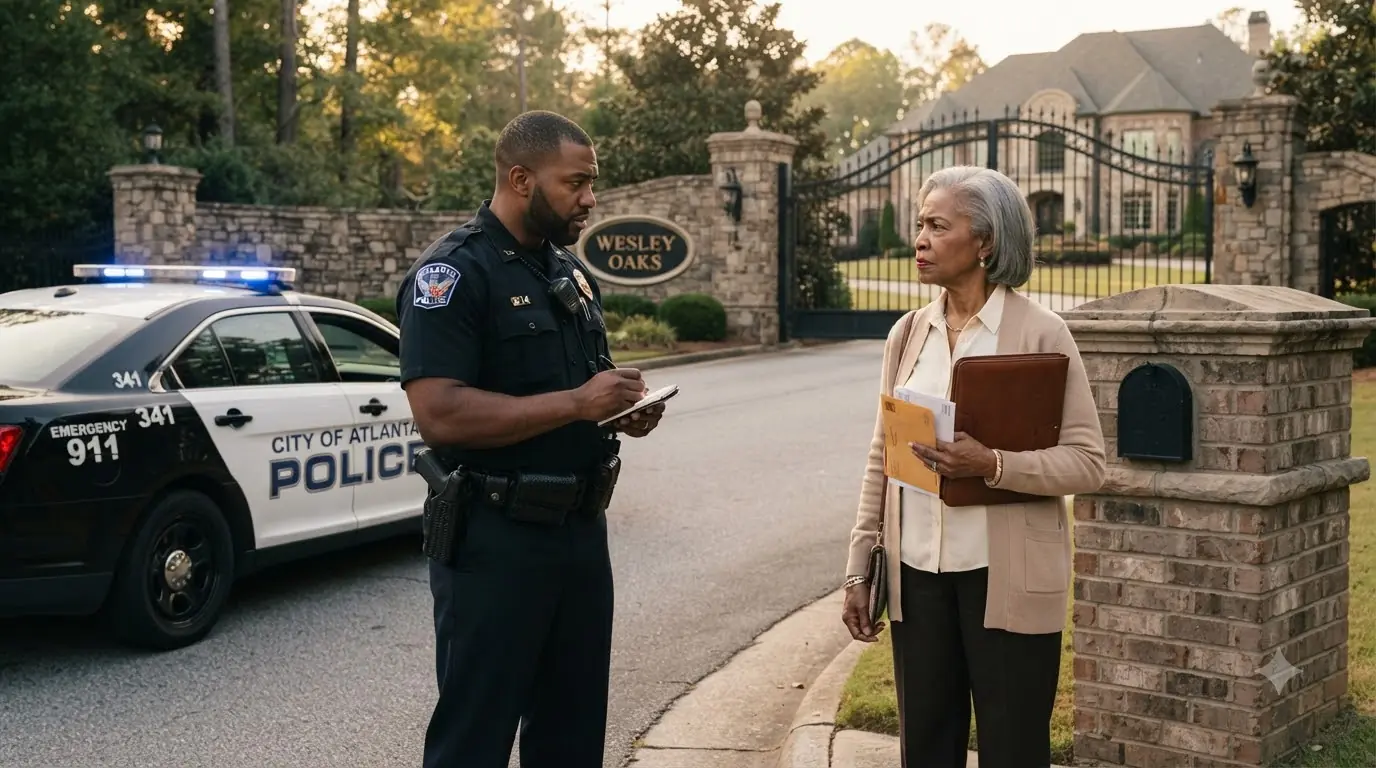
She preferred to listen.
People became astonishingly honest around someone they had already decided did not matter.
That Thursday afternoon in Ashford Crest began no differently.
The neighborhood sat north of Atlanta behind stone gates, old oaks, manicured hedges, and enough surveillance cameras to make privacy feel like an expensive illusion. The houses were enormous but restrained, built in brick and pale stone rather than glass. No sports cars revved in driveways. No fountains rose twenty feet into the air. Wealth there had learned to whisper.
Evelyn’s house stood near the end of Briarwood Lane.
Three stories.
Red brick.
White columns.
A deep front porch overlooking a curved drive.
She had owned it for nineteen years.
Yet when she walked down to the mailbox wearing a beige cardigan, cream blouse, dark trousers, and low leather shoes, she looked nothing like the version of wealth Officer Darius Monroe expected to find in Ashford Crest.
That mistake would become important.
Evelyn carried a thin leather folder beneath one arm.
Inside were notes for a private meeting beginning at four.
Police Chief Adrian Wallace had already arrived.
So had the United States Attorney for the Northern District of Georgia, two deputy chiefs, a civil-rights lawyer from Washington, the city attorney, and a federal compliance specialist.
They were waiting in Evelyn’s living room.
The meeting was not social.
For eleven months, Evelyn had been serving as special master in a federal consent decree governing the Bellwood Police Department after a series of unlawful-stop complaints, falsified reports, and discriminatory enforcement cases had triggered federal litigation.
Bellwood was not Atlanta.
It was a neighboring jurisdiction with wealthy subdivisions, commercial corridors, older working-class neighborhoods, and an increasingly tense relationship between residents and officers.
The department had improved in some areas.
Body-camera activation rates were higher.
Use-of-force reporting had become stricter.
Complaints were finally being tracked instead of buried inside separate precinct filing systems.
But Evelyn still had questions.
Too many.
Especially about discretionary stops in affluent neighborhoods.
Calls for “suspicious persons.”
Trespassing complaints involving residents who actually lived on the property.
Domestic workers stopped while leaving late shifts.
Delivery drivers held because a homeowner “didn't recognize the vehicle.”
Black teenagers questioned on streets where their parents owned houses.
Elderly residents challenged while walking dogs.
The individual incidents looked small when separated.
Together they described a culture.
And culture, Evelyn knew, rarely announced itself in policy manuals.
It appeared in ordinary decisions made by people who believed nobody important was watching.
That afternoon, she intended to ask the police chief exactly how much had changed beneath the statistics.
She never reached the front door.
A patrol cruiser turned onto Briarwood Lane while Evelyn was opening the mailbox.
The vehicle slowed.
She noticed but thought little of it.
The cruiser passed.
Then stopped.
Reverse lights appeared.
Evelyn looked over one shoulder.
The cruiser backed twenty feet and angled toward the curb.
The driver’s door opened.
Officer Darius Monroe stepped out.
He was thirty-eight, tall, muscular, and sharply groomed, with a close-cropped haircut and neatly trimmed beard. His uniform looked immaculate. His boots shone. His body camera sat centered on his chest.
Evelyn noticed the green indicator light.
Recording.
Good.
Darius closed the door.
“Ma’am.”
Evelyn removed the mail.
“Good afternoon.”
He looked past her toward the mansion.
Then back.
“You work here?”
The question was so familiar that Evelyn almost smiled.
“No.”
Darius nodded as though he had expected resistance.
“Who are you here to see?”
“No one.”
He took two steps closer.
Evelyn closed the mailbox.
“Can I help you with something, Officer?”
“Received a call about somebody checking mailboxes and walking around private property.”
Evelyn glanced at the envelopes in her hand.
“I was checking my mailbox.”
“I can see that.”
“Then I’m not sure what the confusion is.”
His eyes moved toward the house.
“You live in this neighborhood?”
“Yes.”
“Which residence?”
She looked behind herself.
“That one.”
Darius followed her gaze.
The mansion.
His expression changed slightly.
Not disbelief exactly.
Something closer to irritation that her answer had complicated the version of events he already preferred.
“You're saying you live there?”
“I am.”
“Owner?”
“Yes.”