Iris Green arrives in Ridgemont, Colorado, looking nothing like the federal official the town’s police leadership expects.
At thirty-three, Iris is a highly experienced civil-rights investigator assigned to conduct a confidential preliminary assessment of the Ridgemont Police Department after fourteen complaints raised troubling questions about unlawful stops, retaliatory detentions, excessive force, and the department’s treatment of people who questioned officer authority.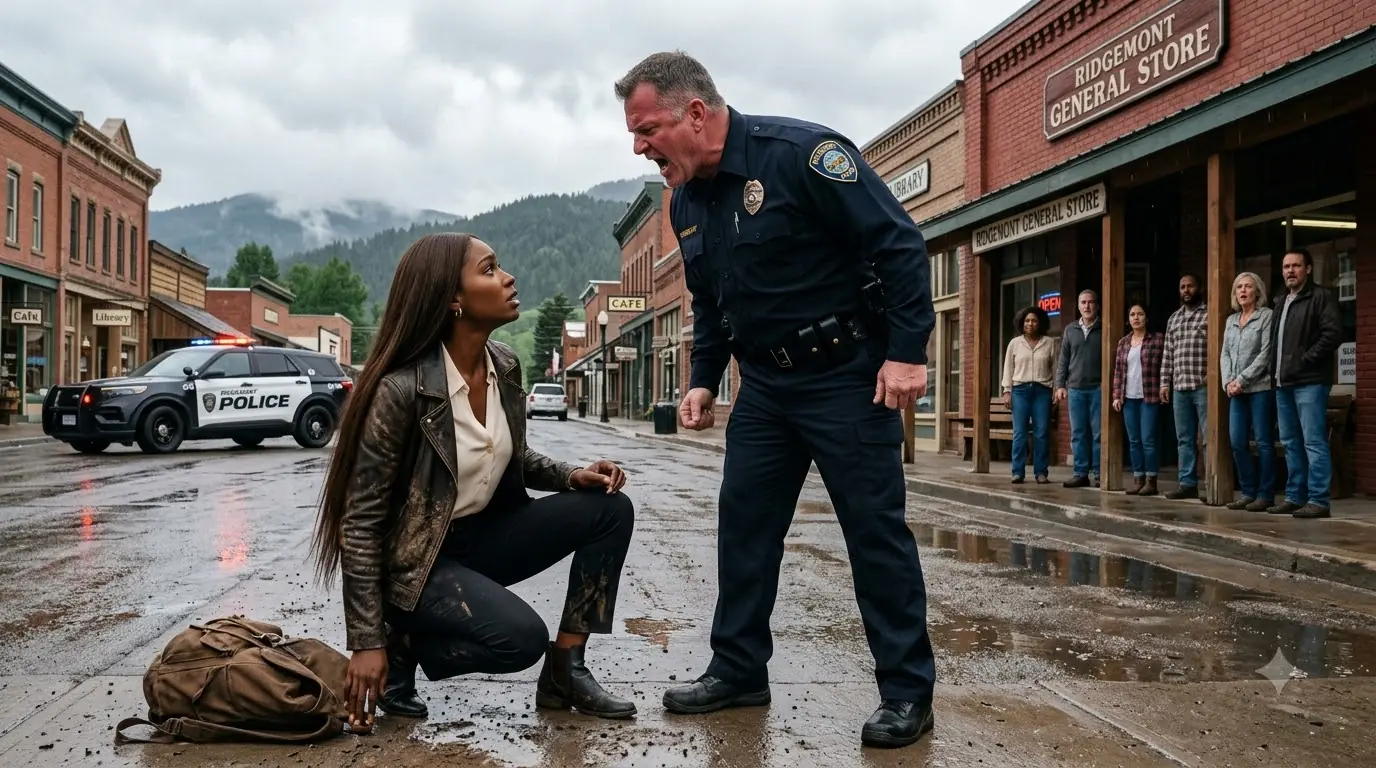
She deliberately enters town quietly.
No escort.
No announcement.
No government vehicle.
Just a worn backpack, ordinary clothes, and a small recording device authorized for her field documentation.
Her purpose is simple: observe how the department behaves before senior leadership knows an investigator is watching.
She gets her answer within an hour.
Sergeant Wade Hollister, a veteran officer with a reputation for aggressive street enforcement, stops Iris on Main Street as she walks toward the courthouse. He demands to know where she is going, orders her to surrender her backpack, and becomes increasingly hostile when Iris calmly asks what legal justification he has for detaining or searching her.
A younger officer, Daniel Davis, watches the confrontation unfold.
He knows something is wrong.
He does nothing.
When Iris refuses to surrender her constitutional rights simply because Hollister demands obedience, the sergeant grabs her backpack, crushes documents beneath his boot, and then violently kicks her off balance.
Iris falls from the curb into a muddy gutter.
Her glasses crack.
Her shoulder is injured.
Several townspeople watch.
One records.
Another laughs nervously.
Hollister orders Davis to film Iris lying in the gutter and jokes about posting the image with a humiliating caption.
What Hollister does not know is that Iris’s hidden field camera has captured everything.
He also does not know that Iris has already spent weeks reading complaints bearing his name.
Hours later, Police Chief Raymond Keller gathers senior officers for what they believe is a routine federal compliance meeting.
The conference-room door opens.
Iris walks in wearing a clean suit, her damaged glasses replaced, a medical support brace beneath one sleeve, and a black investigative folder in her hand.
Hollister recognizes her instantly.
So does Davis.
The room goes silent.
But Iris does not demand Hollister’s badge.
She does not threaten him.
She does not use her authority for humiliation.
Instead, she requests preservation of every body-camera recording, dispatch log, complaint file, disciplinary report, use-of-force record, text message, and supervisory review connected to Hollister and several other officers.
The evidence exposes a problem larger than one violent sergeant.
Complaints were repeatedly dismissed without meaningful investigation.
Supervisors rewarded high arrest numbers while ignoring questionable stops.
Junior officers learned that challenging senior officers could cost them assignments and promotions.
Citizens who asked legal questions were routinely described as “argumentative,” “hostile,” or “noncompliant.”
Officer Davis must confront his own responsibility. Although he did not kick Iris, he stood there while it happened because he feared Hollister more than he trusted his own judgment.
Chief Keller discovers that years of avoiding conflict allowed misconduct to become culture.
And Hollister, initially furious that Iris has “destroyed his career,” eventually faces the hardest truth of all: Iris did not create the evidence against him.
She merely survived long enough to preserve it.
The investigation leads to discipline, prosecutions where evidence supports them, reopened complaints, independent oversight, revised training, stronger body-camera preservation rules, and protections allowing junior officers to intervene when senior colleagues cross legal boundaries.
Iris refuses to let reform become revenge.
Her central principle remains unchanged throughout the case:
The problem was never that Wade Hollister failed to recognize an important federal investigator.
The problem was that he believed the woman in front of him was unimportant enough to mistreat.
Iris Green reached Ridgemont at 8:12 on a gray Tuesday morning.
Rain had stopped less than twenty minutes earlier.
Water still ran along the gutters of Main Street, carrying yellow leaves, cigarette filters, gravel, and thin ribbons of mud toward storm drains at each intersection.
Ridgemont was the kind of Colorado mountain town that looked expensive from a distance and complicated from up close.
Brick storefronts lined the central district.
American flags hung from angled poles above shop entrances.
Decorative black streetlamps carried navy banners printed with the town logo.
RIDGEMONT.
A STRONGER, BRIGHTER TOMORROW.
Beyond the rooftops, mountains rose beneath low clouds.
Iris stood on the sidewalk with one hand wrapped around the strap of a faded brown backpack.
She was thirty-three years old.
Tall.
Elegant even when trying not to look elegant.
Her skin was a deep warm brown.
Her straight dark hair fell nearly to her waist, parted perfectly down the center.
Small gold hoops caught the weak morning light.
She wore dark tailored trousers, a cream blouse, practical ankle boots, and a brown leather jacket that had already collected several drops of rain.
Nothing about the outfit announced federal authority.
That was intentional.
Inside the backpack were three things that mattered.
A black credential folder.
A sealed evidence notebook.
And copies of fourteen complaints filed against members of the Ridgemont Police Department during the previous thirty-one months.
Six carried the same name.
Sergeant Wade Hollister.
Iris had memorized them.
She could have recited the facts without opening a single page.
March 4.
A twenty-one-year-old college student stopped outside a grocery store after midnight.
No crime.
No arrest.
Complaint alleged Hollister shoved him against a wall after the student asked whether he was free to leave.
Closed.
Officer conduct within policy.
June 19.
A Latina home-care nurse questioned outside a client’s residence.
Complaint alleged Hollister searched her work bag without consent.
Closed.
Insufficient evidence.
August 2.
A Black construction supervisor ordered from his vehicle during a traffic stop.
Complaint alleged Hollister mocked him for “talking like a lawyer” when he asked why the stop had been extended.
Closed.
No policy violation established.
January 11.
A seventeen-year-old boy detained outside a convenience store.
No charges.
Mother alleged Hollister threatened to “teach him respect.”