By nine-thirty on Monday morning, Lecture Hall One was already full.
Not merely crowded.
Full.
Every fixed burgundy seat from the curved front row to the highest balcony had been taken, and students who arrived late stood along the paneled walls with laptops pressed against their chests. Others sat on the carpeted steps. Several graduate students had dragged chairs from a neighboring classroom and wedged them beside the rear doors before campus security noticed.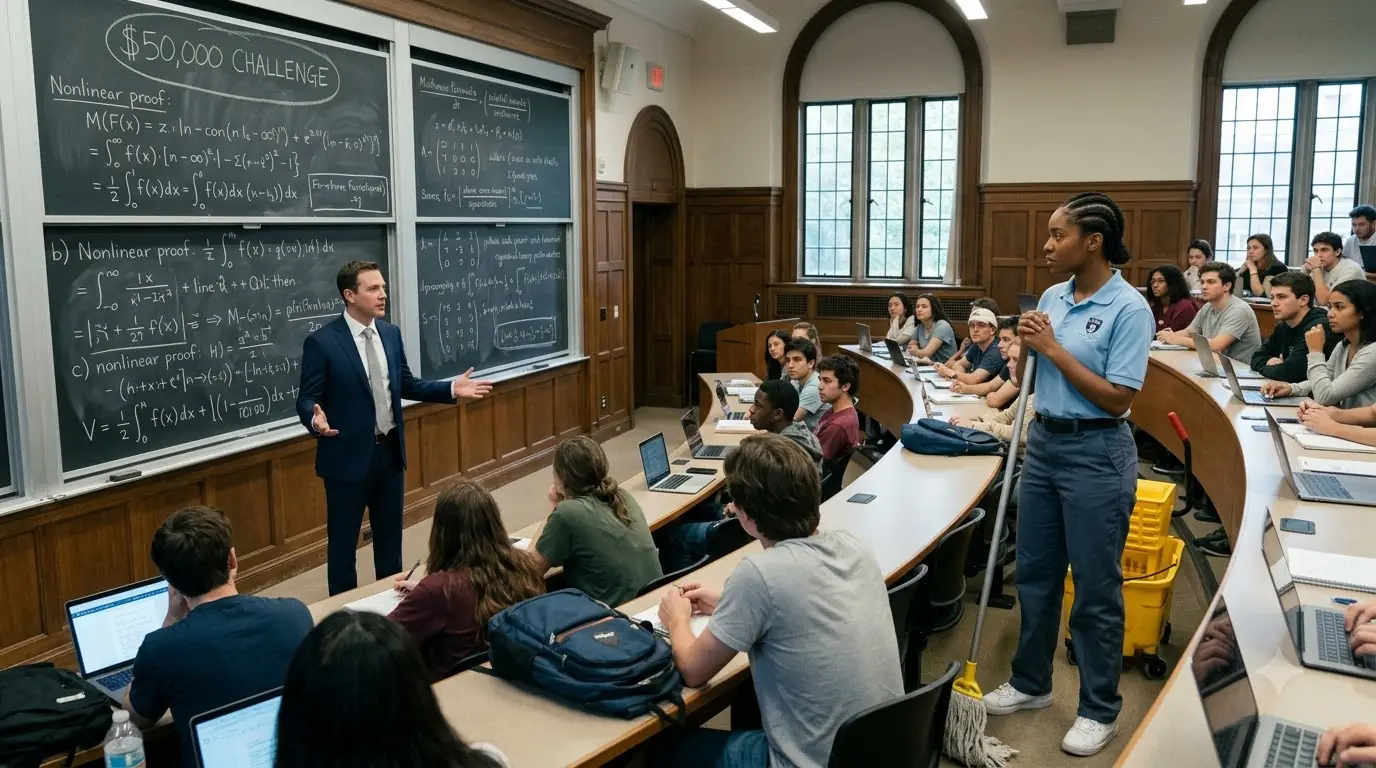
The reason was written across the largest chalkboard at the front of the hall.
It was not a title.
It was an equation.
Or, more accurately, an entire landscape of equations.
Four long horizontal sections covered almost the full width of the green board. There were nested integrals, probability operators, matrix terms, conditional expectations, nonlinear boundary conditions, and a final expression boxed in white chalk beneath a short sentence:
PROVE EXISTENCE AND UNIQUENESS UNDER THE GENERAL CASE.
Beneath that, in larger letters:
$50,000.
And beneath that:
ANY STUDENT. ANY METHOD. NO NOTES.
The Mathematics Professor stood beside the board with one hand in the pocket of his navy suit.
He was forty-two, white American, handsome in the polished way that university brochures loved: thick dark hair, straight posture, expensive silver tie, precise diction, and the permanent confidence of a man accustomed to being introduced before entering rooms.
He had joined Halston University six years earlier.
In those six years, he had become one of the most visible academics on campus.
Television interviews.
Industry consulting.
Conference keynotes.
A popular introductory lecture series streamed online.
A forthcoming book.
He was not merely respected.
He had built a brand around being difficult to impress.
Students liked telling stories about him.
The time he rejected a doctoral proof after finding an incorrect minus sign on page eighty-three.
The time he solved a visiting professor's optimization problem during lunch.
The time he told a room full of graduate candidates that mathematics did not reward feelings.
And now this.
Fifty thousand dollars.
His own money, he claimed.
For anyone who could solve the proof written behind him.
The challenge had been announced Friday afternoon.
By Saturday morning, students were photographing the board through the locked lecture-hall doors.
By Sunday night, several online forums had entire threads devoted to it.
By Monday, Lecture Hall One looked less like a class and more like a sporting event.
The Professor waited until the room settled.
Then he smiled.
"Good morning."
A few students laughed because the situation clearly had nothing ordinary about it.
He turned toward the board.
"I understand some of you have spent your weekend trying to solve this."
More laughter.
He nodded toward a cluster of graduate students.
"How much sleep?"
A doctoral candidate called back, "Not enough."
"Then at least you have begun to understand research."
The room laughed harder.
The Professor stepped toward the board.
"This is not a trick problem."
He tapped the boxed final expression.
"It does have a solution."
Several students leaned forward.
"And before anyone asks, yes, the offer is genuine."
He pointed toward a small black case sitting on the desk.
"A cashier's check for fifty thousand dollars."
Murmurs rolled through the hall.
"Any currently enrolled Halston student who completes the proof correctly before the end of today's lecture receives it."
A student in the front row raised his hand.
"Professor, does partial credit get partial money?"