At twenty-three, Emily Carter inherits forty acres of exhausted Iowa farmland that almost everyone around her believes is already finished. The topsoil is thin, the tractor barely runs, the barn leaks, the mortgage is late, and the bank has made it clear that patience is running out. Her neighboring farmer, Ray Mercer, has already begun looking at the Carter property as land that will eventually be sold and absorbed into his much larger operation.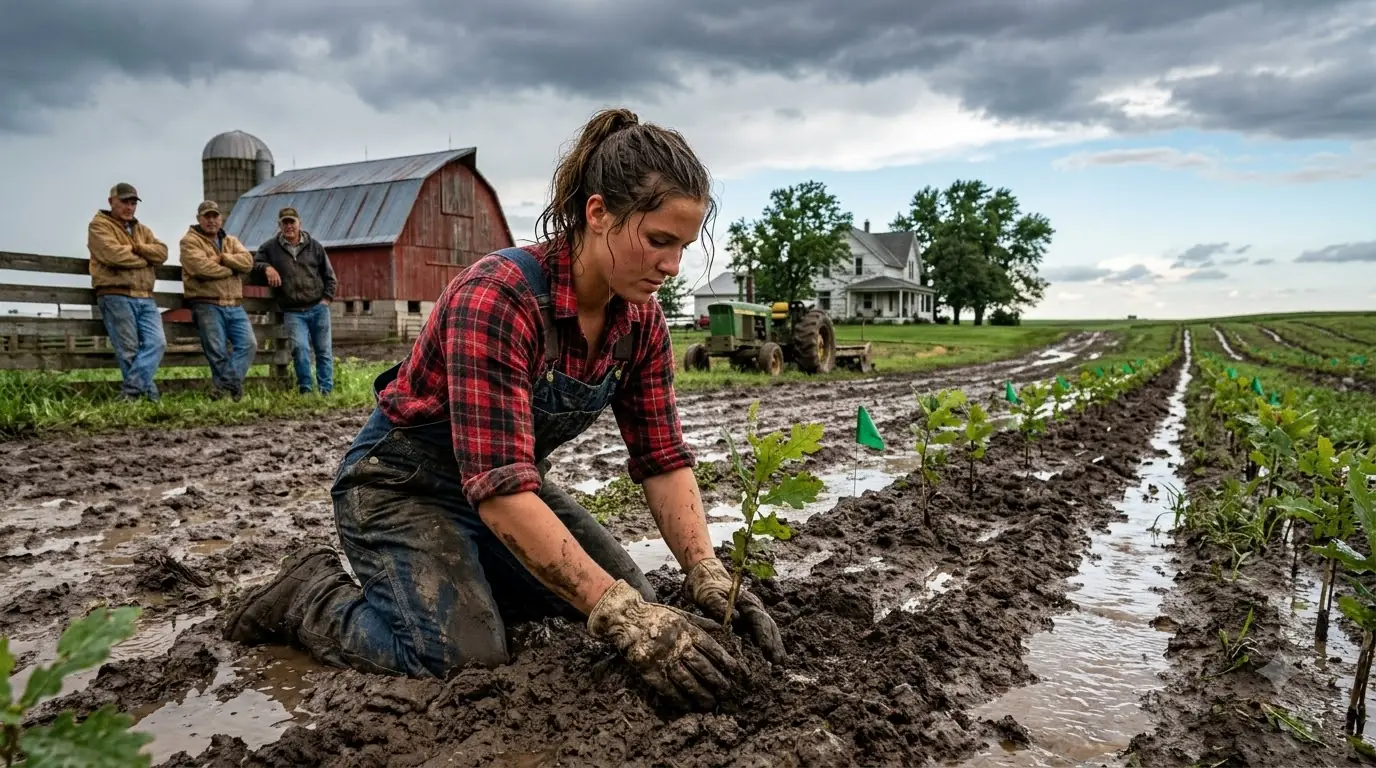
Emily refuses to sell.
While cleaning her late grandfather’s office, she discovers three weathered notebooks containing decades of rainfall records, field observations, and hand-drawn maps showing how water moves across the Carter farm. Her grandfather had noticed something nobody around Emily is discussing: the farm is not merely depleted. Every heavy storm is physically carrying its best soil away.
The problem is not simply water.
It is speed.
Emily begins comparing the notebook maps with the land itself. She studies where weeds survive, where the soil stays cooler, where water collects, and where runoff accelerates toward the western ditch. Gradually she realizes her grandfather had been imagining a different kind of farm, one built around slowing water rather than forcing exhausted soil to keep producing through increasingly expensive inputs.
Her solution seems ridiculous to almost everyone else.
She spends nearly all the money she has left on 4,000 young trees and plants them in long contour rows across the forty acres.
Older farmers laugh.
Some call it a forest.
Others tell Emily she is wasting valuable cropland on trees that may not provide meaningful shade for years. Ray warns her that the bank will not accept patience as a mortgage payment. At the feed store, men joke that Emily has confused farming with landscaping.
Emily does not argue.
She plants.
She repairs fences, replaces dead saplings, spreads old crop residue around the roots, monitors rainfall, digs test holes, and keeps detailed records. The first season nearly breaks her. Heat kills young trees. Rabbits strip bark. A storm uproots twenty-one saplings. Neighboring cattle crush another row.
The farm still does not become profitable.
The bank still wants money.
Then a severe drought arrives.
Nearby corn curls under the heat. Pastures brown. Farmers begin feeding hay early. Emily’s trees struggle too, but she notices something beneath them: several inches below the dry surface, the soil remains darker, cooler, and slightly moist. Where roots and leaf litter protect the ground, moisture lasts longer than it does in the exposed portions of neighboring fields.
Emily keeps measuring.
Sixty-three days pass without meaningful rain.
Then the sky finally breaks.
A powerful storm dumps months of missing water in only a few hours.
Farmers expect Emily’s unusual planting to fail spectacularly. The storm seems strong enough to rip the small trees from the ground and turn her field into mud.
Instead, the rain reveals what she has actually built.
Across the neighboring bare field, brown runoff accelerates downhill, carrying topsoil toward the ditch. On Emily’s property, the tree rows interrupt the flow. Water spreads sideways, slows, pools briefly, and begins soaking into protected soil.
The following morning, the difference is impossible to ignore.
A county agricultural agent drives a soil probe deep into the damp ground beneath Emily’s trees, then crosses the fence and can barely force the same probe into the hardened neighboring field.
Only then do the watching farmers understand the real purpose of the 4,000 trees.
Emily was never waiting for timber.
She was trying to keep the farm itself from washing away.
The results do not magically make her wealthy. The bank does not erase the mortgage. But reduced erosion, better moisture retention, improved soil cover, and a surviving crop give Emily enough evidence to secure a revised financial plan and keep the property.
Over the following years, the trees grow.
Their roots strengthen the soil. Their leaves return organic matter. Shade reduces surface heating. Water stays longer. The creek holds through dry periods. The farm slowly changes.
Eventually, even Ray Mercer begins experimenting with tree rows on his own property.
Emily never wins through one dramatic argument.
She wins because she changes what everyone can see.
The story follows the source’s central continuity: Emily inherits forty acres of declining ground, finds her grandfather’s maps of runoff patterns, plants 4,000 trees along the contours, survives drought, and finally watches a major storm expose the difference between exposed soil and land protected by roots, shade, and organic cover. Pasted markdown Pasted markdown
“Are you out of your mind?”
Emily Carter did not look up.
The shovel entered the ground beside her right boot, stopped against a layer of compacted soil, and shuddered through both of her arms.
She pushed harder.
Nothing.
Across the road, three men stood beside a dark green Ford pickup watching her.
Ray Mercer had both hands on his hips.
Walter Dean was leaning against the truck bed.
The third man, Leonard Shaw, held a paper coffee cup and looked like he had discovered the best entertainment available in Jasper County before breakfast.
Emily shifted one boot onto the shovel blade.
Pressed.
The steel finally cut through.
She worked the handle backward.
A chunk of pale Iowa soil broke loose.
Ray laughed.
“I’m serious, Emily.”
She dropped to one knee.
Beside her lay a young bur oak, barely five feet tall, its roots wrapped in damp packing material.
Emily pulled away the wrapping and lowered the root system into the hole.
Ray stepped closer to the roadside fence.
“You’ve got forty acres that need to produce something this year.”
Emily straightened the sapling.
Walter called:
“She is producing something.”
Ray looked at him.
“What?”
“Shade for the year 2042.”
All three men laughed.
Emily packed dirt around the roots.
Her gloves were already stained brown.
Her faded red-and-cream plaid shirt clung to her shoulders from sweat despite the cool March morning, and the knees of her denim overalls were dark with mud.
Ray raised his voice again.
“How many did you order?”
Emily tightened the soil.
No answer.
“Emily.”
She finally looked over.
“Four thousand.”
Walter nearly dropped his coffee.
Leonard laughed so hard he coughed.
Ray did not.
He simply stared.
“Four thousand trees.”
“Yes.”
“On forty acres.”
“Not all evenly.”
“That makes it better?”
Emily picked up the shovel.
Ray stepped closer to the fence.
“Your mortgage payment is late.”
Her expression changed.
Only slightly.
Enough for him to notice.
Walter stopped smiling.
Ray knew immediately he had crossed a line, but instead of stepping back, he continued more quietly.
“Your dad was my friend.”
Emily looked toward the next marked stake.
“Then don’t talk about my mortgage from the road.”
Ray exhaled.
“I’m trying to help.”
“Then help.”
“How?”
She drove the shovel into the ground.
“Stop telling me what everybody already thinks.”
Ray watched her.
“The trees won't save this place.”
Emily pulled another chunk of compacted earth from the hole.
“You don't know that.”
“I’ve farmed forty-two years.”
“And?”
“And you’re twenty-three.”
Emily looked at him.
There it was.