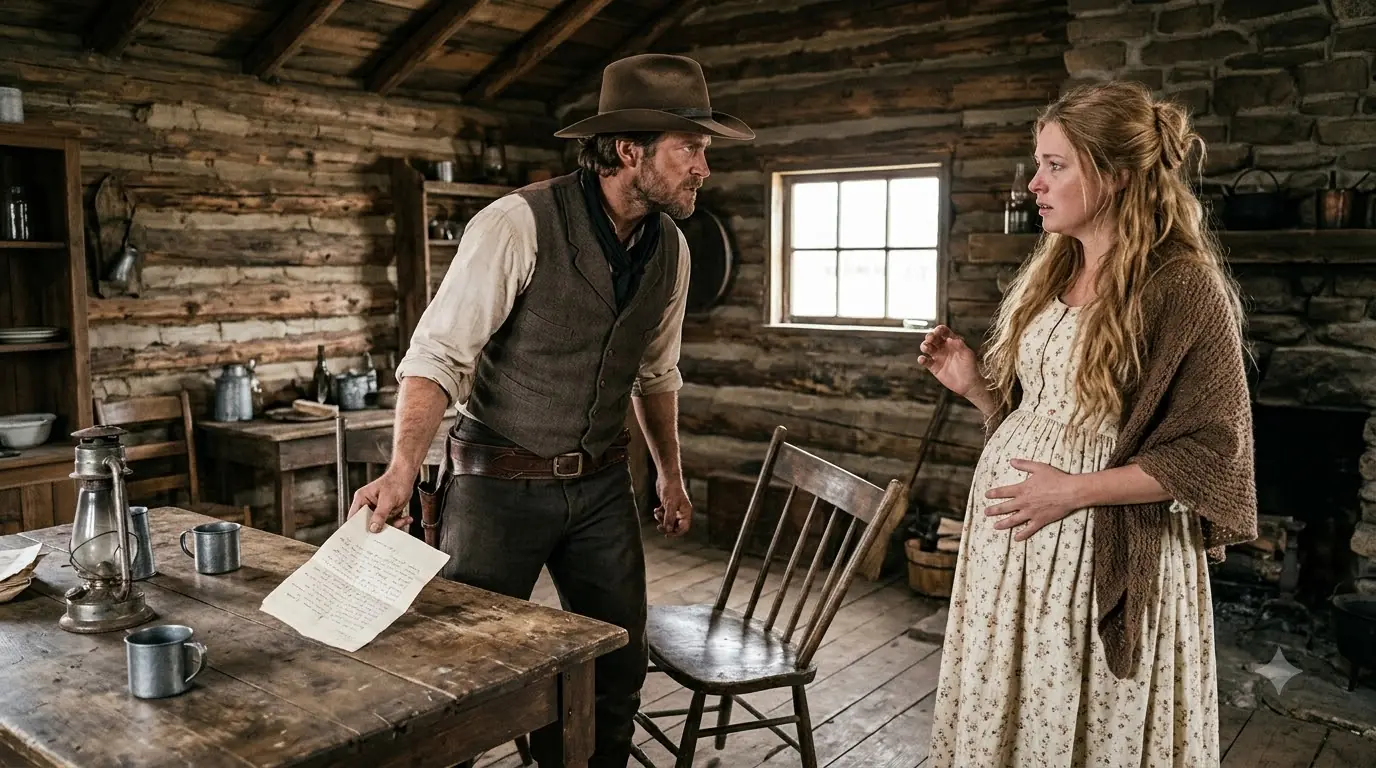
Gabriel Morrow stood beside the kitchen table, staring at the hand she had pressed against her stomach. His jaw was clenched, his hazel eyes wide with disbelief, and the letter that had brought her nine hundred miles across the American frontier lay crumpled beneath his trembling fingers.
Outside, an October wind swept across the Wyoming plains, rattling the shutters of the house he had built with his own hands.\
Inside, the silence seemed unbearable.
"You're carrying a child?"
Clara lowered her eyes.
She was thirty years old, beautiful in a quiet, almost fragile way, with fair skin, soft blue-gray eyes, and thick honey-blonde hair gathered loosely at the back of her head. She wore a faded cream dress printed with tiny flowers, a brown knitted shawl, and the same worn shoes she had brought from Missouri.
Her dress had become too tight around the waist.
Until that evening, she had managed to conceal the change beneath her shawl and apron.
But when Gabriel returned unexpectedly from the barn, he found her standing beside the fireplace, one hand resting protectively over the unmistakable curve beneath her dress.
Now there was nowhere left to hide.
"Clara."
His voice sounded different.
Not loud.
Not cruel.
Wounded.
She raised her face.
"Yes."
He swallowed.
"Tell me I'm mistaken."
Tears gathered in her eyes.
She tried to answer, but her throat tightened.
Gabriel stepped backward.
His boot struck the chair.
He shoved it aside, and the furniture fell against the floor with a sharp crash.
Clara recoiled.
The movement changed something in his expression.
He looked at the overturned chair, then at her frightened face.
For a moment, shame crossed his features.
But the question remained.
"How long?"
She pressed her palm more firmly against her stomach.
"Almost four months."
Gabriel stared.
Four months.
He had placed his marriage advertisement six weeks earlier.
She had accepted his proposal three weeks after that.
And she had arrived at his Wyoming ranch only four days ago.
The arithmetic was painfully simple.
He looked toward the letter on the table.
The one he had read so many times that the paper had begun to wear along its folds.
The one in which she wrote that she admired his honesty, respected his circumstances, and hoped they might build a peaceful home together.
He had believed every word.
Now his hands trembled.
"You knew."
Clara began crying.
"Yes."
"You knew before you answered my advertisement."
She nodded.
Gabriel dragged one hand across his face.
For years, he had lived with a private sorrow he rarely allowed himself to name.
He had survived a terrible fever as a boy, and the doctor who treated him later warned that the illness had probably left him unable to father children.
That news had followed him into adulthood.
It had ended one engagement.
Destroyed several hopes.
And eventually convinced him that no sensible woman would choose a man who couldn't give her the family she might want.
Yet Clara had written to him.
She had accepted his proposal.
She had traveled to his ranch.
And for four precious days, she had filled the house with something he hadn't realized he missed so desperately.
Laughter.
Conversation.
The sound of another person moving through the rooms.
The smell of fresh bread.
The sight of two cups resting beside the morning coffee pot.
He had begun imagining a life with her.
Not merely a marriage of convenience.
A real marriage.
One built slowly, carefully, from trust.
Now he felt as though the ground beneath the house had shifted.
"You knew I couldn't have children."
Clara's lips trembled.
"Yes."
He looked away.
The answer hurt more than he expected.
He thought of the advertisement he'd placed in the Cheyenne newspaper.