The crack of the plastic card was quieter than Isaiah Brooks expected.
For something that represented twenty-two years of his life, something he had carried through airports, deployment centers, hospitals, security gates, retirement briefings, and finally the first forty-eight hours of civilian life, it made almost no sound at all when Sheriff Arthur Cleary bent it between both hands.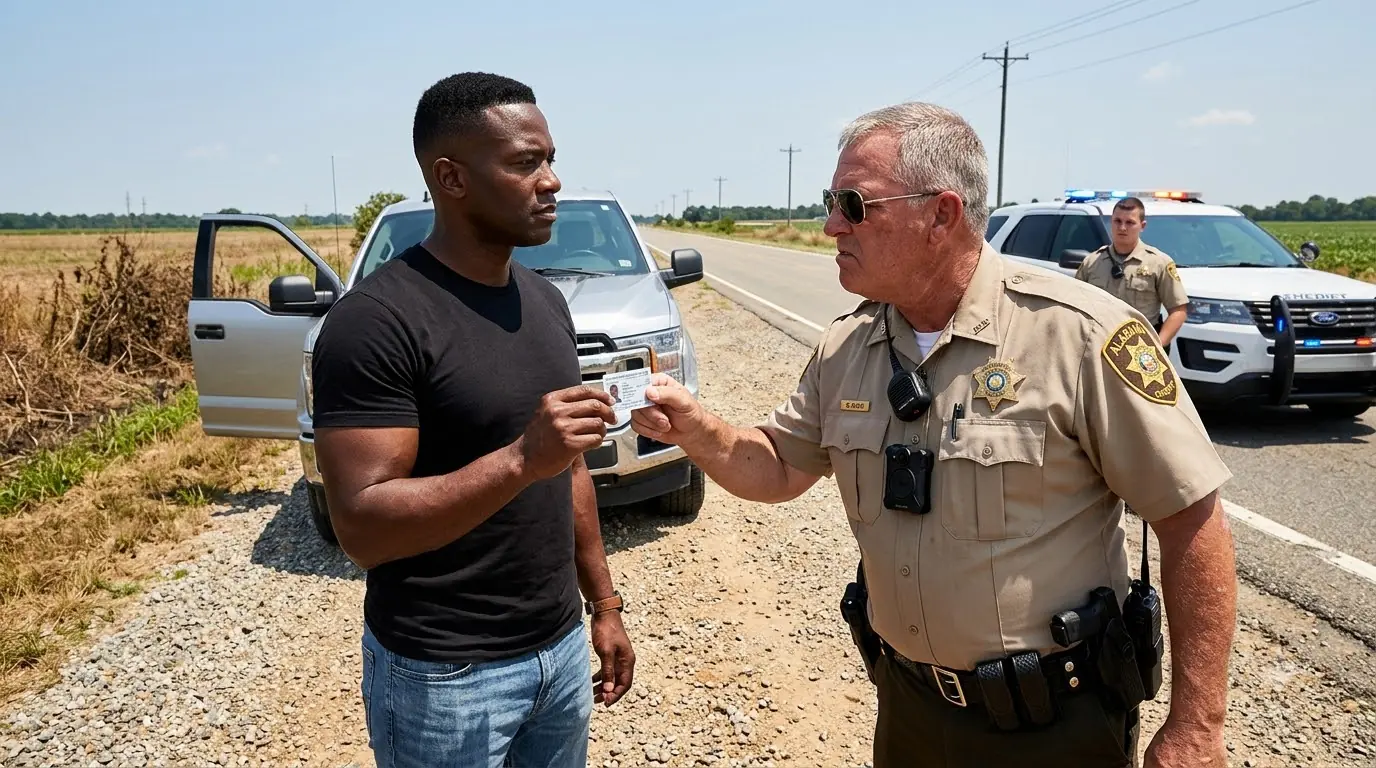
Just a dry little snap beneath the Alabama sun.
Then Cleary looked directly into Isaiah’s face and dropped the two pieces into the open window of his silver Ford F-150.
One landed against Isaiah’s thigh.
The other slid between the seat and the center console.
“There,” Cleary said. “Now you can stop pretending.”
Isaiah stared at him.
He was forty-two years old, six feet two, broad through the shoulders, with deep-brown skin, short black hair, and the disciplined posture of a man who had spent most of his adult life learning to control what happened after anger arrived.
The heat on County Road 44 was merciless.
It shimmered above the pavement and made the distant tree line look as though it were floating.
Isaiah had been driving with the air conditioner high, cruise control set at fifty-three in a fifty-five, one hand resting lightly on the steering wheel.
He had been thinking about his sister’s barbecue.
That was all.
His younger sister, Danielle, lived outside Mobile with her husband and two children. She had been asking him for almost a year what he planned to do after retirement.
Isaiah never had a satisfying answer.
Sleep.
Drive somewhere without checking in.
Wake up without needing a schedule.
Sit on Danielle’s back porch while his nephew complained about high school football.
Help his niece learn to drive.
Maybe buy a small fishing boat.
Maybe do absolutely nothing for several months.
He had spent enough of his life having somewhere else he was required to be.
Forty-eight hours earlier, he had walked out of his final out-processing appointment carrying a folder, a duffel bag, several documents he barely understood, and the unfamiliar realization that nobody would be calling him back.
Then Sheriff Arthur Cleary appeared in his rearview mirror.
Isaiah saw the cruiser accelerate from behind an abandoned farm stand.
The lights came on before the sheriff was close enough to have observed anything meaningful.
Isaiah did what he had been trained to do long before anybody called it training.
He signaled.
Pulled fully onto the shoulder.
Turned off the engine.
Lowered all four windows.
Placed both hands on the wheel.
Waited.
The man who approached wore a tan county uniform stretched tightly across a thick stomach.
Cleary was somewhere in his late fifties, with a sun-reddened face, gray hair combed back from his forehead, mirrored aviator sunglasses, and the slow confidence of someone who believed his badge ended every argument before it began.
His right hand rested beside his holster.
Not on it.
Close.
“License and registration.”
No greeting.
No explanation.
Isaiah had nodded.
“My wallet is in my back pocket, Sheriff. Registration’s in the glove box.”
Cleary leaned closer.
“You always narrate everything you do?”
“I’m telling you where my hands are going.”
“I can see your hands.”
“Yes, sir.”
That answer should have helped.
Instead, Cleary seemed annoyed by it.
“License.”
Isaiah removed his wallet slowly.
The retirement identification card sat directly behind his driver’s license because the clerk who issued it two days earlier told him he would probably need it often while adjusting benefits and medical records.
Isaiah handed over both without thinking.
Cleary looked at the driver’s license first.
“Illinois.”
“Yes.”
“You’re a long way from home.”
“Visiting my sister near Mobile.”
Cleary examined him through the open window.
“Where’d you come from?”
Isaiah hesitated.
“North.”
Cleary smirked.
“That supposed to be funny?”
“No.”
“Where specifically?”
Isaiah named the town where he had spent his final week completing administrative appointments.
Cleary glanced at the second card.
His entire expression changed.
Isaiah recognized the reaction immediately.
People had different ideas about what certain words on an identification card meant.
Some became respectful.
Some curious.
Others suspicious.
Cleary belonged to the third group.
“Special Operations Command.”
Isaiah said nothing.
Cleary looked at the card again.
Then at Isaiah.
“You expect me to believe this?”
“It’s identification.”
“Looks fake.”
“It isn’t.”
Cleary tilted it toward the sunlight.
“You some kind of war hero?”
Isaiah’s jaw tightened.
“No.”
“Then what is this?”
“A retirement credential.”
“Twenty-two years?”
“Yes.”
Cleary laughed.
“You don’t look old enough.”
Isaiah almost answered that he didn’t feel old enough either.