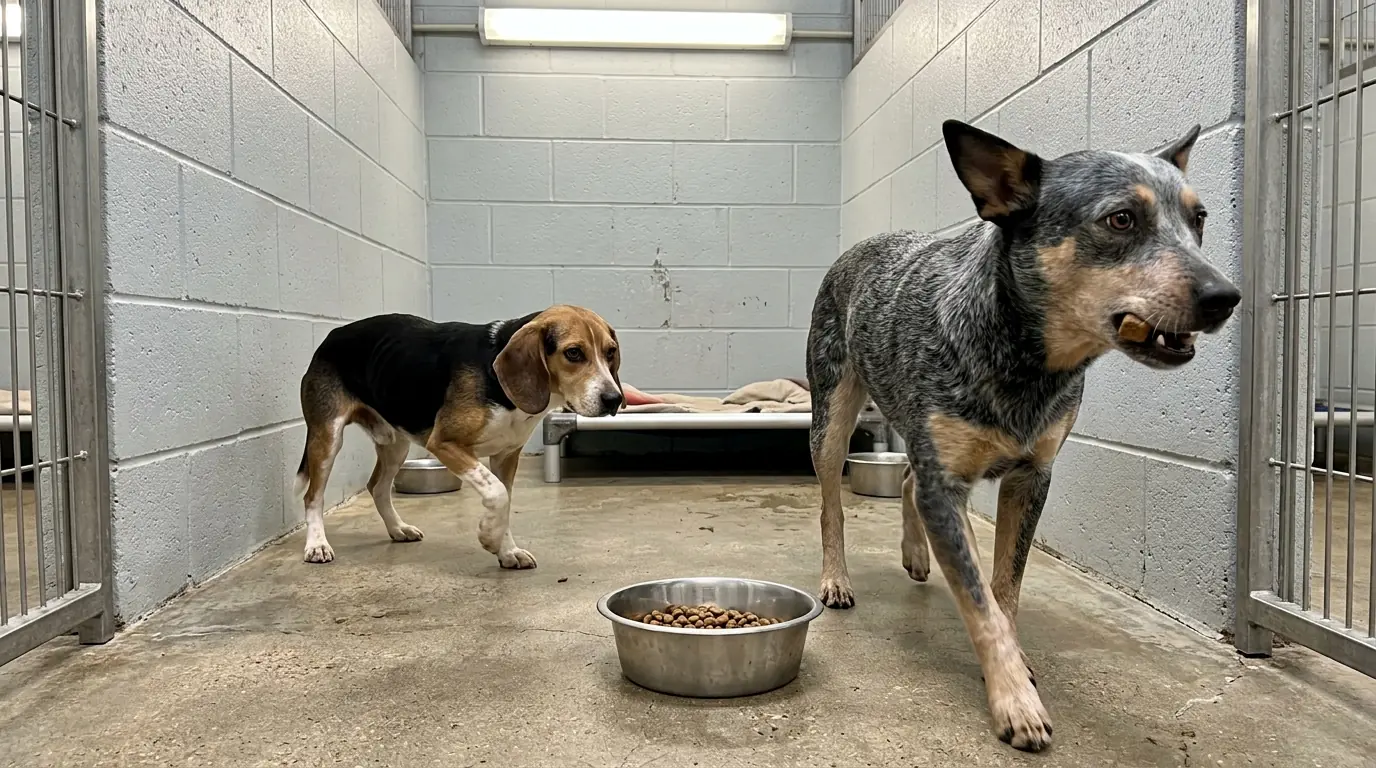
Theo was hungry.
That was what made the scene so difficult to understand.
The five-year-old Beagle mix was underweight when he arrived at the shelter, yet when a bowl of kibble was placed inside the shared kennel, he often wouldn’t walk up to it.
He would stay several feet away instead.
His body remained low and cautious. His eyes moved between the bowl, the kennel entrance, and the activity around him. Even after staff stepped away, Theo sometimes continued standing there as though approaching the food required more confidence than he had.
Then Luna would move.
The four-year-old Cattle Dog mix would approach Theo’s bowl, quietly steal a single piece of kibble, and walk away.
Almost immediately, Theo’s behavior changed.
He stepped forward.
He lowered his head over the bowl.
And finally, he ate.
It happened often enough that shelter staff began to realize they weren’t simply watching one shy dog and one opportunistic kennel mate.
For some reason, Luna taking that first piece seemed to be the moment Theo needed before he could begin.
Theo and Luna Came From an Overcrowded Home
Before entering the shelter, Theo and Luna had lived together in an overcrowded household.
Situations like these can vary enormously. Without knowing every detail of what happened inside the home, shelter staff could not assume exactly what the dogs had experienced around food.
What they could document was what arrived through their doors.
Theo was thin and extremely timid.
New spaces seemed difficult for him. Sudden movement could make him hesitate, and ordinary shelter activity—the opening of kennel doors, unfamiliar voices, barking from nearby dogs, metal bowls moving across the floor—could leave him watching rather than participating.
Luna adjusted differently.
She was more willing to move around their shared space and investigate what staff brought into the kennel.
That difference became particularly obvious at mealtime.
For Theo, food was available.
But simply having a full bowl in front of him did not mean he felt comfortable approaching it.
Being Underweight Made His Hesitation More Concerning
A dog who is already underweight needs careful nutritional monitoring.
Shelter staff needed to know how much Theo was actually eating rather than assuming an empty bowl meant he had consumed the food himself—especially while another dog was sharing his kennel.
His reluctance could also have several possible explanations.
Stress can suppress appetite or interfere with normal feeding behavior. Dental pain, gastrointestinal problems, parasites, systemic illness, or other medical issues can also contribute to weight loss or poor eating.
That meant Theo’s body condition and feeding behavior needed veterinary attention rather than being dismissed as simple pickiness.