By eleven in the morning, Lena Hartwell already knew she had made a mistake.
She stood at the far end of the long wooden table inside the Cedar Hollow meeting hall with both hands folded over a flour-stained ivory apron, trying not to look at the desserts surrounding her.
There were seven-layer cakes glazed with sugar so white they looked carved from winter snow. Raspberry tarts gleamed beneath careful latticework. Bundt cakes had been dusted with powdered sugar and decorated with preserved cherries. Someone had brought a tower of tiny cream pastries arranged on three silver trays borrowed from the hotel.
And then there was Lena’s bread.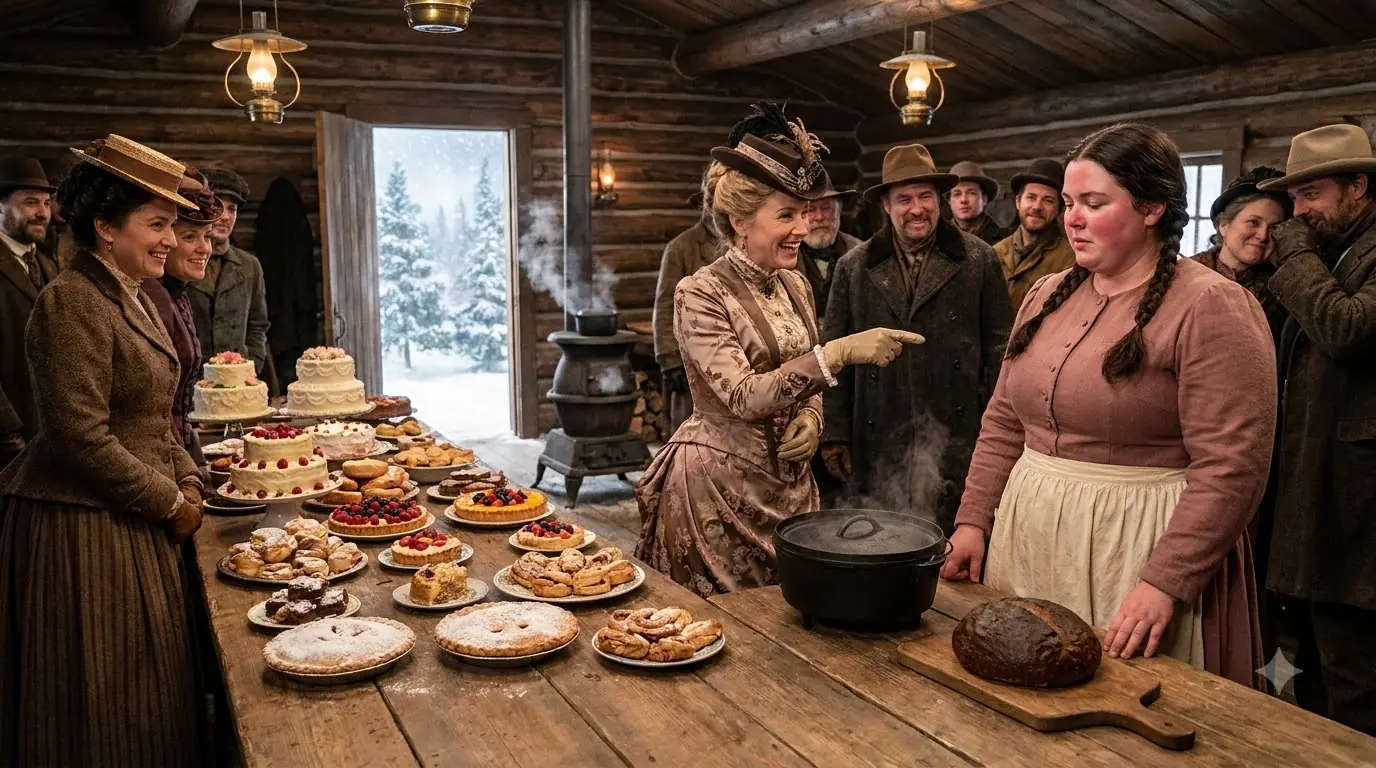
One dark Dutch oven.
One thick round loaf.
Nothing on it except a blistered brown crust and a little coarse salt.
Steam still slipped from beneath the heavy iron lid.
The women standing behind the neighboring entries had noticed the contrast immediately.
So had everyone else.
Lena pretended not to hear the first laugh.
She heard the second.
By the third, pretending required more effort.
“What exactly is it supposed to be?”
The question came from Caroline Dunley, whose lemon cake occupied the center of the table like a royal monument.
Lena kept her eyes on the bread.
“Bread.”
Caroline smiled toward the other women.
“Yes, dear. We can see that.”
A few quiet laughs followed.
Lena’s cheeks warmed.
She was thirty years old, and she had long ago learned that there were several different kinds of laughter.
Children laughed openly.
Men often laughed in groups.
Women like Caroline had perfected something quieter. A laugh wrapped inside sympathy so the victim appeared unreasonable for being wounded by it.
Lena knew that kind well.
Caroline leaned toward the Dutch oven.
“It looks heavy.”
“It is.”
“I meant the bread.”
More laughter.
Lena raised her eyes.
Caroline was beautifully dressed in a fitted dark-blue gown trimmed with black lace. Her blond hair had been arranged beneath a small velvet hat, and even at a winter fundraising sale in a frontier town she wore pearl earrings.
Lena’s own dress was dusty rose.
Plain wool.
High cream neckline.
Long sleeves.
No embroidery.
No imported trim.
Her hair had been braided down her back because elaborate pins gave her headaches.
She was a large woman, soft through the waist and hips, with broad arms strengthened by years of kneading dough, hauling flour, chopping wood, carrying water, and doing all the work people somehow believed a woman of her size must be too lazy to perform.
Lena had heard variations of that belief since childhood.
Too slow.
Too heavy.
Too plain.
Too much woman for fashionable clothing.
Too little of everything men supposedly wanted.
She had learned to survive by becoming useful.
Useful women could remain in rooms where beautiful women were admired.
Useful women could cook.
Mend.
Clean.
Keep books.
Stretch flour.
Heal a fever.
Prepare six meals from ingredients someone else would throw away.
People did not praise useful women, but they kept them nearby.
Most of the time, Lena had convinced herself that was enough.
Then Caroline lifted the lid of the Dutch oven without asking.
A cloud of fragrant steam escaped.
Several people turned.
The bread smelled of roasted grain, browned butter, a faint sourness from the starter Lena had kept alive for nine years, and something almost nutty from rye flour she had ground herself.
Caroline’s smile faltered for half a second.
Then she recovered.
“My.”
She touched one fingernail lightly against the crust.
“Very sturdy.”
Lena closed the lid.
“Please don't handle it.”
Caroline’s eyebrows rose.
“I was only looking.”
“You were touching.”
The room nearest them became quieter.
Lena immediately regretted speaking.
Caroline did not.
The woman smiled.
“Well, I suppose we should all be grateful Mr. Reid owns strong teeth.”
Someone laughed again.
Lena looked toward the door.
Mr. Reid.
That was the entire reason the bake sale mattered.
Not to Lena specifically.
To Cedar Hollow.
The winter had come early and hard that year. Snow buried the upper road before Thanksgiving. Two ranches had lost cattle. The sawmill had cut shifts after a machine failure, and the school roof leaked badly enough that children moved desks whenever it snowed.
The women’s committee organized the sale to raise money for repairs.
The wealthiest rancher in the district, Nathaniel Reid, had been invited because people said whatever item he purchased would likely bring the highest donation of the day.
Rumors followed him.
He owned Black Ridge Ranch forty miles north.
Eighty hired men during peak season.
Thousands of acres.
Cattle.
Timber contracts.
A private grain store.
Some claimed he had more money than the bank.
Others insisted he simply lived like a man who did not care about displaying it.
Lena had never met him.
She had seen him once from across Main Street.
Large.
Dark-haired.
Riding through snow in a wolfskin coat.
He had looked more like a man returning from a war than a wealthy rancher attending a supply meeting.
Caroline had spent the morning mentioning that her husband had once negotiated cattle with him.
The implication was obvious.
When Nathaniel Reid arrived, he would know where respectable food stood.