Marcus Reed expects nothing more complicated from Saturday afternoon than smoke from the grill, too much food, and several hours with the people he loves.
The forty-two-year-old Black homeowner lives with his wife, Danielle, and their children in Brookfield Pines, an affluent North Carolina subdivision where carefully trimmed lawns and polished entrances conceal a neighborhood that has spent nearly two years fighting over the increasingly aggressive behavior of HOA president Brenda Whitmore.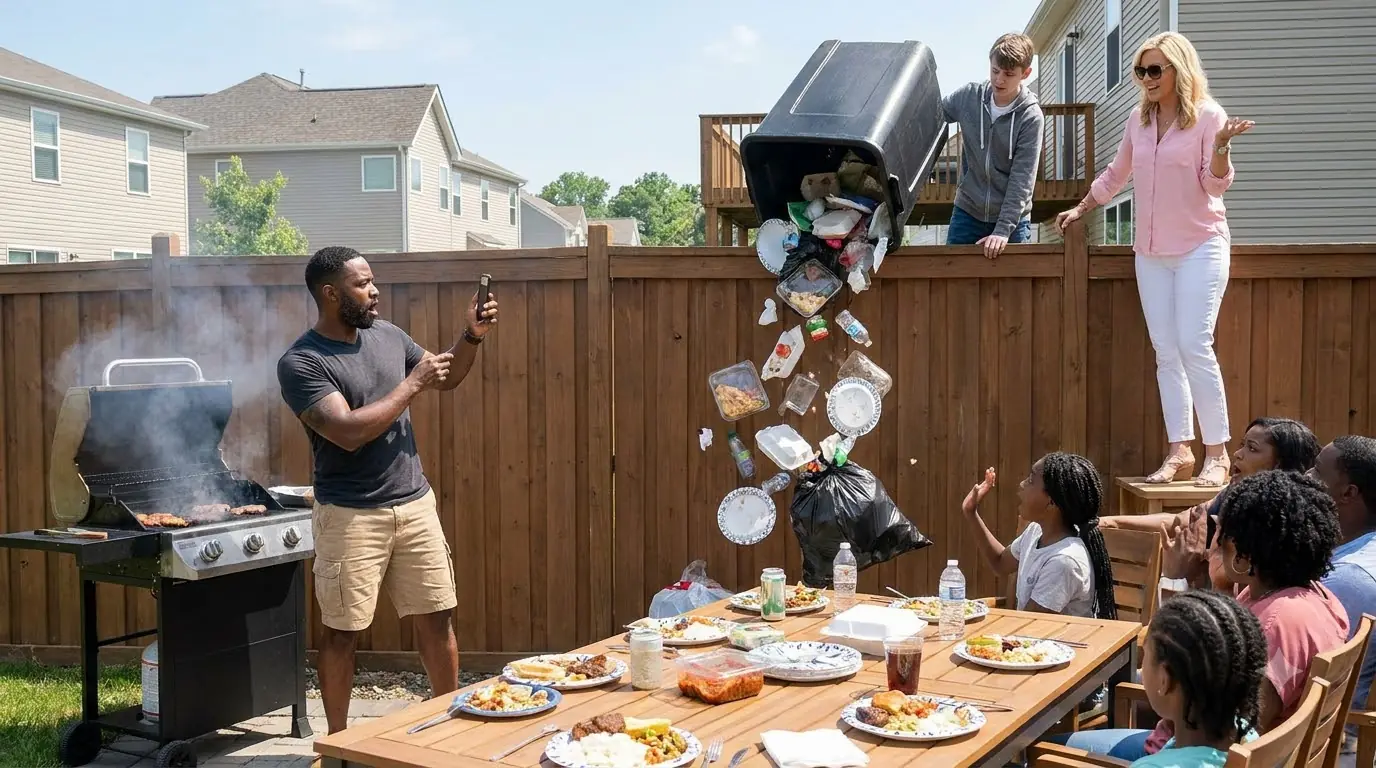
Marcus has become one of Brenda’s least favorite residents.
Not because he refuses legitimate rules.
Because he reads them.
Whenever Brenda sends a violation notice, Marcus checks the governing documents, photographs his property, requests the evidence, and appeals when the association is wrong. During the previous year, he has successfully challenged citations involving his fence, patio furniture, landscaping, and backyard gatherings.
Brenda increasingly treats those victories not as routine corrections but as personal humiliation.
On the afternoon of Marcus’s mother’s birthday cookout, the Reed family fills the backyard with music, barbecue smoke, folding chairs, trays of food, and laughter.
None of them realizes that Brenda’s eighteen-year-old son, Tyler, has quietly dragged a large garbage bin through the neighboring yard.
Brenda, dressed in a bright pink blouse and sunglasses, stands behind the privacy fence directing him.
Tyler climbs onto a wooden platform.
Then he tips the entire bin over the fence.
Household garbage explodes across Marcus’s backyard.
Dirty paper plates strike the food table.
Plastic containers bounce across the patio.
Spoiled leftovers scatter near the grill.
Marcus immediately pulls younger relatives away from the mess, drops his barbecue tongs, and begins recording.
Brenda claims it was an accident.
Marcus does not believe her.
Then four neighbors emerge from surrounding properties holding phones.
Each has recorded something from earlier that morning.
One captured Tyler dumping garbage into another resident’s flower beds.
Another recorded Brenda directing him toward a different backyard.
A doorbell camera shows Brenda loading trash into the bin herself.
The fourth video captures her telling Tyler which homes belong to residents she calls “repeat problems.”
The cookout was not an isolated act.
It was the latest step in a deliberate attempt to manufacture HOA violations.
At an emergency board meeting, Brenda insists the videos are being misinterpreted. She says her son was helping with community cleanup and accidentally placed debris in the wrong locations.
Then Marcus asks a simple question.
Has anyone else received a violation notice immediately after unexplained garbage appeared on their property?
Four hands rise.
Within days, HOA records reveal something even more damaging.
Several violation letters were drafted before the garbage was dumped.
Brenda was not merely retaliating against residents.
She was creating the conditions she later cited as evidence of noncompliance.
The targets share one characteristic: each had successfully challenged her authority.
Tyler eventually provides texts showing that his mother instructed him to create “visible conditions” around specific properties so that photographs could be taken and fines issued.
The scandal forces Brookfield Pines to confront a larger truth.
Brenda’s scheme survived because too many people experienced one suspicious event in isolation and assumed nobody else would believe them.
Board members approved notices without reviewing original evidence.
The management company accepted photographs without checking when they were taken.
Residents paid fines because fighting cost more time than surrendering.
And Tyler, desperate for his mother’s approval, participated long after he realized what they were doing was wrong.
Marcus refuses to turn the neighborhood into a revenge campaign.
He wants restitution for the destroyed food and cleanup costs, removal of fabricated violations, and rules ensuring no future board president can personally manufacture enforcement evidence.
Brenda ultimately loses her position and faces consequences for unlawful dumping, trespass, falsified association records, and the civil claims created by her actions.
But the deeper change occurs among the neighbors.
People who once dealt with Brenda separately begin comparing records.
Residents who barely knew each other start attending meetings together.
The four raised hands become the symbol of the entire case.
One person can be dismissed as difficult.
Four independent witnesses carrying timestamps, videos, and matching documents are much harder to silence.
And one year later, when the Reed family holds another backyard cookout, the same fence stands behind them.
This time several neighbors are on Marcus’s side of it.
Not because the neighborhood finally learned who mattered.
Because it finally learned what happens when people stop allowing authority to isolate them from one another.
Marcus Reed had been standing over the grill for exactly eleven minutes when his father told him the burgers were burning.
“They are not burning.”
Samuel Reed leaned closer.
“They’re turning black.”
“That is called a crust.”
“That is called burning with confidence.”
Marcus glanced at his father.
Samuel was seventy-one, silver-haired, broad through the shoulders even after retirement, and completely incapable of allowing another man to operate a grill without supervision.
“You want the tongs?”
“No.”
“Then sit down.”
“I’m helping.”
“You’re criticizing.”
“At my age, that is helping.”
Marcus shook his head.
Behind them, laughter rolled across the backyard.
It was Saturday afternoon in Brookfield Pines, North Carolina, and for the first time in almost three months Marcus had managed to gather nearly everyone in his family at the same place.
His mother, Gloria, sat beneath the patio umbrella opening birthday cards while Danielle arranged trays of food across the long table.
Marcus’s younger sister Renee had brought peach cobbler.
His brother Aaron had brought nothing except an appetite and two folding chairs.
Marcus’s daughter Maya was trying to keep her twelve-year-old cousin from stealing deviled eggs before dinner.
Music played softly from an outdoor speaker.
Smoke curled above the grill.
The swimming pool reflected a cloudless blue sky.
It was exactly the kind of ordinary afternoon Marcus had spent years working hard enough to create.
That mattered to him.
The house itself mattered less than people assumed.
Yes, it was large.
Two stories.
Stone entry.
Four bedrooms.
Swimming pool.
The kind of house people described as impressive when what they usually meant was expensive.
Marcus had not bought it to impress anyone.
He had bought it because he grew up in a two-bedroom apartment with three siblings and parents who worked opposite shifts so somebody would always be home.
He remembered birthdays squeezed around a folding table.
He remembered his mother sleeping through afternoon noise because she had worked overnight.
He remembered his father carrying groceries up three flights of stairs after ten-hour construction shifts.
When Marcus became successful managing major commercial construction projects, he wanted one thing from money.
Space.
Enough room for everyone to come over.
Enough chairs.
Enough food.
Enough parking.
Enough backyard for children to run without somebody downstairs banging on the ceiling.