Darius Grant knew the first-class cabin better than most of the passengers already sitting inside it.
He knew why the cream leather seats had been widened by an inch and a half two years earlier.
He knew the wood-grain panel beside the windows was not real walnut, even though the supplier had spent six meetings arguing that passengers would never know the difference.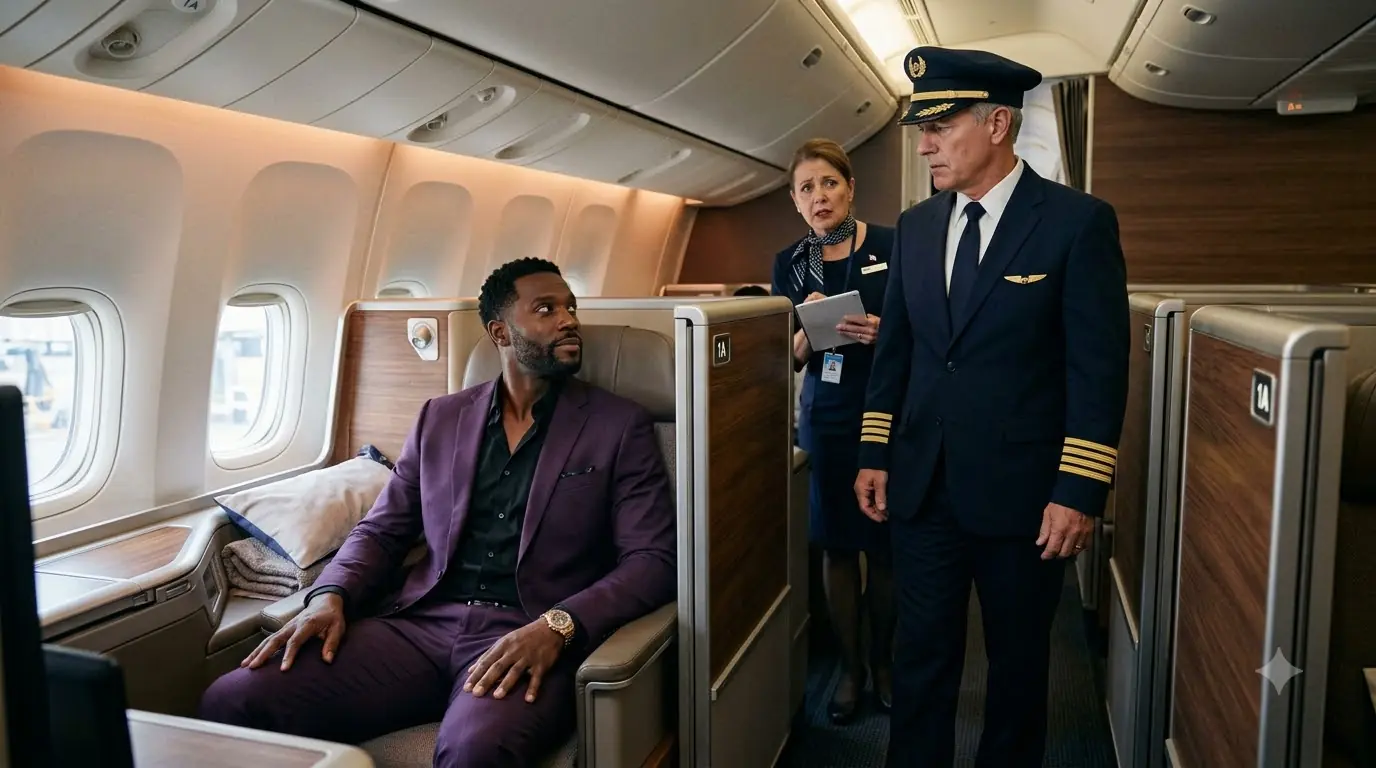
He knew why the reading lights angled four degrees farther inward than the ones on the airline’s older aircraft.
He knew how much Northstar Airways had paid to redesign the overhead bins after a retired schoolteacher from Denver wrote a three-page letter explaining that she could no longer lift her carry-on above shoulder height.
He knew the stitching pattern on the headrest.
The supplier who made the seatbelt buckles.
The reason the carpet near the forward galley was a shade darker than the rest of the cabin.
And he knew exactly what seat 1A cost the airline when it flew empty.
That morning, however, none of that mattered to anyone looking at him.
To the crew preparing Northstar Airways Flight 418 for departure, Darius appeared to be what he had deliberately arranged to appear to be.
A passenger.
Nothing more.
He was forty-three years old, Black, tall, athletic without looking like he spent his life in a gym, with a neatly trimmed beard, short black hair, and the kind of steady eyes that people often mistook for calm even when he was furious.
He wore a beautifully tailored deep-purple suit over a black open-collar shirt.
No tie.
No executive pin.
No Northstar identification clipped to his pocket.
His watch was expensive, but discreet enough that only someone who knew watches would notice.
His phone rested in his right hand.
His boarding pass sat folded beside a glass of water on the console.
One small leather carry-on occupied the approved space beneath the side compartment.
No entourage.
No assistant.
No security.
No announcement from corporate.
Two people in the entire airline knew he was on Flight 418.
His executive assistant.
And the senior operations officer monitoring the test from headquarters.
That was precisely the point.
For six months, complaints had been accumulating in a file that Darius could no longer dismiss as random.
They were not catastrophic complaints.
No engine failures.
No emergency landings.
No headline-making safety events.
They were worse in a quieter way.
A Black cardiologist removed from first class because a crew member believed she had boarded the wrong cabin.
A Latino software executive repeatedly asked whether his business-class ticket was really his.
A college professor wearing a sweatshirt challenged three separate times while passengers in suits around him were not.
A disabled veteran told his mobility device would have to be checked without anyone reading the accessibility note attached to his booking.
A young mother asked to prove she had paid for lounge access after her digital pass had already turned the scanner green.
Individually, each case could be explained.
A misunderstanding.
A tired employee.
A communication problem.
An outdated note.
A crowded boarding process.
Together, they formed a pattern.
The customer-experience department had produced reports.
The legal department had warned against drawing conclusions from incomplete anecdotes.
The inflight division had presented charts showing complaint rates remained below industry averages.
Northstar’s chief operating officer had used a sentence Darius increasingly hated.
“We have no evidence of a systemic problem.”
Darius had asked:
“Do we have evidence there isn’t one?”
The room had gone quiet.
Two weeks later he began flying.
Not as CEO.
As himself.
His own name was not secret, but Northstar’s public image had never centered on him.
Darius had deliberately avoided becoming a celebrity executive.
He gave interviews when necessary.
Appeared at earnings calls.
Spoke at aviation conferences.
But Northstar’s advertising did not feature his face.
Most passengers could not identify the chief executive of any airline.
Most employees outside corporate offices could not either.
That anonymity had become useful.
He had already taken five flights.
Two economy.
Two premium economy.
One business class.
Flight 418 was the first first-class test.
Until the captain appeared, it had also been the least eventful.
The senior flight attendant had greeted Darius professionally.
“Good morning, Mr. Grant.”
No hesitation.
No second look.
She had offered to hang his coat.
He declined.
She asked whether he wanted water, orange juice, or sparkling wine.
“Water, please.”
“Of course.”
Nothing about the interaction felt unusual.