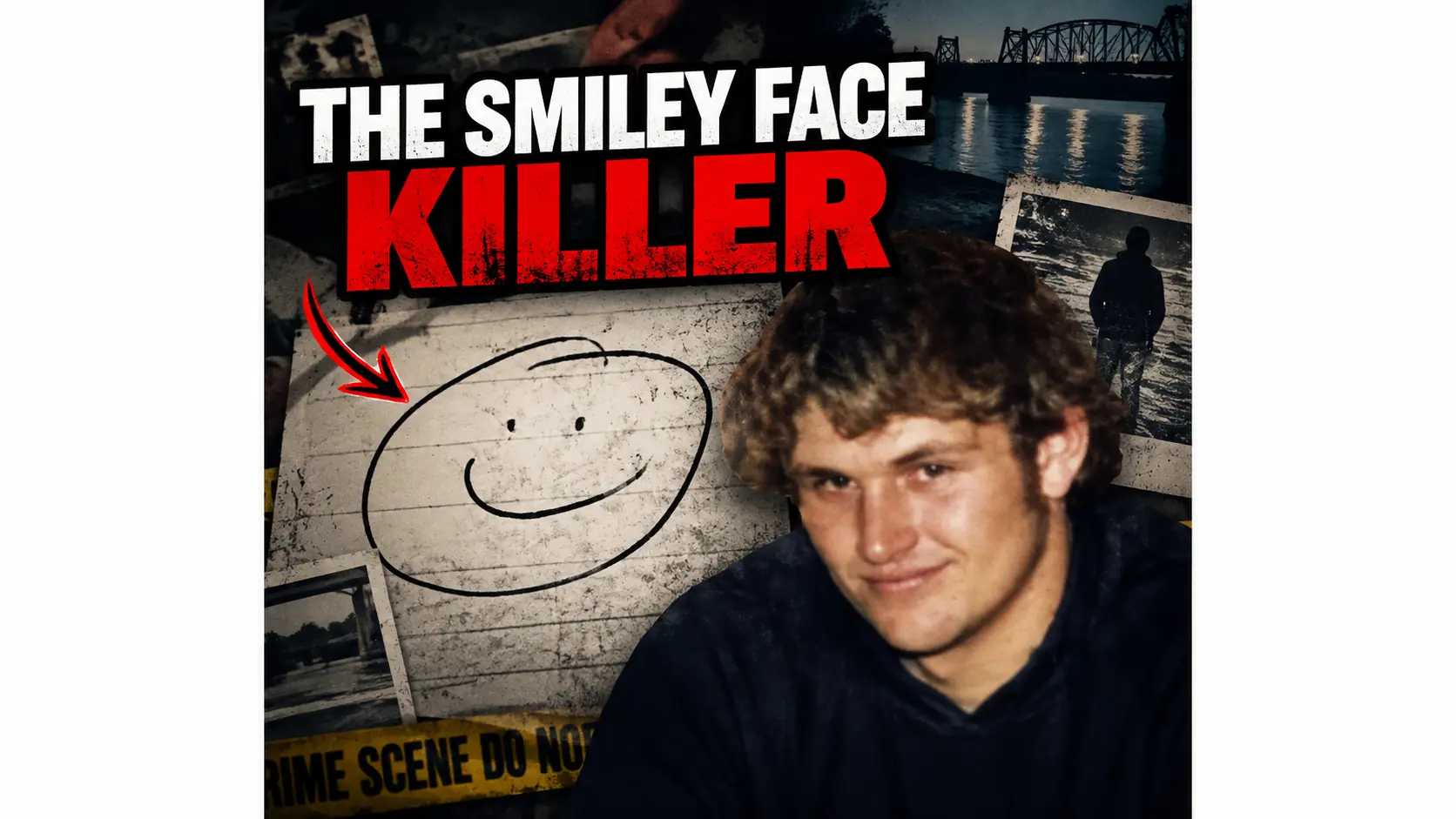
Portland, Oregon.
January 1990.
The story of the Happy Face Killer did not begin with a smile.
It began with a young woman who never came home.
Her name was Taunja Bennett.
She was twenty-three years old.
She lived in the Portland area and was known as an outgoing young woman who enjoyed going to neighborhood bars, talking to people, playing pool and making friends easily.
On the evening of January 21, 1990, Taunja went out.
By the following morning, she was dead.
A bicyclist traveling along the historic Columbia River Gorge highway east of Portland noticed something below the road.
Down an embankment, surrounded by the dense vegetation of the gorge, was the body of a young woman.
She had been attacked and strangled.
Investigators did not immediately know who she was.
The location offered little help.
The Columbia River Gorge was beautiful, heavily wooded and filled with scenic roads, overlooks and isolated places where a vehicle could stop briefly without attracting much attention.
Whoever had left the woman there had chosen a place where evidence could vanish into rain, vegetation and mud.
Police eventually identified her as Taunja Bennett.
The case looked difficult.
There was no obvious suspect standing beside the body.
No murder weapon had been conveniently abandoned.
No security camera had recorded a vehicle.
No smartphone location data existed.
There were no social-media messages to reconstruct her final hours.
This was 1990.
Detectives had witnesses.
Paper records.
Physical evidence.
Memory.
And whatever the killer had failed to remove.
At first, there was very little.
Then the telephone rang.
A woman said she knew who had killed Taunja Bennett.
That call seemed to give police exactly what they needed.
Instead, it would lead them into one of the strangest wrongful-conviction stories in American criminal history.
Because the woman on the telephone was lying.
The man she accused was innocent.
She would eventually accuse herself as well.
Both would go to prison.
And while they sat behind bars, the actual killer would travel America's highways, killing again.
What frustrated him most was not that police might catch him.
It was that they were giving someone else credit for his crime.
So he began writing.
First on restroom walls.
Then in letters.
Each message carried the same bizarre signature.
A crudely drawn smiling face.
For years, authorities would not know the hand behind that symbol.
Then another woman disappeared.
Another body was discovered.
A truck driver's name entered the investigation.
And suddenly investigators realized that the mysterious man writing to newspapers, the person claiming responsibility for multiple unsolved murders, and the suspect in the latest killing might all be the same person.
His name was Keith Hunter Jesperson.
And by the time the truth finally emerged, the investigation would force Oregon prosecutors to admit something almost unimaginable:
They had already convicted two innocent people of Jesperson's first known murder.
The Body in the Gorge
Taunja Bennett was killed on January 21, 1990.
Her body was discovered the next morning off the Old Columbia River Highway, east of Portland near the Columbia River Gorge.
She had been beaten, sexually assaulted and strangled.
The physical scene suggested that whoever attacked her had moved through the area with enough confidence to leave before being noticed.
The body lay down an embankment.
Taunja's belongings were not all present.
Her purse was missing.
So were other personal items.
Those missing possessions mattered.
At the time, police could not know that one of them would become the most important piece of evidence in the case almost six years later.
The investigation initially focused on Taunja's final hours.
Where had she been?
Who had seen her?
Who had spoken with her?
Witnesses placed her at the B&I Tavern in Portland.
Like countless homicide investigations, detectives began with the victim's known world.
Friends.
Bars.
People who had been nearby.
People who might have had a reason to hurt her.
The real killer was not yet part of that known world.
He was a long-haul truck driver.
Large.
Nearly six feet six inches tall.
Constantly traveling.
Able to move hundreds or thousands of miles between jurisdictions.
His name meant nothing to the investigators.
Not yet.
Thirteen days after the murder, police received a tip.
The caller was a woman.
She said she had information about a man named John Sosnovske.
According to her, Sosnovske had talked about killing Taunja Bennett.
That tip looked like the breakthrough investigators had been waiting for.
The woman was Laverne Pavlinac.
And John Sosnovske was her boyfriend.
Laverne Pavlinac
Pavlinac was nearly sixty.
She did not resemble the kind of suspect investigators expected in the brutal killing of a twenty-three-year-old woman.
She looked grandmotherly.
Her home was tidy.
She offered investigators coffee.
She spoke openly.
Most important, she appeared frightened of John Sosnovske.
The relationship was abusive.
Sosnovske drank heavily.
Pavlinac told investigators she wanted to escape him.
At first she positioned herself outside the murder.
She said Sosnovske had talked about it.
He had supposedly bragged.
Then her story changed.
As police continued investigating, Pavlinac began producing details.
Some sounded remarkably specific.
She said she knew where Taunja had been taken.
She described objects.
She discussed the Columbia Gorge.
She eventually produced what appeared to be evidence.
Inside the trunk of her car, she claimed to have found a purse that did not belong to her.
The purse contained a newspaper clipping about Taunja's case.
There was also a piece of denim.
That was significant because part of Taunja's jeans had been cut away.
Investigators had not emphasized every detail publicly.
For police, the discovery seemed important.
Perhaps Sosnovske had kept a piece of clothing as a trophy.
Perhaps Pavlinac's car had been used during the crime.
But the crime laboratory examined the items.
The purse was not Taunja's.
The denim did not match.
Pavlinac had planted them.
A case that seemed to be getting stronger suddenly became stranger.
Investigators confronted her.
Why fabricate evidence if she was telling the truth?
Pavlinac admitted creating the fake evidence.
But instead of withdrawing her accusation, she made the story bigger.
She now said she had personally participated in disposing of Taunja Bennett's body.
The Story Changes
Pavlinac told investigators that Sosnovske had called her and demanded help.
In one version, she said she arrived at a truck stop and found Taunja's body.
She claimed they loaded the body into a vehicle and drove into the Columbia Gorge.
Then came another version.
This time, Taunja was still alive.
Pavlinac placed herself at the scene.
She described driving with Sosnovske and Bennett toward Vista House, the historic stone observatory overlooking the gorge.
She said events escalated there.
She described a rope.
She described sexual activity.
She described herself holding the rope while Sosnovske assaulted Taunja.
According to this version, Pavlinac realized too late that Taunja had stopped breathing.
The confession was emotional.
Police recorded it.