The Real Killer
Keith Hunter Jesperson was born in Canada in 1955 and spent much of his life in the Pacific Northwest.
By adulthood, he was enormous.
Roughly six feet six inches tall.
Broad.
Physically imposing.
He married young and had children.
He worked various jobs.
Eventually, long-haul trucking became central to his life.
The job placed him on interstate highways constantly.
Truck stops.
Rest areas.
Motels.
Industrial corridors.
Small towns.
Remote exits.
One state in the morning.
Another by night.
It was not an invisible profession.
Truckers leave fuel receipts, logs and employment records.
But for someone seeking victims outside his normal social circle, mobility offered an obvious advantage.
A woman could disappear in one state.
Her body could be discovered in another.
The person who last saw her might live hundreds of miles away.
Local investigators might never know similar cases existed elsewhere.
Jesperson's marriage deteriorated and ended around the time his known killings began.
Later, he would offer many explanations for himself.
Childhood humiliation.
Violence in his family.
Sexual trauma.
Divorce.
Anger.
A desire to be noticed.
Control.
His later claims must be treated cautiously.
Jesperson became an enthusiastic narrator of his own life.
He exaggerated.
He sought attention.
He made claims about murders that could not be verified.
The safest way to understand him is not through every story he later told about himself.
It is through what can be independently established.
Eight women were ultimately connected to him as confirmed murder victims.
Taunja Bennett was the first.
January 21, 1990
Jesperson met Taunja at the B&I Tavern.
He later told investigators that his girlfriend at the time, Roberta Ellis, was away driving a trucking route.
Taunja and Jesperson left the bar together.
He brought her to the home he was using.
What happened afterward is known principally through Jesperson's confession, later corroborated in important ways.
He said an argument developed.
He attacked Taunja.
He strangled her.
Then he moved her body into the Columbia River Gorge.
The next day, he returned to dispose of belongings from her purse along the Sandy River.
That last act would become one of the keys to proving his guilt years later.
Police did not know where Taunja's purse had gone.
Pavlinac did not know.
The press did not know.
Only the killer knew.
Jesperson drove away.
Soon he saw the murder on television.
Then something unexpected happened.
Police arrested other people.
The public talked about Pavlinac.
Then Sosnovske.
Jesperson watched two strangers become famous for his crime.
According to his later statements, it infuriated him.
He wanted recognition.
That desire helps explain the restroom messages.
The real killer was effectively announcing:
You have the wrong people.
Look at me.
But he did not give his name.
He wanted attention without surrendering freedom.
That contradiction would define his strange relationship with police and the press for the next five years.
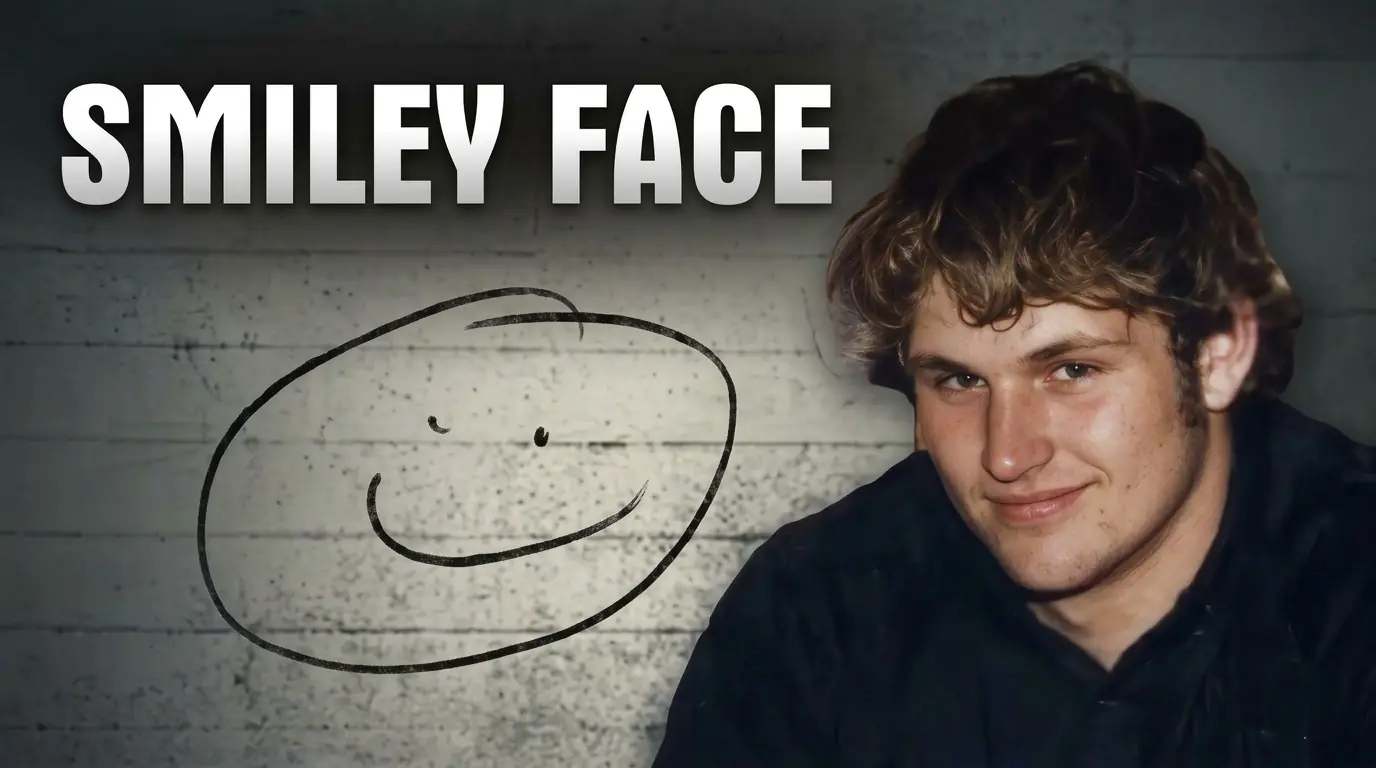
A Smiley Face
Why a smile?
Jesperson later became known nationwide because of the symbol, but there was nothing complex about it.
It was easy to draw.
Memorable.
Almost childish.
That was exactly what made it disturbing.
A smiley face normally means friendliness.
Happiness.
A joke.
A casual note.
Attached to a murder confession, it became grotesque.
Over time, the image functioned almost like a brand.
The press needed a name for the unknown writer.
Journalist Phil Stanford of The Oregonian eventually began calling him the Happy Face Killer.
The name stuck.
But in 1991, nobody knew whether the bathroom messages belonged to the real murderer.
And Jesperson had another advantage.
He had stopped writing long enough for the criminal justice system to settle around its wrong answer.
Pavlinac was in prison.
Sosnovske was in prison.
The real killer was back on the road.
A Killer With a Highway
Long-haul trucking gave Jesperson a geographic pattern unlike a killer who operated within a single neighborhood.
His routes took him across western and southern states.
That made connections difficult.
A body discovered in California might be investigated by a county sheriff.
Another in Oregon by different agencies.
Another in Florida thousands of miles away.
Without a clear common signature or shared database hit, investigators could easily treat them as unrelated homicides.
Several victims were women living transient lives or moving between places.
Some accepted rides.
Some were encountered around truck stops or roads.
Those circumstances made victim timelines difficult to reconstruct.
They also created a dangerous investigative assumption.
A person who moves frequently may not be reported missing immediately.
Family members may not know exactly where she was.
Local police may assume she traveled elsewhere voluntarily.
Jesperson exploited mobility whether consciously planned or simply convenient.
He was mobile.
Some victims were mobile.
The investigations were local.
The pattern was national.
Lydia Jane Wade McWhorter
For more than three decades, investigators did not know her real name.
Jesperson referred to her as "Claudia."
Her body was discovered on August 30, 1992, along Highway 95 roughly seven miles north of Blythe, California.
Jesperson later confessed to killing her.
He said he had met her during his work as a long-haul truck driver.
But "Claudia" remained unidentified.
Even after Jesperson was convicted of her murder in California in 2010, the victim herself did not have a confirmed identity.
The case became an unusual inversion.
Police knew the killer.
They knew the homicide.
They had a conviction.
But they still could not tell a family:
This is your daughter.
Decades later, forensic genealogy reopened that question.
Cold-case investigators analyzed DNA.
They found paternal-family connections.
Then they needed a maternal link.
Public appeals helped lead investigators toward the right family.
A sister provided a DNA sample.
On August 27, 2026, Riverside County prosecutors announced that the woman once known only as "Claudia" had finally been identified.
Her name was Lydia Jane Wade McWhorter.
She was twenty-six.
Her sisters had spent decades not knowing what happened after she disappeared from Texas.
Thirty-four years after her body was found, she had her name back.